


The Colchian rock lizard (Darevskia mixta) occurs in Georgia’s moist, forested valleys in the west, but not in Adjara. It belongs to the true lizard family (Lacertidae). It is not venomous and is not dangerous to people. The 2026 Georgian checklist recognizes it as a confirmed species, not a candidate species. The specimen used to describe the species came from Abastumani. Its body, including the head but excluding the tail, is often about 5–6 cm long. The IUCN lists it as Near Threatened. It is not included in Georgia’s 2014 Red List. Its range should not be assumed to cover all of Georgia: recent records name Sairme, Chkhorotsku and Baniskhevi. Based on these records, the atlas map shows Samegrelo–Zemo Svaneti, Imereti and Samtskhe–Javakheti. This does not mean the species occurs only at those three places. English sources often call it the Ajarian lizard or Mixed rock lizard. The Georgian checklist suggests Georgian lizard because it does not occur in Adjara.
Identification
How to identify Mixed Rock Lizard
This small rock lizard is found in the damp valleys of the west. Colour alone is not enough to identify it in the wild. You also need to look at its scales and size, and consider where it is found. It is not found in Adjara.
Often confused with


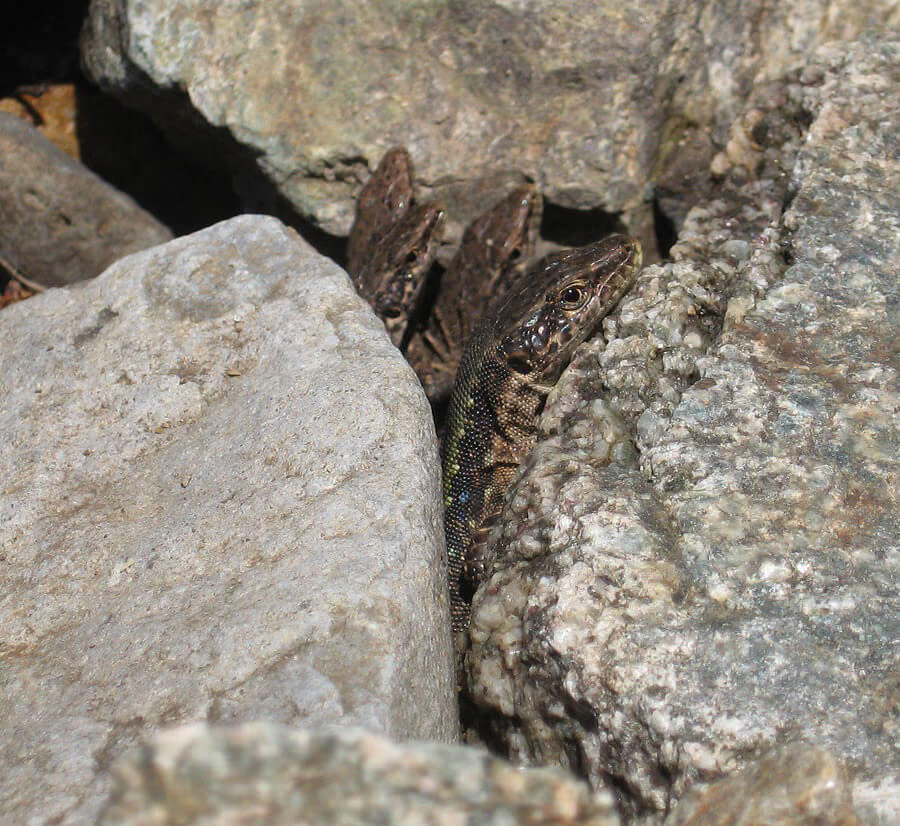
This lizard lives on rocks and stones, rather than on the forest floor. It often measures about 4.9–6.3 cm from its nose to the base of its tail. During the breeding season, males often have an emerald-green back and dark sides. This coloring is characteristic, but color alone cannot be used to tell species apart.
One large scale on the side of the head, between the scale in the middle of the temple and the scale by the ear, is an almost decisive clue for identifying this species. The plates in front of the anus are often paired, but on the Greater Caucasus there is more often just one. Do not pick up the lizard to count its scales. Rarely, caucasica may also have a similar large scale. Where the ranges of the two species meet, this scale alone is not enough to identify the species.
The Turkish lizard (D. clarkorum) is its closest relative, but lives separately from it in the southwest, for example in the Charnali Valley. adjarica, which belongs to the parvula group, may occur near Shuakhevi in Adjara. mixta does not occur in Adjara. In the Greater Caucasus, its range overlaps with that of the Caucasian lizard (D. caucasica) only in a narrow strip. Part of their DNA is similar, and they cannot be told apart by color.
The Artvin lizard (D. derjugini) may also be found in the same valley, but it lives on the ground in the forest. Its head is not flattened, and it is not found on vertical rock faces. mixta was once thought to be a hybrid of derjugini and saxicola; it is now considered a separate species. Another rock lizard species, such as D. brauneri, is also found in Samegrelo. Color alone is not enough to tell them apart. The illustrations in the paper (Sairme) show the scales on the head and the plates in front of the anal opening.
The 2026 list treats mixta as a confirmed species, not a possible one. It is found only in western Georgia, excluding Adjara. Recent records place it in Sairme, Chkhorotsku and Baniskhevi. The Turkish lizard (D. clarkorum) occurs separately from it in the southwest, for example in the Charnali Gorge.

It occurs in Georgia, but its presence in Adjara, the Colchian Lowland or the dry plains of the east should not be treated as confirmed. A 2026 paper includes an image of the species from Sairme. Genetic data also exist for samples from Sairme and Chkhorotsku, while genetic data from a Baniskhevi sample are mentioned in the paper. The information on its distribution is considered moderately reliable. According to a 2015 study, its range lies in the eastern part of the Meskheti Range and on the southern slopes of the Greater Caucasus, between the Rioni and Khobi valleys. Of the 26 locations named in the study, samples came from Zekari Pass, the Borjomi Valley, the Rioni Valley and the Samegrelo Range. It has not been found in lowlands or below about 250–280 m. It lives in moist forest valleys among cliffs and rocks. There it warms itself and shelters in crevices; it does not live in open, dry steppe. Moisture and temperature in its immediate surroundings matter to it. It avoids dry or overly warm places. Repeated searches on the Likhi Range did not find this species, although another rock lizard (D. obscura / rudis s.l.) occurs there. The 2015 study did not confirm its presence in Adjara or west of the Abastumani Valley. One old specimen from Giresun, Turkey, was probably misidentified. Later records without an exact location are also not treated as confirmed on this page. At present, this atlas map shows no other administrative region. That does not mean every suitable valley has been checked.
Biology
Diet, behavior, and conservation
Diet
This page does not include a Georgian study of food found in this species’ stomach. It probably eats small animals without backbones, as rock lizards do, but its diet has not been studied here. It is not venomous and catches prey with its mouth.
Behavior
It is active during the day. This rock lizard warms itself on stones, shelters in cracks, and defends its territory. This page does not specify its exact hours of activity or which seasons it is active in Georgia. It lays eggs. On the maternal side, it is an ancestor of the Armenian rock lizard (D. armeniaca) and Dahl’s lizard (D. dahli). These lizards reproduce without males and are separate species. They are more likely to occur in southern and eastern Georgia, but that does not mean they are also found in the same western valley. If you catch one, its tail may come off or it may bite. Observe it, but do not pick it up; leave it where it is.
Conservation
In 2009, the IUCN assessed the species as Near Threatened (Tuniyev and coauthors). That assessment is now old. The species is found in a small area and is associated with moist forest valleys. It is not on Georgia’s 2014 Red List (Resolution No. 190). Tarkhnishvili and coauthors (2026) consider its presence biologically confirmed. Changes in its numbers in Georgia have not been measured here. It is not listed under CITES. Do not catch wild lizards.
Questions
Frequently asked questions
Short answers to the most important questions about Mixed Rock Lizard.
Yes. Its presence is biologically confirmed in the 2026 list. It is found only in western Georgia, excluding Adjara. Image — Sairme. Barcodes — Sairme, Chkhorotsku and Baniskhevi.
It is found on cliffs and rocks in damp forest valleys: in the eastern part of the Meskheti Range, in the Borjomi Valley, and on the southern slopes of the Greater Caucasus between the Rioni and Khobi. Specific locations include Sairme, Chkhorotsku, Baniskhevi, and Abastumani. Do not look for it in Adjara, in the lowlands, or on the Likhi Range.
It is a small rock lizard. Males often have green backs and dark sides, but color alone is not enough to identify it. More reliable clues are where it occurs and whether it has a single large scale at the temple that reaches the ear plate. Compare it with clarkorum in Adjara, caucasica in the Greater Caucasus, and ground-dwelling derjugini.
No. It has no venom. It may bite if you catch it. Its tail may also come off. Leave it where it is.
The head and body together are often about 5–6 cm long (about 4.9–6.3 cm in published measurements). The total length, including the tail, has not been measured on this page.
No. mixta is not found in Adjara. In Shuakhevi, adjarica may belong to the parvula group. The English name Ajarian lizard is misleading; the list suggests Georgian lizard instead.
No. The list marks it as biologically confirmed. It was once considered a hybrid, but is now regarded as a separate species. Its range overlaps with that of caucasica only in a small area.
It is active during the day. This page does not give a complete account of when it can be found in Georgia throughout the year. It is likely to be seen in damp valleys during the warmer months.
References
Sources
References
Sources
- Tarkhnishvili et al. 2026 — Annotated checklist of Georgia's amphibians and reptiles
- Gabelaia, Tarkhnishvili & Murtskhvaladze 2015 — Phylogeography of Darevskia mixta
- Tarkhnishvili 2012 — Evolutionary history and habitats of Caucasian rock lizards
- Tarkhnishvili & Iankoshvili 2023 — Geographic proximity and niche overlap in Caucasian rock lizards
- Murphy et al. 2000 — Phylogenetic constraints on parthenogenesis in lacertid lizards
- Darevsky 1967 — Rock lizards of the Caucasus
- Tuniyev et al. 2009 — IUCN Red List, Darevskia mixta
- საქართველოს მთავრობის დადგენილება №190 (2014) — წითელი ნუსხა
- The Reptile Database — Darevskia mixta
Species profiles are compiled from peer-reviewed literature and established biodiversity databases, and are reviewed as new taxonomic and conservation data become available.
Related guides

