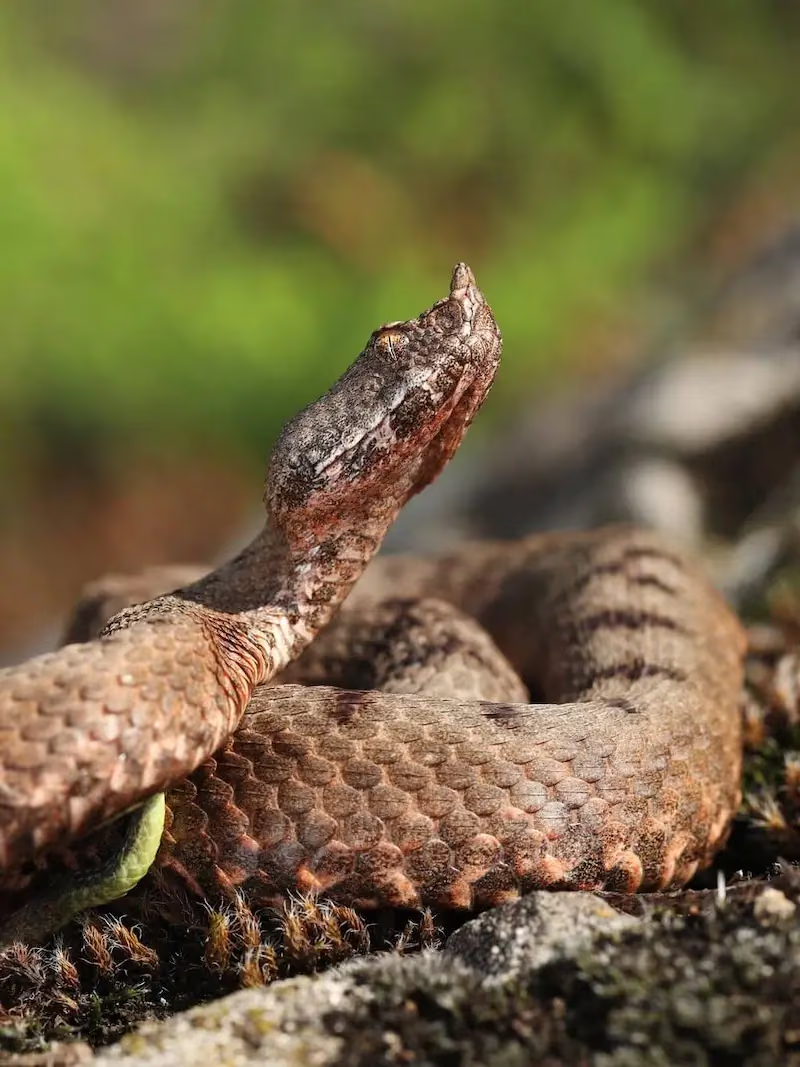
Dinnik's viper
Vipera dinniki
A venomous viper endemic to the Greater Caucasus, found in high-mountain forests and the subalpine zone.
Found in
Abkhazia, Racha — Lechkhumi — Kvemo Svaneti, Mtskheta — Mtianeti

Species atlas
Explore reptiles recorded in Georgia — field descriptions, range maps, photography, and the facts that matter for identification and safety.
0
species in the atlas
93 photos · 12 regions
Start exploring
Turtles and amphibians are coming next — with the same depth, maps, and photography.
Explorer
Search by name, or refine by type, risk, habitat, and region.
12 species

Vipera dinniki
A venomous viper endemic to the Greater Caucasus, found in high-mountain forests and the subalpine zone.
Found in
Abkhazia, Racha — Lechkhumi — Kvemo Svaneti, Mtskheta — Mtianeti

Macrovipera lebetina
Georgia's largest and most dangerous venomous snake — a resident of dry, rocky landscapes.
Found in
Kvemo Kartli, Kakheti, Tbilisi

Vipera kaznakovi
A venomous viper endemic to the Caucasus — a rare inhabitant of Colchic forests and the Black Sea coast.
Found in
Abkhazia, Samegrelo — Zemo Svaneti, Guria +2

Vipera ammodytes
One of Europe's most dangerous vipers, with a horn-like growth on its snout; rare in Georgia.
Found in
Samtskhe — Javakheti, Shida Kartli

Coronella austriaca
A harmless colubrid snake with copper-toned coloring — secretive, smooth-scaled, and often confused with a viper.
Found in
Abkhazia, Samegrelo — Zemo Svaneti, Guria +6

Elaphe urartica
A harmless spotted ratsnake — described as a species in 2019; native to Kakheti and the dry landscapes of eastern Georgia.
Found in
Imereti, Shida Kartli, Mtskheta — Mtianeti +2

Natrix tessellata
A non-venomous, semi-aquatic snake with checkered blotches — an inhabitant of rivers, lakes, and shorelines; harmless.
Found in
Abkhazia, Samegrelo — Zemo Svaneti, Guria +9

Natrix natrix
A non-venomous, semi-aquatic snake with a yellow "collar" — an inhabitant of wetlands, lakes, and damp forests; harmless.
Found in
Abkhazia, Samegrelo — Zemo Svaneti, Guria +5

Dolichophis schmidti
A fast, non-venomous racer with a copper or reddish back and a distinctive red–orange belly — native to the dry landscapes of eastern Georgia.
Found in
Shida Kartli, Kvemo Kartli, Kakheti +1

Platyceps najadum
A non-venomous, extremely slender racer with dark pale-edged neck spots and an olive to buckthorn-tan body — native to dry, rocky landscapes.
Found in
Samtskhe — Javakheti, Shida Kartli, Kvemo Kartli +1

Telescopus fallax
A crepuscular and nocturnal rear-fanged snake with a vertical, cat-like pupil — native to dry, rocky landscapes.
Found in
Samtskhe — Javakheti, Shida Kartli, Kvemo Kartli +2

Pseudopus apodus
A legless lizard often mistaken for a snake — with eyelids, ear openings, and a lateral fold; harmless.
Found in
Abkhazia, Samegrelo — Zemo Svaneti, Guria +7
Regional atlas
Hover a region to see species counts and common residents, then open the full regional guide.
Field context
Georgia sits between the Black Sea, the Greater Caucasus, and the arid east — a short geographic span that supports vipers of high mountains and Colchic forests, water snakes of rivers and wetlands, racers of dry foothills, and a widespread legless lizard often mistaken for a snake. This atlas focuses first on well-documented reptiles of Georgia, with bilingual accounts, Georgia-specific range notes, and field photography.
Species richness here is shaped by elevation, humidity, and refuge habitats. Western Colchic landscapes favor moisture-linked snakes such as Natrix; eastern semi-arid basins hold Macrovipera lebetina and fast colubrids; alpine and subalpine belts hold Caucasus endemics including Vipera dinniki. Counts on this page reflect published profiles in the atlas and will grow as lizards, turtles, and amphibians are added with equal rigor.
Only a minority of Georgia’s snakes are medically significant. In this atlas, “venomous” means moderate or high risk to humans: the Levantine viper (Macrovipera lebetina), Caucasus viper (Vipera kaznakovi), Dinnik’s viper (Vipera dinniki), and nose-horned viper (Vipera ammodytes). Most other snakes here — grass snake, dice snake, racers, smooth snake, cat snake — are harmless to people, though several are frequently misidentified.
Safe encounter practice is simple: do not handle wild snakes, keep distance, and learn the lookalikes common in your region. Open each profile for identification traits, habitat, and conservation status. This is educational natural-history guidance, not emergency medical advice.
Distribution in the atlas is recorded by Georgia’s administrative regions as a practical field layer — from Abkhazia and Adjara on the humid west to Kakheti and Kvemo Kartli in the dry east, plus the capital district of Tbilisi. A species may appear in several regions; endemics and elevational specialists are more narrowly placed.
Use the map to move from place to fauna, then open regional pages for habitats, safety notes, and the local species list. For research-grade occurrence data, profiles also cite databases such as GBIF and the Reptile Database alongside IUCN assessments where available.
Freshness
Profiles refreshed with new text, taxonomy notes, or photography — a living atlas, not a static checklist.
Trust
Reptiles.ge compiles bilingual species accounts for Georgia with field photography, regional range maps, and references to established biodiversity sources. The goal is a calm, citeable public atlas for hikers, students, and researchers.
Catalog last updated 2026-08-04
Each profile combines taxonomic identity, Georgia-relevant habitat and behavior notes, conservation status, identification traits, and FAQs. Accounts are reviewed as new literature and Red List changes appear.
Primary references include IUCN Red List assessments, GBIF, the Reptile Database, and peer-reviewed herpetological literature cited on each species page.
Images are selected for identification value and field context. Credits appear on species pages when photographer attribution is available.
Reptiles is building a bilingual, citeable atlas of Georgia’s reptiles — curated from established biodiversity sources and updated as taxonomy and conservation data change.
About Reptiles