


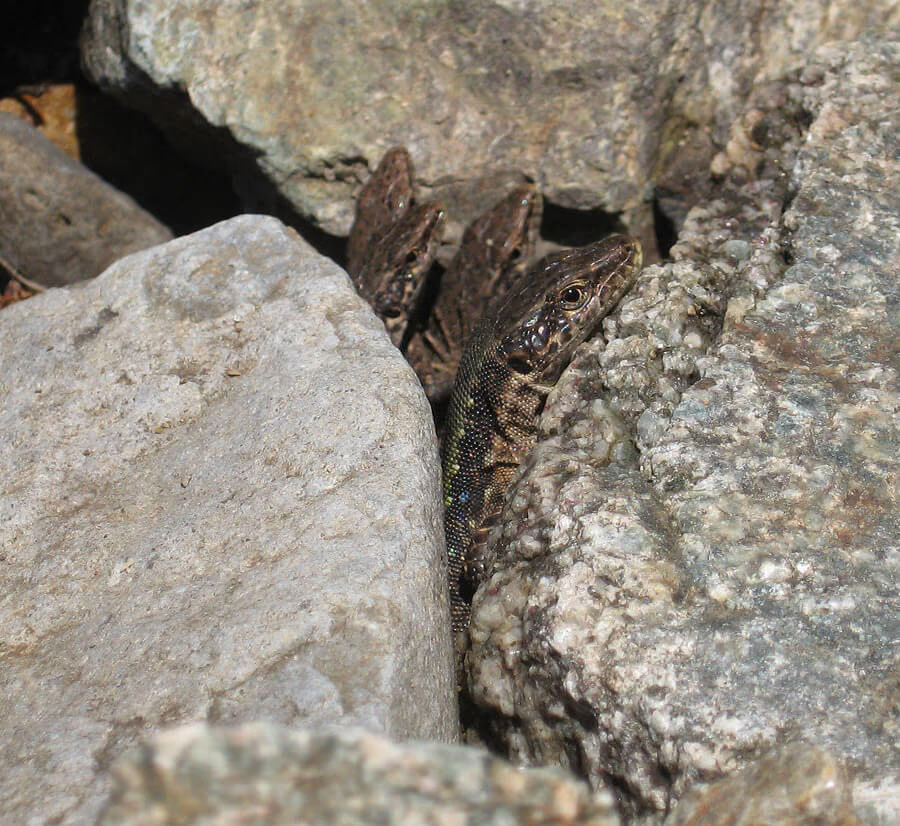
Brauner’s rock lizard (Darevskia brauneri) is associated with the western and central Greater Caucasus. The species has been recorded in Georgia and is not venomous. However, a 2026 paper by Tarkhnishvili and coauthors leaves open the question of whether it is a separate species. The paper mentions Mestia, the Manshura River, Martvili, Ertso Lake, the Enguri and Tekhuri river basins, and Lebarde. It also mentions northwestern Georgia in connection with D. b. myusserica. This list shows which places in Georgia appear in records of the lizard. But color or a single photo is not enough to identify every similar lizard as Darevskia brauneri. It belongs to the D. saxicola group. It is widely accepted as a separate species, but the paper remains cautious: the boundaries between it and D. saxicola and D. szczerbaki, where they meet, and how their features change gradually from place to place have not yet been fully checked. The D. arribasi described near Ertso is not treated as a separate species in this paper and remains D. b. arribasi.
Identification
How to identify Brauner's Rock Lizard
To identify Brauner’s rock lizard, first consider where you saw it: in the western or central Greater Caucasus. The study specifically mentions Mestia/Manshura, Martvili and Ertso. Colour is only a supporting clue. Among lizards in the closely related D. saxicola group, scale features, body size and proportions, and groups identified through genetic research do not always line up. So a quick identification based on a photo alone calls for caution.
Often confused with


For Georgia, the source mainly lists the western and central parts of the Greater Caucasus.
It belongs to the D. saxicola group of species. In this group, it is not always easy to determine which are distinct species.
The paper still treats the “arribasi” from Ertso as D. b. arribasi, not as a separate species.
When comparing them, the scales on the head and the scale plates in front of the anal opening matter more than overall color.
If the photo shows only the color of the back, the answer should say Darevskia sp. or make clear that the species identification is tentative.

Sources on this species link Brauner’s rock lizard in Georgia to the western and central Greater Caucasus. They specifically name Mestia and the Manshura River; the paper includes an illustration and barcodes associated with them. Martvili, Ertso Lake, the Enguri and Tekhuri river basins, and Lebarde are mentioned in the discussion of the closest genetic sequences. D. b. myusserica is mentioned from northwestern Georgia. We should not assume it occurs beyond these places based only on a general idea of where a Caucasian rock lizard might live. For a field record, the most useful details are the exact location, the elevation and a description of the surroundings if available, and a full set of photos, especially of the head and the area in front of the anal opening.
Biology
Diet, behavior, and conservation
Behavior
The sources used for this page do not separately describe which times of year or day Brauner’s rock lizard is active in Georgia, or how it feeds. Its behavior is therefore not used here to identify the species. When observing one, it is best to record where it was seen, what the surface or surroundings were like, and whether there are photos that allow its scale markings to be compared. Without this information, movement, posture or color alone cannot reliably identify the species.
Conservation
D. brauneri is still considered a possible separate species. Within the saxicola group, it has not yet been fully verified how distinct the different forms are, where they come into contact, or where the boundaries between closely related forms lie. Being a “candidate species” is not a threat category and does not change the assessments of the IUCN or Georgia’s Red List. There are records of it being found in Georgia, but because these questions remain unresolved, no unverified threat level is given here.
Questions
Frequently asked questions
Short answers to the most important questions about Brauner's Rock Lizard.
Yes, the paper lists it from Georgia. However, it has not yet been settled whether it is a separate species. That is why this page uses cautious wording: there are records of it in Georgia, but the exact boundaries between species in the saxicola group are still unclear.
The western and central parts of the Greater Caucasus, Mestia and the Manshura River are mentioned. Martvili also appears in the data. Lake Ertso, the Enguri and Tekhuri river basins, Lebarde and northwestern Georgia are also listed for D. b. myusserica.
First, consider where the photo was taken. Then check whether the head, sides and the area just in front of the opening under the tail are clearly visible. Color alone is not enough to tell them apart: the forms in the saxicola group look alike. The study compares their scales, body measurements and proportions.
The main distinction on this page concerns how they are grouped: D. brauneri belongs to the saxicola group, while “arribasi,” described near Ertso, is treated as a subspecies in that paper. Color alone is not enough to distinguish them from D. saxicola and D. szczerbaki.
No. This atlas marks the species as harmless, and this page does not describe it as venomous.
In a photo, color also depends on the lighting and the quality of the image. Closely related Darevskia species look alike. To tell them apart, people compare features of their scales, body size and shape, location, and genetic data. Color is therefore only an initial clue, not enough for a firm conclusion.
References
Sources
References
Sources
- Tarkhnishvili et al. 2026 — Annotated checklist of Georgia's amphibians and reptiles
- Iankoshvili & Tarkhnishvili 2021 — Georgian herpetofauna records cited in Tarkhnishvili et al. 2026
- The Reptile Database
Species profiles are compiled from peer-reviewed literature and established biodiversity databases, and are reviewed as new taxonomic and conservation data become available.
Related guides
Continue with related pages

Darevskia adjarica
Ajarian Rock Lizard
Adjara (Shuakhevi) and Abastumani
Darevskia armeniaca
Armenian Rock Lizard
Southern Georgia — Ninotsminda (Saghamo), Akhalkalaki

Darevskia clarkorum
Clark's Rock Lizard
Adjara — Charnali Gorge (Khelvachauri)

Darevskia daghestanica
Daghestanian Rock Lizard
Tusheti; Akhmeta (Tbatana)