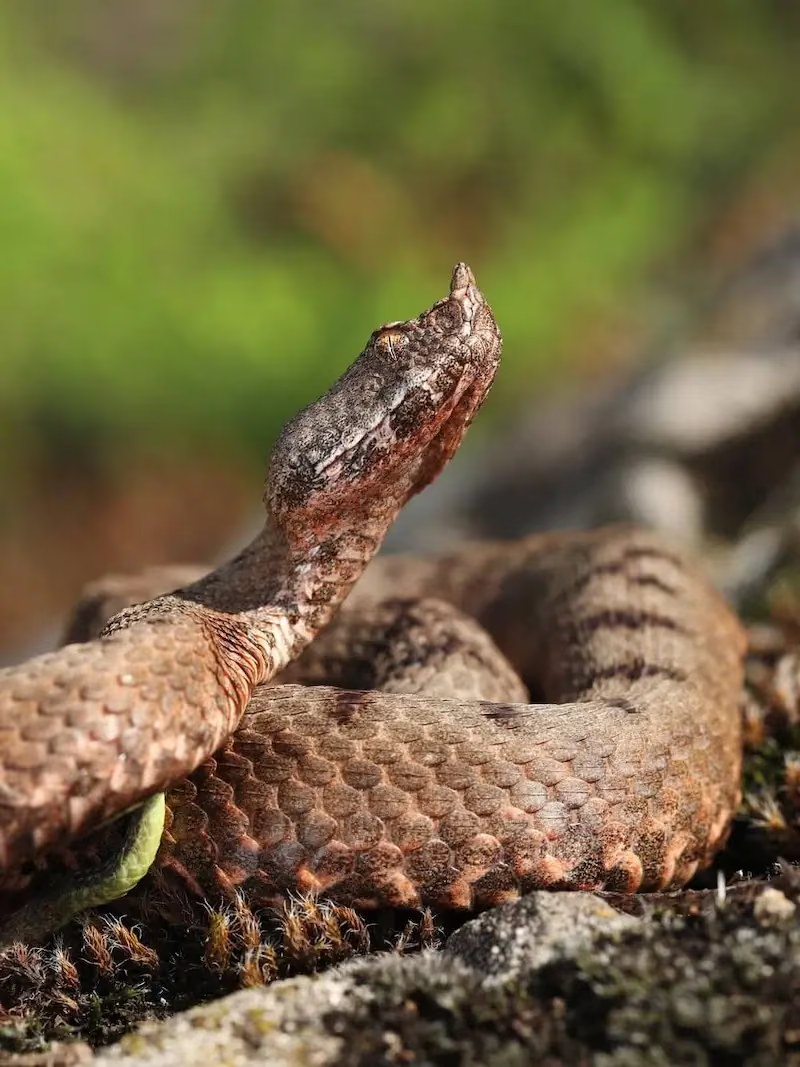
Dinnik’s viper (Vipera dinniki) is a snake found in the high mountains of the Greater Caucasus. Its presence in Georgia has been confirmed, but it is not found throughout the country. A 2026 list treats it as a possible distinct species within the Vipera kaznakovi group. The boundary between Dinnik’s viper and the Caucasian viper as separate species is still not fully clear. One form of Dinnik’s viper is found mainly above the upper edge of the forest. According to the same list, its subspecies Vipera dinniki tuniyevi is associated with wooded and mountainous areas of central Georgia. An adult Dinnik’s viper is usually about 40–55 cm long. It is venomous, so avoid close contact; it poses a moderate risk to people. The IUCN considers the species vulnerable, meaning it faces a risk of extinction. Dinnik’s viper is also included in Georgia’s 2014 Red List.
Identification
How to identify Dinnik's viper
Dinnik’s viper is a small snake that lives high in the mountains. Its pupils are vertical, and its scales have a raised line down the middle. It often has a dark zigzag or almost straight stripe along its back. Where and in what kind of place you saw it matters when identifying it: it can be confused with the Caucasian viper or the cat-eyed snake.
Often confused with


Its body is relatively slender and not bulky. Adults are usually about 40–55 cm long. Females are generally larger than males, while males have relatively longer tails. The head is triangular, but narrower and less clearly separated from the neck than that of the Caucasian viper.
The pupil looks like a vertical slit. Each scale on the back has a pronounced raised line down its center. The body’s main color may be gray, silver, brownish, or greenish gray. Some also have a yellow or orange tint. A dark zigzag usually runs along the back, though it sometimes looks almost like a straight stripe. The belly may be dark with light patches or light with dark speckles. Entirely black ones are also common among groups living in the west. In Georgia, this all-black coloring has been documented around Stepantsminda.
The young are usually gray-brown, unlike the reddish young of the Caucasian viper. Even those that later turn black are born with the usual pattern. They darken as they grow and become completely black around their third year.
The Caucasian viper (Vipera kaznakovi) is found mainly in lower, damp Colchian forests, often up to about 1,000 m above sea level. It has a relatively broad head and is often reddish orange. Even entirely black snakes often have a red or yellow tint around the mouth. Darevsky’s viper (Vipera darevskii) is found in the high mountains of the Lesser Caucasus, in the Javakheti–Erusheti area, mostly above 2,300 m. The gyurza (Macrovipera lebetinus) is a much larger snake. In Georgia, it is found mainly in the dry and semi-dry lowlands and foothills of the east.
The cat-eyed snake (Telescopus fallax) is sometimes mistaken for a viper. It also has vertical pupils, but its body is slimmer, its eyes are large, and the scales on its back are smooth. The nose-horned viper (Vipera transcaucasiana) is easy to recognize by the horn-like growth on its nose. In Georgia, it is associated with areas of the Lesser Caucasus. Dinnik’s viper is venomous. It is considered a moderate risk to humans, and a bite requires medical attention.

Gallery
Dinnik's viper in photos
Dinnik’s viper lives in the high mountains of the Greater Caucasus. It is most often found near the upper edge of the forest, in mountain meadows above it, in rocky places and among stones and gravel left by glaciers. The Colchian lowlands and the dry plains of eastern Georgia are not its usual habitats. The map shows only regions where records made in the field confirm its presence; other observations are not counted as evidence of its range. Records are known from Svaneti, including the Enguri basin and the Ushguli–Shkhara area, as well as Ardoti in Khevsureti, the Stepantsminda area and Truso. It has also been mentioned in Tusheti. According to the IUCN, Dinnik’s viper is found mainly at about 1,500–2,800 m above sea level. Other records from the Caucasus have sometimes placed it as high as 3,000 m, and it may descend slightly lower in valleys. It is often found on south-facing and southeast-facing slopes. Its range is not continuous: separate groups often live apart from one another.
Distribution
Where Dinnik's viper is recorded in Georgia
84 field records2006–20264 regions
Interactive map is loading.
- Field observation
- Several records in one spot
- Photo record
- Confirmed distribution region
| regions | field records | |
|---|---|---|
| Distribution confirmed | ||
| Confirmed distribution region | 42 | |
| Confirmed distribution region | 8 | |
| Confirmed distribution region | 7 | |
| Confirmed distribution region | 5 | |
The Dinnik's viper map combines Reptiles.ge editorial photo records with public iNaturalist observations. Regions are taken from the records-by-region table, and only confirmed status counts as distribution; record counts do not measure population density.
Data: Reptiles.ge + iNaturalist · Methodology
Biology
Diet, behavior, and conservation
Diet
Adult Dinnik’s vipers mainly catch lizards and small mammals. They may also occasionally catch the chick of a bird that nests on the ground. Young vipers more often eat small lizards and insects, including grasshoppers. When hunting, these vipers often lie in wait and subdue their prey with venom. This information comes from observations in the western Caucasus. The diet of Dinnik’s vipers in Georgia has not been fully studied separately.
Behavior
In high mountain areas, Dinnik’s viper is usually active from mid-April until the second half of September. It is mostly seen during the day. In hot weather, it seeks shade; on cloudy days, it may stay out for a long time during the day. It spends the winter in rock crevices, often in the same area where it lives in summer. Dinnik’s viper gives birth to live young. It usually mates from late April through May. According to records from the Caucasus, the young are born in August or September: earlier on northern slopes and somewhat later on southern slopes. A newborn is about 13 cm long and eats almost nothing before its first winter. Because conditions in the high mountains are harsh, females do not breed every year. If you encounter a Dinnik’s viper, keep your distance and do not try to pick it up or catch it. It does not seek out people and mainly defends itself when it feels threatened.
Conservation
The IUCN classifies Dinnik’s viper as Vulnerable (VU). Its range is relatively small and highly fragmented. The shrinking of its habitat and population is still considered a threat. It is also listed as Vulnerable (VU) in Georgia’s 2014 Red List. The main threats include the deterioration of subalpine pastures and excessive grazing. A 2026 list treats Dinnik’s viper as a possible separate species within the Vipera kaznakovi group. Data on the species’ complete genetic makeup have yet to fully establish where the boundaries between species in this group lie.
Questions
Frequently asked questions
Short answers to the most important questions about Dinnik's viper.
Yes. The Dinnik’s viper has been confirmed in Georgia, but it is not found throughout the country. Its range is linked to the high mountain areas of the Greater Caucasus. A 2026 list treats it as a possible separate species because it is still unclear how the snakes in the Vipera kaznakovi group should be divided into distinct species.
Dinnik’s viper is found in Georgia’s high Greater Caucasus mountains, in mountain meadows, near the upper edge of forests, and in rocky places. The map marks as part of its range only regions where its presence has been confirmed. Other observations are shown separately as field records. There are records of sightings from Svaneti, Khevsureti, the area around Stepantsminda, Truso, and Tusheti. The lowlands of western Georgia and the dry plains in the east are not places where it is usually found.
Yes, Dinnik’s viper is venomous. It is considered a moderate risk to people—less of a risk than the gyurza—but a bite still requires medical attention. It does not chase people and usually defends itself when it feels threatened. Keep your distance, and do not try to pick it up or catch it.
Call 112 immediately. Reassure the person who was bitten, have them lie down, and try to keep them from moving as much as possible. Do not cut the bite, suck out the venom, or use a tight tourniquet. They need to be taken to a hospital for treatment. For more information, see the snakebite guide.
Dinnik’s viper is a small, relatively slender snake. Its pupils are vertical, its scales have a raised line down the middle, and it has a dark zigzag or almost straight stripe along its back. Its main color is often gray or brownish. Unlike the Caucasian viper, it usually lacks a bright red-orange background color. The cat snake also has vertical pupils, but its body is slimmer, its eyes are larger, and the scales on its back are smooth.
An adult Dinnik’s viper is usually about 40–55 cm long. Females are generally larger than males. It is relatively small among the vipers found in Georgia and much shorter than the gyurza.
Dinnik’s viper is found mainly in the high mountains of the Greater Caucasus, at elevations of about 1,500–2,800 m. It is often grey or brownish. The Caucasian viper is found lower down, in moist Colchic forests, mainly below 1,000 m. It has a relatively broad head, and its main body colour is often red-orange. The 2026 list does not yet fully settle how these two forms should be distinguished as species.
In the 2026 list, Dinnik’s viper is treated as a possible separate species because it has not yet been fully confirmed that it is genetically distinct from other vipers in the Vipera kaznakovi group. According to the IUCN, the species is vulnerable (VU): its range covers less than 20,000 km² and is highly fragmented. Dinnik’s viper is also listed as vulnerable (VU) on Georgia’s Red List.
References
Sources
References
Sources
- Tarkhnishvili et al. 2026 — Annotated checklist of Georgia's amphibians and reptiles
- Iankoshvili & Tarkhnishvili 2021 — Distribution of snakes in Georgia
- Orlov & Tuniyev 1990 — Three species in the Vipera kaznakowi complex
- Schmid et al. 2023 — Melanism in Vipera dinniki in Georgia
- Tuniyev et al. 2009 — IUCN Red List account for Vipera dinniki
- საქართველოს მთავრობის დადგენილება №190 (2014) — წითელი ნუსხა
- The Reptile Database
Species profiles are compiled from peer-reviewed literature and established biodiversity databases, and are reviewed as new taxonomic and conservation data become available.
Related guides