


The eastern steppe viper (Vipera renardi), also called Renard's viper, is a venomous member of the viper family. It ranges from south-eastern Europe into Central Asia; IUCN also includes Transcaucasian populations in Armenia, Azerbaijan, and Georgia. On this page's records-by-region table, distribution in Georgia is confirmed in Kakheti and Shida Kartli — one record in a region is enough. Public coordinates in Shida Kartli are obscured, so those points are approximate. Published eastern localities — the Shiraki Plateau and Dedoplistskaro (Shemakha group / kakhetiensis) — fall in Kakheti. The Javakheti and Erusheti plateaus are often treated as V. r. eriwanensis; Samtskhe–Javakheti is not confirmed in this table and is not marked as a distribution region. It is relatively small (about 40–60 cm), with a dark dorsal zigzag, and prefers open steppe habitats. The European regional IUCN assessment lists it as Vulnerable due to habitat loss.
Identification
How to identify Eastern steppe viper
The eastern steppe viper is a small venomous steppe species. Size, a dorsal zigzag, and open steppe habitat are the main cues — and it is rare in Georgia.
Often confused with
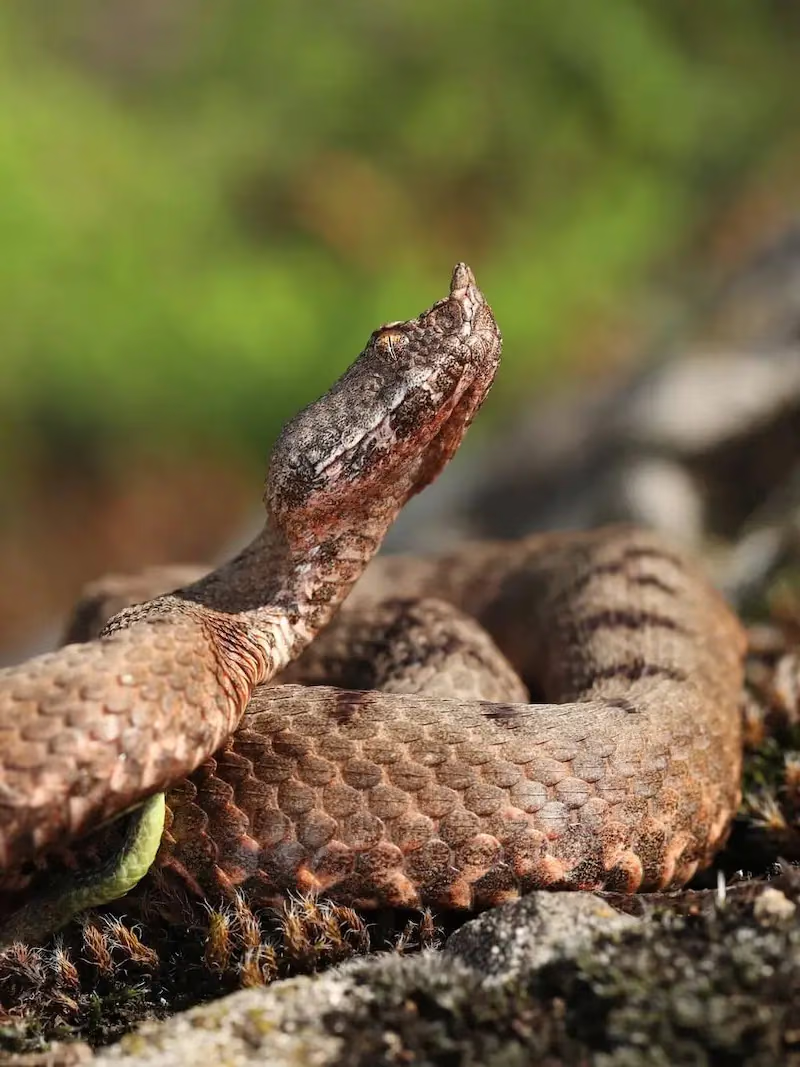
Relatively small — length roughly 40–60 cm.
The pupil is vertical; scales are keeled; the head is broad.
A dark zigzag or row of blotches on a pale dorsum.
In Georgia, confirmed distribution follows records in Kakheti and Shida Kartli.
Smaller and more steppe-bound than the Levantine viper; lacks the nose-horn of V. transcaucasiana.

Gallery
Eastern steppe viper in photos
It prefers open steppe, meadows, scrub, and rocky foothills — often well-drained slopes and semi-arid zones. In Georgia the confirmed regions are Kakheti and Shida Kartli. Kakheti records include Dedoplistskaro Municipality. The Shiraki Plateau, Dedoplistskaro, the area near Khornabuji, and the Artsivis Kheoba foothills are published localities in Kakheti. Vertically it occurs from roughly 0–2,500 m; eastern Georgian populations are mostly at low to mid elevations.
Distribution
Where steppe viper distribution is confirmed in Georgia
10 field records2012–20262 regions
Interactive map is loading.
- Field observation
- Several records in one spot
- Confirmed distribution region
| regions | field records | |
|---|---|---|
| Distribution confirmed | ||
| Confirmed distribution region | 7 | |
| Confirmed distribution region | 3 | |
The steppe viper map uses public iNaturalist observations of Vipera renardi. One field record in a region is enough for confirmed distribution; a region with no records is not treated as distribution. Some public coordinates are obscured, so points near regional borders are approximate. Record counts reflect observation effort, not population density.
Data: Reptiles.ge + iNaturalist · Methodology
Biology
Diet, behavior, and conservation
Diet
Often feed on orthopterans — grasshoppers and related insects — as well as lizards and small rodents. Juveniles hunt smaller invertebrates and lizards. It hunts by ambush and subdues prey with venom.
Behavior
Active in the warm season — in Georgia and Azerbaijan roughly from April to early October. In spring and autumn it is often diurnal; in summer heat it seeks shade and scrub. It hibernates in crevices and under stones. It is ovoviviparous: pregnancy lasts about three months; young are born in July– August (sometimes up to 10–17 individuals).
Conservation
Listed as Vulnerable in the European regional IUCN assessment — over 30% habitat loss across the last three generations and ongoing fragmentation. The main threat is conversion of steppe and meadows to intensive agriculture and overgrazing. It is rare in Georgia; eastern populations were reconfirmed after a 75-year gap. It benefits ecosystems by regulating insects and rodents.
Questions
Frequently asked questions
Short answers to the most important questions about Eastern steppe viper.
It is venomous, though danger is rated moderate — milder than the Levantine or nose-horned viper. Immediate medical attention is still required; the snake bites mainly when it feels threatened.
On the records table, distribution is confirmed in Kakheti (Shiraki Plateau, around Dedoplistskaro and Khornabuji) and in Shida Kartli. Samtskhe–Javakheti is not confirmed by this table.
The steppe viper is smaller (about 40–60 cm) and prefers open steppe. The Levantine viper is large, egg-laying, and lives in dry eastern lowlands. The nose-horned viper has a snout horn and is linked to the Lesser Caucasus highlands.
It is ovoviviparous — young are born in July–August; pregnancy lasts about three months.
Intensive conversion and overgrazing of steppe and meadows destroy its habitat and fragment the range. The European IUCN assessment lists it as Vulnerable; Georgian populations are small and scarce.
The eastern steppe viper is a small venomous steppe species. Size, a dorsal zigzag, and open steppe habitat are the main cues — and it is rare in Georgia.
It is venomous, though danger is rated moderate — milder than the Levantine or nose-horned viper. Immediate medical attention is still required; the snake bites mainly when it feels threatened.
References
Sources
References
Sources
- Tarkhnishvili et al. 2026 — Annotated checklist of Georgia's amphibians and reptiles
- IUCN Red List
- GBIF
- The Reptile Database
- Tuniyev et al. 2018 — Rediscovery of the steppe viper in Georgia
- Mebert et al. 2025 — Steppe vipers of Western Asia
Species profiles are compiled from peer-reviewed literature and established biodiversity databases, and are reviewed as new taxonomic and conservation data become available.
Related guides


