


Lizards
Uzzell’s lizard confirmed in Armenia for the first time
Four parthenogenetic Darevskia uzzelli at one site — a species not confirmed in Georgia at this stage.
Read the article
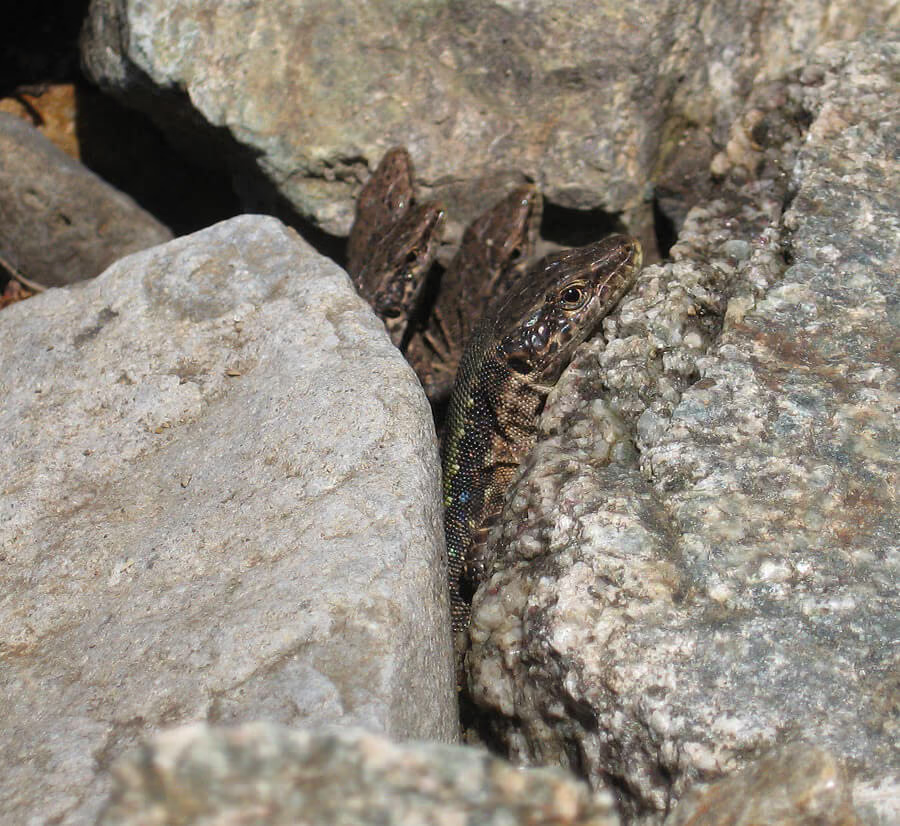
The Armenian rock lizard (Darevskia armeniaca) is a harmless lizard found in rocky areas of southern Georgia. A 2026 study lists it as a species rather than a candidate species. The main locations it names in Georgia are Lake Saghamo in Ninotsminda Municipality and Akhalkalaki. A lizard with similar coloring in these places is not necessarily D. armeniaca: Darevskia species often look alike. To identify one reliably, you need to consider where it was found and examine a detailed photo and the features of its scales. Females of this species can reproduce without males. Its origins are linked to D. valentini and D. mixta, while its genetic line passed down from the mother also matches those of D. mixta and D. dahli. These genetic links do not provide a simple way to identify it: color, a single photo or one feature is often not enough.
Identification
When identifying the Armenian rock lizard, pay more attention to location than color: the sources cited on this page place it in southern Georgia, around Lake Saghamo and Akhalkalaki. Color alone cannot reliably distinguish it from similar lizards, especially D. valentini, D. mixta and D. dahli. Consider where these lizards are found, and look at clear photos and the features of their scales. If you are still unsure, record it as Darevskia sp.
Often confused with
In Georgia, Lake Saghamo and Akhalkalaki are important places for gverdi.
This species reproduces without fertilization, but you cannot quickly tell that from a photo.
It is closely related to D. valentini, D. mixta and D. dahli. Color cannot be used to tell them apart.
The mitochondrial lineage also matches D. mixta and D. dahli. So a single genetic or color trait is not enough to tell them apart in the field.
The images in the paper show the scales on the head and the plates in front of the anal opening. These details matter more than the shade of the back.

In Georgia, a small range in the south of the country is indicated for this species. The lizard shown in the study is from Lake Saghamo in Ninotsminda Municipality, while the DNA record is from Akhalkalaki. These are the only specific records of its range given here. Similar surroundings or colour alone cannot confirm its presence elsewhere. If you see one in the wild, it helps to provide the exact location and date, along with clear photos showing its back, sides and the pattern of scales on its head. “I saw a green/brown rock lizard in southern Georgia” is not enough to identify the species.
Biology
Females can reproduce without males. This is an important trait, but it will not directly help you identify the species: you cannot check it from a photo or a single observation. There is no separate information for Georgia on the hours when it is active, seasonal changes, or feeding. So describe exactly what you saw, but do not identify the species conclusively based only on its behavior or color.
Tarkhnishvili et al. (2026) lists D. armeniaca as a distinct species; this page does not label it a candidate species. The sources used here do not provide separate assessments from the IUCN or Georgia’s Red List. In Georgia, the species is known from a small area in the south. More evidence is needed to confirm whether it occurs more widely.
Questions
Short answers to the most important questions about Armenian Rock Lizard.
Yes. The sources cited on this page list the Armenian rock lizard as recorded in Georgia, rather than merely as a species that might occur there. Within Georgia, they place it in a small area in the south.
The image in the 2026 work by Tarkhnishvili and colleagues is from Saghamo Lake in Ninotsminda Municipality, while the barcode is from Akhalkalaki. No other locations in Georgia are listed on this page because a similar setting or color alone does not confirm that the species occurs there.
Check the location first: according to this page, the species occurs in a small area of southern Georgia. Then compare more than just color: look at the body’s overall appearance and the scales on the head. Consider closely related species too. If the photos do not show enough to be sure, it is safer to use Darevskia sp. than to name a specific species.
It reproduces without males. Its origins are linked to D. valentini and D. mixta, though this difference is not visible in an ordinary photograph. It also resembles D. dahli in its mitochondrial DNA. To tell it apart, the distribution given in the source and features of its scales are more useful than its colour.
No. This atlas labels the species as harmless. It is not considered venomous to humans.
Darevskia species vary in color, and closely related species often look alike. This species is also harder to identify because its DNA lineage passed down through mothers matches that of D. mixta and D. dahli. Color is therefore only a clue. To identify the species, we also need to consider where it was found, photographs, and the features of its scales.
References
Species profiles are compiled from peer-reviewed literature and established biodiversity databases, and are reviewed as new taxonomic and conservation data become available.
Related guides

Darevskia adjarica
Adjara (Shuakhevi) and Abastumani

Darevskia derjugini
Lagodekhi, Sioni, Mulakhi, Racha, Baniskhevi, Kintrishi

Darevskia obscura
Samtskhe — Javakheti, Adjara

Darevskia raddei
Upper Mtkvari near the Turkish border — Aspindza (Pia), Tmogvi