


Radde’s rock lizard (Darevskia raddei) is nonvenomous. Its presence in Georgia has been confirmed along the upper reaches of the Mtkvari River in Samtskhe-Javakheti. The 2026 Georgian list records it as a confirmed species, rather than merely a possible one. Confirmed records from Georgia are linked to Aspindza Municipality: Pia, Tmogvi, and the Mtkvari valley near the Turkish border. This does not mean the species occurs throughout Georgia. Distinguishing D. raddei from D. nairensis is difficult. The 2026 list does not treat them as clearly separate species. It places the lizards in Georgia closer to the nairensis lineage, while retaining nairensis as a subspecies. Worldwide, the species is rated Least Concern, meaning its risk of extinction is low. This page does not establish whether its numbers in Georgia are rising or falling.
Identification
How to identify Radde's Lizard
This small rock lizard belongs to the genus Darevskia. In Georgia, the main clues to identifying it are where it is found, its body structure and the details of its scales. Colour alone is not enough.
Often confused with

It belongs to the true lizard family (Lacertidae). It has a slender body, well-developed legs and a long tail. Unlike a legless lizard, it has legs. You would usually look for it near cracks in rocks or on rocky slopes, not in water.
The back is often brown or olive-brown, with dark and light spots. Color varies, so Georgia’s Darevskia species cannot be told apart by color alone.
In Georgia, where a lizard was seen is an important clue when identifying Rade’s lizard: confirmed records come from the upper reaches of the Mtkvari River, around Phia–Tmogvi. A similar lizard photographed in another region should not automatically be identified as Rade’s lizard.
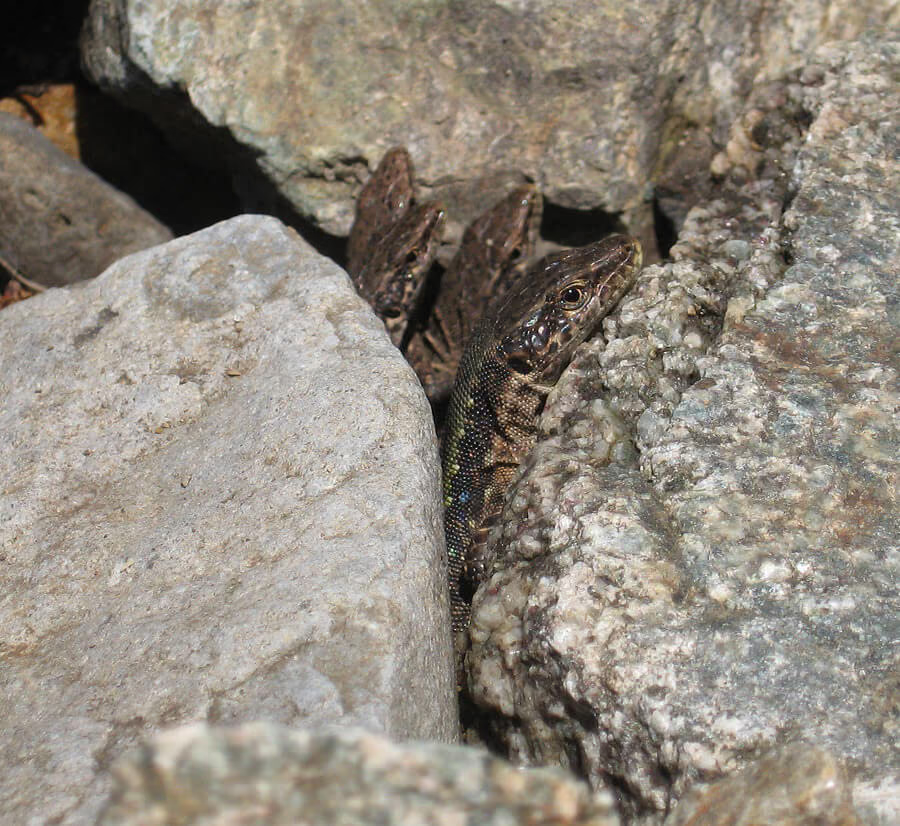
A close-up photo or a specimen is needed to examine the scales on the head and the plates in front of the anal opening. The images in the 2026 list show these features on an individual Fia.
The main species to compare it with is the Meskhetian rock lizard, which has been reported from more places in the same basin. Color alone is not enough to tell the two species apart. You also need to consider where they are found and compare the details of their scales.
This page does not present D. nairensis as a separate species in Georgia. The 2026 list also does not consider it clearly distinct from raddei and continues to treat it as a subspecies.

In Georgia, the species has been confirmed along the upper Kura River in Samtskhe-Javakheti, near the Turkish border. It has been recorded in Aspindza (Fia) and Tmogvi; the images show one individual found in Fia, in the Kura Valley. Samtskhe-Javakheti is marked on this atlas’s map based on those records. This does not mean that every suitable rocky site there has been checked. The species is also known from Armenia, southern Azerbaijan, northwestern Iran and northeastern Turkey. Data from across its range place it at elevations of 600–2,500 metres above sea level, in wooded, shrubby, grassy and rocky places. This elevation range is not a measured limit for Georgia.
Biology
Diet, behavior, and conservation
Diet
This page does not include published information about what it eats in Georgia. The 2026 list does not say what it eats either, so specific groups of predators are not named here. Do not catch or feed a wild animal.
Behavior
You are most likely to see it in rocky places, near crevices and on stony slopes, where it can quickly hide. This page has no confirmed information on exactly when it is active in Georgia, which months it breeds or how many eggs it lays. As with other small lizards in the same family, it is best to watch and photograph it from a distance; there is no need to pick it up.
Conservation
Tarkhnishvili and coauthors (2026) consider the species’ presence in Georgia confirmed. Its global IUCN assessment is Least Concern (LC), but this does not show how many there are in Georgia or whether their numbers are rising or falling. The Reptile Database and the 2026 Georgian list differ in their lists of subspecies and in how they describe the status of nairensis. This page uses the practical conclusion of the Georgian list. The threats it faces in Georgia are not assessed here in numerical terms.
Questions
Frequently asked questions
Short answers to the most important questions about Radde's Lizard.
Yes. According to Tarkhnishvili and co-authors (2026), the species’ presence in Georgia has been biologically confirmed.
Confirmed records come from the upper reaches of the Mtkvari River in Samtskhe-Javakheti: Aspindza, Pia and Tmogvi, near the Turkish border. This page has no confirmed records from other regions.
No. It has no venom and poses no threat to human health. If you catch it, it may bite you or break off its tail, so it is best not to pick it up.
In the Rade’s lizard group, head and body length usually reaches about 6–7 cm; the tail is longer than the body. These figures do not come from measurements taken in Georgia, so the exact size of lizards here still needs to be determined.
First, check the location. In Georgia, reliable records are linked to the Pia–Tmogvi area. Then check whether its body shape matches that of Darevskia rock lizards. To tell it apart from them, you often need a close look at the scales on its head and just in front of the anus.
The Meskhetian rock lizard (Darevskia obscura) is known from more places within the same broad basin. Colour is not a reliable way to identify it; the exact place where it was found, its size and the features of its scales matter more.
Not in this atlas. The 2026 Georgian list does not treat D. raddei and D. nairensis as clearly distinct species; nairensis remains a subspecies.
This page does not provide published information on what this lizard eats in Georgia or a complete account of when it can be seen during the year. You are most likely to encounter it during the day in rocky places where it can hide in crevices.
References
Sources
References
Sources
- Tarkhnishvili et al. 2026 — Annotated checklist of Georgia's amphibians and reptiles
- Iankoshvili & Tarkhnishvili 2021 — Georgian herpetofauna records cited in Tarkhnishvili et al. 2026
- Tuniyev et al. 2009 / 2017 errata — IUCN Red List account for Darevskia raddei
- Rastegar-Pouyani et al. 2011 — A new subspecies of Darevskia raddei from northwestern Iran
- Dehghani et al. 2014 — Sexual size dimorphism in Darevskia raddei from northwestern Iran
- The Reptile Database
Species profiles are compiled from peer-reviewed literature and established biodiversity databases, and are reviewed as new taxonomic and conservation data become available.
Related guides
Continue with related pages

Darevskia adjarica
Ajarian Rock Lizard
Adjara (Shuakhevi) and Abastumani
Darevskia armeniaca
Armenian Rock Lizard
Southern Georgia — Ninotsminda (Saghamo), Akhalkalaki

Darevskia derjugini
Derjugin's Lizard
Lagodekhi, Sioni, Mulakhi, Racha, Baniskhevi, Kintrishi

Darevskia mixta
Mixed Rock Lizard
Western Georgia (not Adjara) — Sairme, Tchkhorotskhu, Baniskhevi