


The Adjarian rock lizard (Darevskia adjarica) occurs in Georgia, in Adjara and around Abastumani. It belongs to the true lizard family (Lacertidae). It has no venom and is not dangerous to people. For a long time, it was regarded as a subspecies of D. parvula found in a separate area. In 2018 and 2022, Arribas and coauthors considered it a separate species from D. parvula and D. tuniyevi found in Turkey. The 2026 Georgian checklist and this atlas treat it as a possible separate species, but this has not yet been confirmed. Lizards living where the ranges of these species meet need to be studied. It remains possible that they breed freely with one another. The location given for the specimen used to describe the species is Abastumani, Georgia, at about 1,400 m. This does not mean the lizard occurs throughout Georgia. Recent records name Shuakhevi and Abastumani. A DNA segment obtained at Ajaristsqali resembles that of this species, but is listed as D. parvula in a database. The checklist also uses the spelling ajarica in places; this is another spelling of the same name, not a different species.
Identification
How to identify Ajarian Rock Lizard
It is a medium-sized rock lizard found in southwestern Georgia. Color alone is not enough to identify it. To distinguish it from other Darevskia species in the wild, consider its scales, the type of place it lives in, and the areas where it is found.
Often confused with


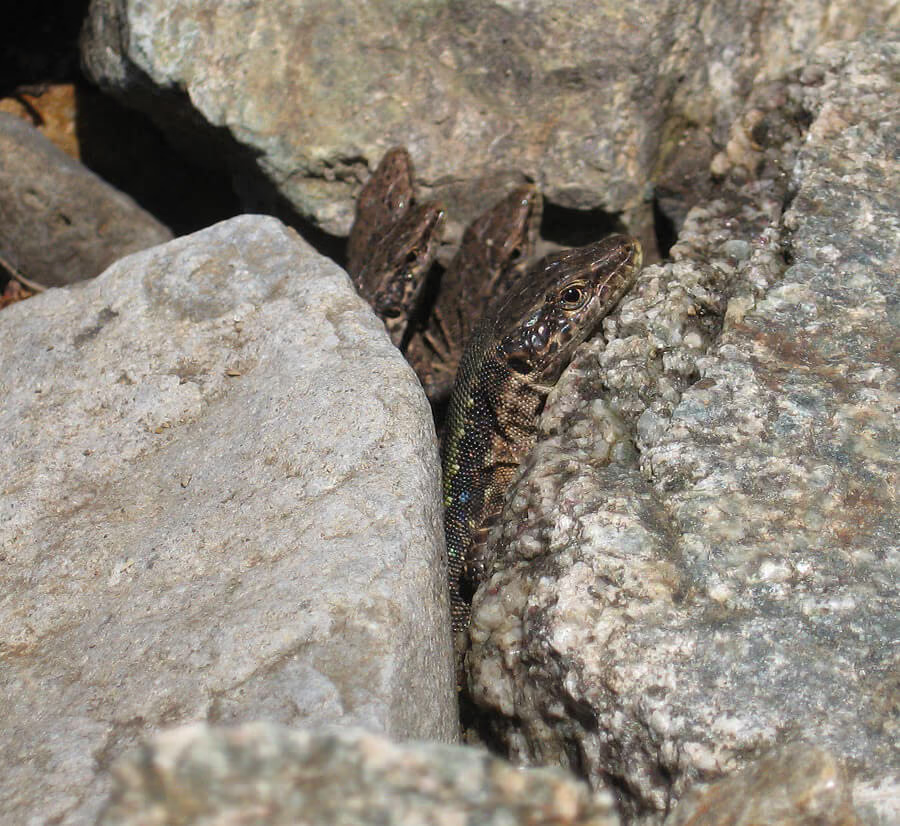
This rock-dwelling Darevskia has well-developed legs and a relatively flat head. It is found on rocks and in crevices, unlike the forest-floor derjugini and the large, ground-dwelling Lacerta. Its body is stockier and more rounded than that of D. parvula. The middle of its back often stands out clearly from the dark stripes that pass through the temple area. A pale stripe or a row of whitish spots is often visible along the edges of these dark stripes. Adult males often have orange or brick-red bellies; a blue ring near the armpit is seen rarely. Any greenish tint comes from a sheen, not a separate pigment. These are features of its appearance, and color alone cannot be used to tell the species apart.
Head and body length is often about 5–5.5 cm. In one study, it was about 4.2–6.2 cm among the animals examined. Most were from Turkey, with others from Abastumani and Shuakhevi. This page does not give separate measurements for the specimens from Georgia. The tail is usually longer than the body. Total length is not given in the table.
The sixth scale under the jaw can help tell them apart. According to the original description, it is triangular with outward-curving edges in about 95% of cases, while this scale is often flat in D. parvula. In about half of cases, there is one large scale in front of the scale by the rear opening; in the remaining cases, there are two. The images from Shuakhevi in the list show the scales on the head and those in front of the rear opening, rather than the animal’s coloring. These features are hard to make out in the wild without a magnifying glass.
Clark's rock lizard (D. clarkorum) is a separate species. Its presence in the Charnali valley in Adjara has been confirmed. D. derjugini may also occur in the same valley. It lives on the ground in forests and has a more rounded head. The Colchian rock lizard (D. mixta) is found only in western Georgia, but not in Adjara. It was formerly called “Ajarian lizard” in English; it should not be confused with the lizard discussed here. The true D. parvula is not on Georgia's species list. D. tuniyevi occurs in Turkey. One paper suggests that it may extend in a narrow strip as far as Ajaristsqali, but its presence in Georgia has not been confirmed. They cannot be told apart by colour alone.
The 2026 Georgian list includes it only as a possible species, not a confirmed one. For a long time, it was considered a local subspecies of D. parvula. The species was described from a lizard found in Abastumani, Georgia. Recent accounts name Shuakhevi and Abastumani as places where it has been found. This does not mean it occurs throughout Georgia. D. parvula itself is not included in Georgia’s species list. The Colchian rock lizard (D. mixta) does not occur in Adjara.

Gallery
Ajarian Rock Lizard in photos
It occurs in Georgia. We should not assume that it lives on the dry plains of eastern Georgia or along the entire length of the Greater Caucasus. A 2026 review lists southwestern Georgia as its range, though the information is considered moderately reliable. An image of its head scales and DNA records come from Shuakhevi. A specimen was also collected there in 2019 at about 600 m. The specimen used to describe the species came from Abastumani, at about 1,400 m; another specimen was collected there in 2019 at about 1,300 m. A DNA record from Ajaristsqali, stored under the name D. parvula, matches the Shuakhevi records by 99.21% and is linked to this species in the list. This atlas map shows Adjara based on the Shuakhevi record and Samtskhe-Javakheti based on the Abastumani and 2019 specimens. That does not mean the species occurs only in these two places, or that every suitable valley has been checked. A description from 1980 gives a wider range: the Black Sea coast from Trabzon to Batumi, the Chorokhi River below Borçka, Adjara, and the part of Georgia between Meria (southeast of Poti) and Borjomi. It also mentions a separate group near Bakuriani. Guria, Imereti and Bakuriani are currently absent from this atlas map: they are mentioned in older sources, but the 2026 list gives no specific DNA record for them. It lives on rocks, stones and in crevices in wooded valleys, often near a stream. Its typical surroundings are neither treeless steppe nor the forest floor, where derjugini moves about. Specimens then known as D. p. adjarica were collected in Turkey during the day, in forest near a stream. That observation describes their surroundings in Turkey and provides no data on elevations in Georgia. The specific Georgian sites named on this page lie at elevations of about 600 m to 1,400 m.
Biology
Diet, behavior, and conservation
Diet
This page does not include a study of what was found in this lizard’s stomach in Georgia. Like other rock-dwelling Darevskia species, it likely eats insects, spiders and similar small animals. It has no venom and catches prey with its jaws.
Behavior
It is active during the day. It is a rock lizard: it warms itself on stones and shelters in crevices. This page does not say which hours of the day it is active in Georgia. In Turkey, specimens of lizards then known as D. p. adjarica were collected between 08:00 and 15:30 in clear and cloudy weather. Specimens from Shuakhevi and Abastumani were collected on September 8, 2019, showing that the lizards were still out in late summer. It lays eggs. This page does not say how many eggs it lays at a time in Georgia. If you catch it, its tail may come off, and it may bite. Watch it where it is, do not pick it up, and leave it there.
Conservation
A 2026 study considers D. adjarica a candidate for recognition as a separate species. More evidence is needed from places where its range meets that of D. parvula to determine whether it is a separate species. One source reports a difference of up to 3.7% in the cytochrome b gene between material from Georgia and some genetic records of D. parvula from northeastern Turkey. A 2018 study reports a difference of about 14.4% between the two groups. These figures cannot be compared directly: the studies used different samples, and D. tuniyevi was separated out only in 2022. It has therefore not yet been settled whether D. adjarica should be considered a separate species in Georgia. In 2009, the IUCN assessed D. parvula as being at low risk. At the time, that assessment also included D. adjarica. The IUCN has not assessed D. adjarica separately. D. adjarica is not on Georgia’s 2014 Red List. How its numbers are changing in Georgia has not been measured here. It is not listed under CITES. Do not catch wild lizards.
Questions
Frequently asked questions
Short answers to the most important questions about Ajarian Rock Lizard.
Yes. It is listed as a candidate species in the 2026 list. The specimen used to describe the species came from Abastumani. The barcodes and the image of its head are from Shuakhevi.
Recent records place it in Shuakhevi (Adjara, at about 600 m) and Abastumani (at about 1,300–1,400 m). It is found on rocks and stones in wooded valleys. This does not mean it is found throughout Georgia.
It is a medium-sized rock lizard with dark, distinct markings. Its belly is often orange or brick-red. Color alone is not enough to identify it. Compare it with clarkorum from Charnali and derjugini, which lives on the forest floor. Do not confuse it with mixta, which is not found in Adjara.
No. It has no venom. If you catch it, it may bite you. Its tail may also come off. Leave it where it is.
The head and body together are often about 5–5.5 cm long. Among the animals measured, this length ranged from about 4.2 to 6.2 cm. Figures for Georgia are not given separately on this page.
The list previously treated it as a subspecies of D. parvula. The populations in places where it and D. parvula meet have not been studied. Arribas and coauthors regard it as a separate species. This atlas follows the list’s assessment and treats it as a possible separate species.
mixta does not occur in Adjara. D. parvula is not on Georgia’s species list — it is a species from Turkey. An older DNA record from Ajaristsqali is listed as parvula in the database, but it almost matches the DNA records from Shuakhevi.
It is active during the day. This page does not give a complete account of when it is active in Georgia throughout the year. The sample from Shuakhevi and Abastumani was collected in early September.
References
Sources
References
Sources
- Tarkhnishvili et al. 2026 — Annotated checklist of Georgia's amphibians and reptiles
- Arribas et al. 2018 — Reevaluation of Darevskia parvula
- Arribas et al. 2022 — A new cryptic species of the Darevskia parvula group
- Darevsky & Eiselt 1980 — Lacerta parvula adjarica, original description
- Tarkhnishvili & Iankoshvili 2023 — Geographic proximity and niche overlap in Caucasian rock lizards
- Ilgaz 2009 — Comparative morphology of D. parvula subspecies in northeastern Anatolia
- Tuniyev et al. 2009 — IUCN Red List, Darevskia parvula
- საქართველოს მთავრობის დადგენილება №190 (2014) — წითელი ნუსხა
- The Reptile Database — Darevskia adjarica
Species profiles are compiled from peer-reviewed literature and established biodiversity databases, and are reviewed as new taxonomic and conservation data become available.
Related guides
Continue with related pages
Darevskia armeniaca
Armenian Rock Lizard
Southern Georgia — Ninotsminda (Saghamo), Akhalkalaki

Darevskia obscura
Obscure Rock Lizard
Samtskhe — Javakheti, Adjara

Darevskia raddei
Radde's Lizard
Upper Mtkvari near the Turkish border — Aspindza (Pia), Tmogvi

Darevskia valentini
Valentin's Lizard
Samtskhe — Javakheti — Ninotsminda (Saghamo Lake), Kirkhbulaki