


The gyurza (Macrovipera lebetinus) is a large venomous viper found in Georgia. It is one of the country’s most dangerous snakes for people. It lives mainly in the dry and semi-dry parts of eastern Georgia. It is not known to occur naturally in western Georgia or high mountain areas. Adults have stout bodies, broad triangular heads and vertically elongated pupils. But color or size alone is not a reliable way to identify one. This atlas uses the scientific name Macrovipera lebetinus. Some modern sources also use Macrovipera lebetina, while older ones use Vipera lebetina. If only its spotted back is visible from a distance, it may resemble the Urartu racer or the variegated racer. A gyurza bite requires urgent medical care. Do not approach the snake or try to catch or kill it. Like the venom of other vipers, gyurza venom can cause bleeding, problems with blood clotting and tissue damage around the bite. The bite is dangerous even if the signs seem mild in the first few minutes. Do not treat the bite at home: do not cut the bite site, try to suck out the venom, tightly wrap any part of the body or waste time on folk remedies. Call 112 immediately and follow the advice in the snakebite guide.
Identification
How to identify Levantine viper
The gyurza is a thick-bodied viper. It has a broad, triangular head and vertically elongated pupils. A raised ridge runs down the middle of each scale. If only its spotted back is visible from a distance, it may resemble a Urartu racer or a multicolored racer.
Often confused with


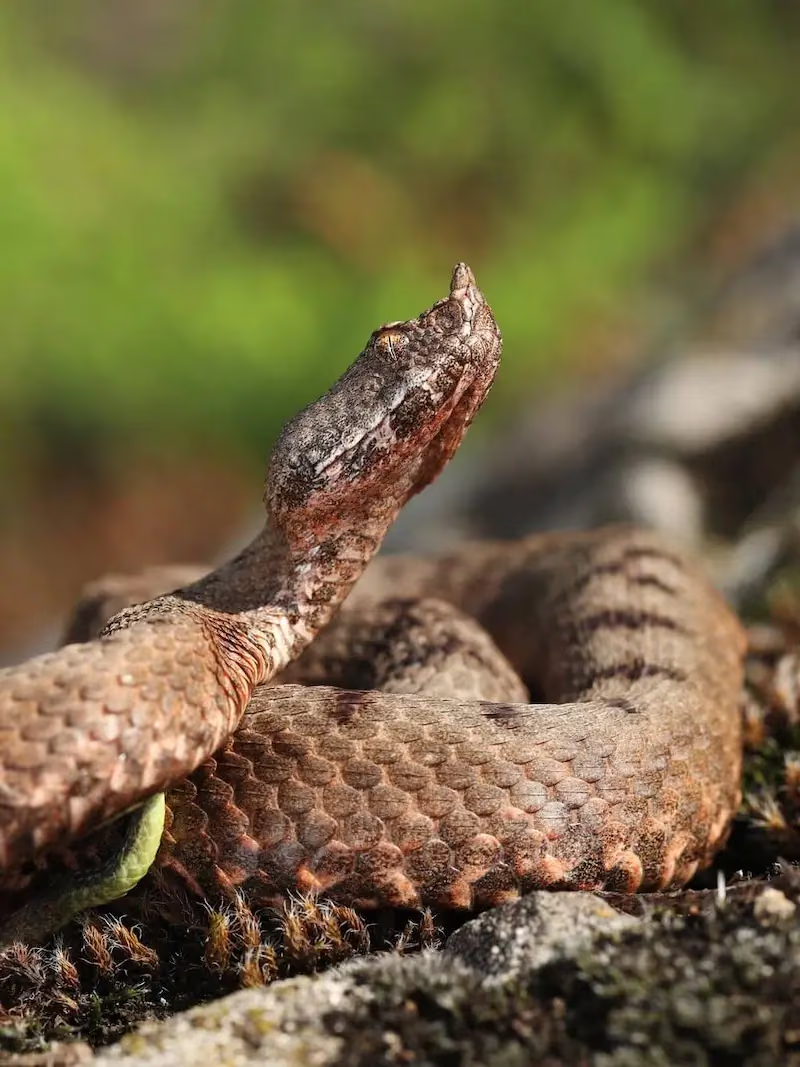
The gyurza has a thick, heavy body. Its broad, triangular head is clearly distinct from its neck. It has a blunt nose and no horn. Gyurzas are usually 70–90 cm long, though large ones can reach 1.5 meters. Reports of gyurzas longer than 2 meters are disputed.
The pupil looks like a vertical slit. Each scale on the back has a prominent raised line down the middle, making the back look rough. The scales on the head, including above the eyes, are mostly small.
It may be gray, sand-colored, or brownish. Its back often has dark spots or bands running across it. These sometimes form a zigzag pattern. Its belly is lighter and often dotted with small dark spots. Some have a more even color.
The Urartu racer has a thick body and large, rounded dark patches on its back. The dark-spotted pattern of the variegated racer can also resemble a gyurza’s, especially when the snake’s head is out of view. Both racers have round pupils; a gyurza’s are vertical. Do not approach a snake to look at its pupils.
The steppe viper is also found in eastern Georgia, but it is much smaller than the gyurza. It is usually about 40–60 cm long. The nose-horned viper has a horn on its nose, making it easy to recognize. It is found in more mountainous areas. Dinnik’s viper lives in the high mountains of the Greater Caucasus and is not found where the gyurza usually lives.

Gallery
Levantine viper in photos
The gyurza is found in dry, stony and rocky places. In Georgia, it lives in dry areas along the lower reaches of the Iori, Mtkvari and Alazani rivers, in Shiraki and Gareji, and in the dry foothills of Kvemo Kartli. It is rare near Tbilisi and Rustavi. This atlas’s map marks the gyurza in Kakheti, Kvemo Kartli and Tbilisi. Confirmed locations include Kvareli, the area around Nekresi Monastery, the Alazani Valley and the Colorful Desert. As of 2026, the area where the gyurza is found had expanded over recent decades from Georgia’s far southeast to the Alazani Valley and Tbilisi. The map has only isolated records for Tbilisi. Records associated with Rustavi mostly concern dry areas of Kvemo Kartli along the Mtkvari. For Tbilisi, this atlas lists the Tbilisi Botanical Garden, Tabori, Nadzaladevi and Saburtalo; toward Rustavi, it lists Rustavi, Gardabani and the Jandari Reservoir. Such a record only confirms that the gyurza could be found in a particular place in a particular year. It does not mean the snake is widespread or frequently seen in every part of the city. The gyurza shelters in cracks in rocks, beneath stones and in rodent burrows; it sometimes enters structures. During intense summer heat, it may appear near water. In Georgia, it is found up to about 1,500 metres in elevation. Its natural presence in western Georgia has not been confirmed. The high mountains of the Greater Caucasus and the Colchic forest are not places where it usually lives.
Distribution
Where Levantine viper occurs in Georgia
76 field records2012–20263 regions
Interactive map is loading.
- Field observation
- Several records in one spot
- Source-confirmed region
| regions | field records | |
|---|---|---|
| Distribution confirmed | ||
| Source-confirmed region | 49 | |
| Source-confirmed region | 15 | |
| Source-confirmed region | 5 | |
The Levantine viper map combines Reptiles.ge editorial photo records with public iNaturalist observations. Source-confirmed regions and individual field records are separate layers, and record counts reflect observation effort rather than population density.
Data: Reptiles.ge + iNaturalist · Methodology
Biology
Diet, behavior, and conservation
Diet
Adult gyurzas mainly eat rodents, but they also catch small birds, lizards and other small animals with backbones. They usually hunt by lying in wait. Sometimes they climb bushes or trees.
Behavior
In the South Caucasus, the gyurza is usually active from April to the end of October, although some sources say it may appear as early as late March. When you might encounter it depends on the weather and daytime temperature: in spring and autumn, it often moves around during the day, while in the summer heat it is more active at dusk and at night. In very hot weather, an encounter is also more likely near water. It spends the winter in rock crevices or burrows. The gyurza lays eggs, unlike other vipers found in Georgia. It usually mates in April and May. In summer, it lays about 15–20 eggs. The young hatch after about 35–45 days and are about 23–25 cm long. The gyurza does not seek out people and usually defends itself when it feels threatened. If you encounter one, keep a safe distance and do not try to catch it.
Conservation
A 2021 assessment found that the gyurza faces a low risk of extinction as a species. It is not on Georgia’s 2014 Red List, although older Georgian encyclopedias sometimes associate it with the Red Book. The vipers listed there include Dinnik’s viper and the Caucasian viper. The gyurza is threatened by changes to its habitat, expanding settlements, excessive livestock grazing, and people killing it deliberately. In dry areas, it hunts rodents and is an important part of the local food chain.
Questions
Frequently asked questions
Short answers to the most important questions about Levantine viper.
Yes. As of 2026, the gyurza has been confirmed in Georgia. It is found mainly in the dry and semi-dry areas of eastern Georgia and is not found throughout the country.
Yes, “gyuza” is a common alternative spelling of “gyurza.” In this atlas, the species Macrovipera lebetinus is called “gyurza.”
In Georgia, the gyurza is found mainly along the lower reaches of the Iori, Mtkvari and Alazani rivers, in Shiraki and Gareji, and in the dry foothills of Kvemo Kartli. It is rare around Tbilisi and Rustavi. This atlas’s map marks it in Kakheti, Kvemo Kartli and Tbilisi. Its presence has also been confirmed in Kvareli, near Nekresi Monastery and in the Colorful Desert. It is not known to occur naturally in western Georgia.
Yes, but rarely — mostly in dry, open, or rocky places. In Tbilisi, the gyurza has been recorded in the Tbilisi Botanical Garden, on Tabor, and in Nadzaladevi and Saburtalo. Toward Rustavi, records list Rustavi, Gardabani, and Jandari Reservoir. These records only confirm that the gyurza was recorded in those places in specific years. They do not mean it is often found in every part of the city.
The gyurza is a venomous snake. Among snakes found in Georgia, its bite is considered one of the most serious threats to human health. It is a large snake and may inject a large amount of venom when it bites. Its venom can cause bleeding, interfere with blood clotting and damage the area around the bite. The gyurza does not usually attack people. It bites when it feels threatened — if someone gets too close, steps on it or tries to catch it. If bitten, call 112 immediately.
If someone is bitten by a gyurza, call 112 immediately. Have the person lie down and reassure them. Try to keep them as still as possible. Do not cut the bite, suck out the venom or tie anything tightly around the bitten area. The person needs treatment in a hospital. If medicine to counter the venom is needed, only a doctor should choose and give it.
In Georgia and the South Caucasus, the gyurza is usually active from April through the end of October. It has also been spotted in late March. In spring and autumn, it often moves around during the day. In the summer heat, it is more likely to appear at dusk or at night. Its activity at any given time also depends on the weather, temperature and location.
The gyurza is a large, thick-bodied snake. It has a broad, triangular head and vertically elongated pupils. Its scales have a raised line down the middle. It has no horn on its snout. Urartu and multicolored racers have round pupils. Do not identify a snake by the spots on its back alone, and do not approach it.
The gyurza is usually 70–90 cm long, though large ones can reach 1.5 metres. In Georgia, it is the largest viper. Reports that it can grow longer than 2 metres are disputed.
The gyurza lays eggs, while Vipera vipers found in Georgia give birth to live young. Gyurzas usually mate in April–May and lay about 15–20 eggs in summer.
Watch the snake from a safe distance and leave it where it is. Do not try to catch or kill it. If you give it room and do not disturb it, the gyurza will usually move away from you on its own.
References
Sources
References
Sources
- Tarkhnishvili et al. 2026 — Annotated checklist of Georgia's amphibians and reptiles
- Jablonski et al. 2019 — Original description of Elaphe urartica
- Tuniyev et al. 2009 — Snakes of the Caucasus
- Yıldız et al. 2023 — Amphibians and Reptiles of Mount Ararat
- Iankoshvili & Tarkhnishvili 2021 — Distribution of snakes in Georgia
- Aghasyan et al. 2021 — IUCN Red List account for Macrovipera lebetina
- Avella et al. 2025 — The biology and toxinology of blunt-nosed vipers
- The Reptile Database
- National Geographic Georgia / National Museum — Levantine viper map
- Seropian & Makharadze 2026 — Georgian Biodiversity Database: Macrovipera lebetinus
- საქართველოს მთავრობის დადგენილება №190 (2014) — წითელი ნუსხა
- მუსხელიშვილი — ენციკლოპედია „საქართველო“ (გიურზა)
Species profiles are compiled from peer-reviewed literature and established biodiversity databases, and are reviewed as new taxonomic and conservation data become available.
Related guides


