


The Turkish lizard (Darevskia clarkorum) is a rock lizard found in Adjara, southwestern Georgia. It belongs to the true lizard family (Lacertidae). It is not venomous and is not dangerous to people. A 2026 Georgian checklist lists it as a confirmed species. This does not mean it is found throughout Georgia: the recent DNA data and images of head scales mentioned here come from the Charnali Valley in Khelvachauri Municipality. The atlas map shows Adjara based on these records, but this does not mean the lizard occurs in every valley in the region. In English, it is called Clark's rock lizard or Clark's lizard. The Georgian checklist calls it the Lazian lizard, while this atlas retains the name “Turkish lizard” used in Georgia's 2014 Red List. The species was first described in Turkey, at the Cankurtaran Pass between Hopa and Borçka in Artvin, not in Georgia. In 2009, the IUCN assessed it as Endangered. Georgia's 2014 Red List also places it in the Endangered (EN) category.
Identification
How to identify Clark's Rock Lizard
The small rock lizard is found in the valleys of Adjara. Color alone is not enough to tell it apart from other Darevskia species in the wild. Its scales, body shape, and where it is found also matter.
Often confused with


This rock-dwelling Darevskia has well-developed legs. It lives on rocks and cliffs and is not a large, ground-dwelling Lacerta. In specimens studied in Turkey, the back is ivy green, light green, brown or grayish brown, often with small dark spots. The dark stripe along the side of the head, near the temple, may have several spots with pale centers. There may also be a blue spot near a front leg. The belly is often bright yellow. This appearance is typical, but color alone is not enough to tell the species apart.
Among the many individuals studied in Turkey, head and body length was about 4.4–6.7 cm (about 5.9 cm on average); the original measurements gave a slightly higher figure. The tail is often longer than the body. One male measured about 18.7 cm in total length. According to Arribas and coauthors (2021), the dryada form from Charnali is larger than the typical clarkorum form; its males have longer heads and more scales on their backs. This page does not provide the full set of measurements for individuals measured in Georgia.
The 2026 list still identifies the form found in southwestern Georgia as D. c. dryada, a geographic subspecies. It does not have a separate species page. Arribas and colleagues (2021) recognize dryada as a distinct group, most likely a subspecies; Schmidtler and colleagues (2002) considered it a form associated with local environmental conditions. Colour alone cannot settle this question in the field. The study’s figures show the head scales and the plates in front of the anal opening of specimens from Charnali.
The Adjarian rock lizard (D. adjarica) is listed as a candidate from the parvula group. The DNA records cited are from Shuakhevi, not Charnali. The Artvin lizard (D. derjugini) is a smaller forest species. It lives on the ground among leaves and grass and is not a typical rock lizard. The Colchian rock lizard (D. mixta) is a close relative, but the list does not include it as a species found in Adjara. In southwestern Georgia, do not identify lizards by color alone.
The 2026 list treats it as a biologically confirmed species. But its presence across all of Georgia should not be assumed: the recent DNA data and images of head scales cited here come from the Charnali Valley (Khelvachauri Municipality). These records are why Adjara is marked on the atlas map, but that does not mean the species occurs in every valley in Adjara. The Adjarian rock lizard (D. adjarica) is listed as a candidate species in the same list; the DNA data cited for it come from Shuakhevi, not Charnali.
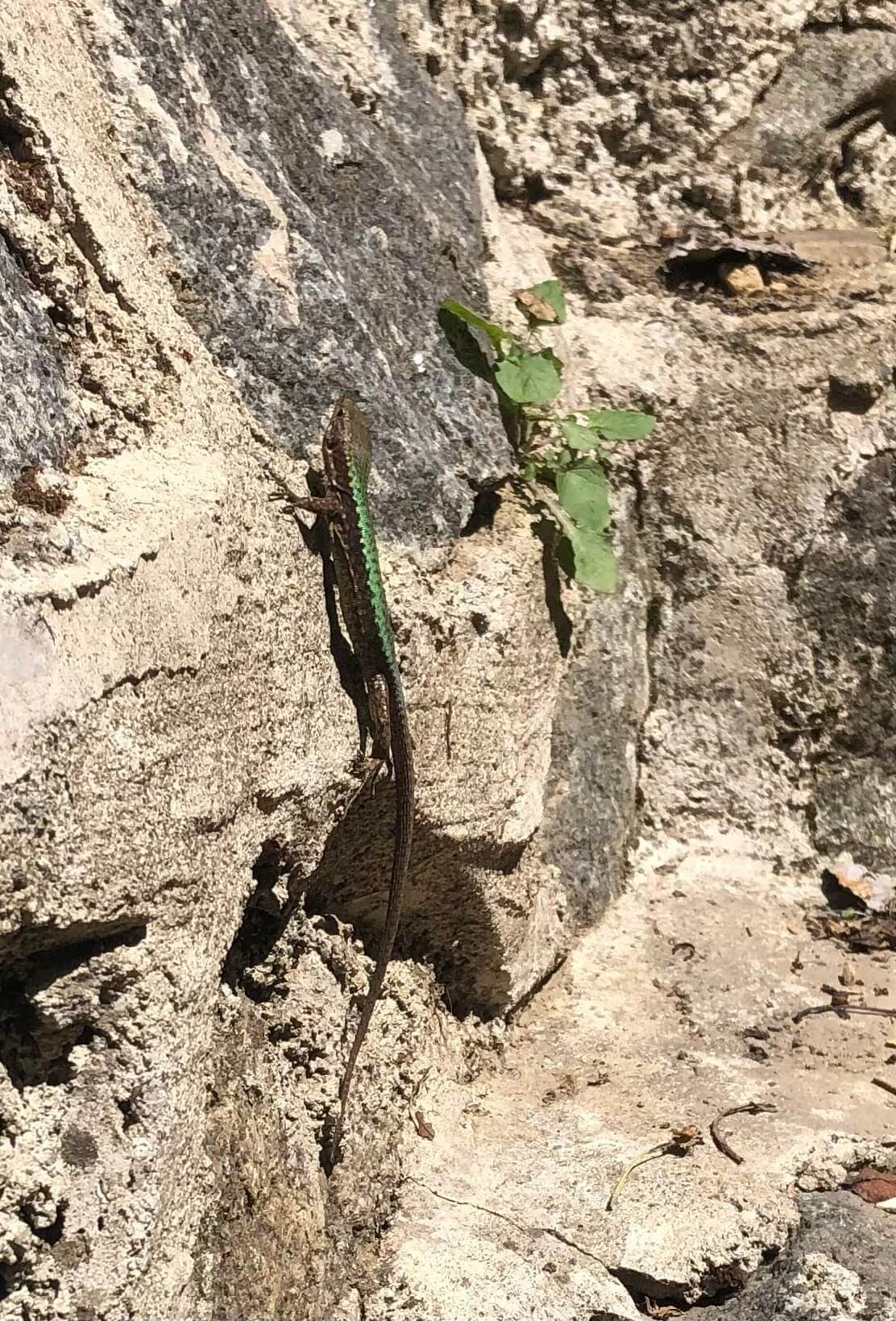
It occurs in Georgia. Do not assume it occurs in Kakheti, Javakheti or the Greater Caucasus. A figure from the Charnali Valley is cited in a 2026 publication; DNA data also come from this valley. The distribution information is considered moderately reliable. A 2009 IUCN text also names a small, separate area on the western slopes of Mtirala, near Batumi. This is the second named location in Adjara, but the records do not establish that Charnali and Mtirala are the same place. Nor do they provide a map of the species’ distribution across the country. A 2021 note in The Reptile Database says the species may reach as far north as the Kintrishi Valley. This information comes from personal communication, and the valley is not a named location in the checklist. The species lives in moist, shrubby places near streams, among stones, protruding rocks and loose rock; it also lives in rocky mountain meadows. In Adjara, it can be found on the slopes of wooded valleys and beside stony streams, not in dry steppe. Sources give different elevation ranges for the species: IUCN (2009) gives 1,500–2,200 m; Darevsky and Tuniyev (1997), about 900–1,700 m; and Turkish data include lower places too, at about 450–2,250 m. Charnali is a Colchian valley; this page gives no measured elevation range for the species in Georgia. The 2009 IUCN text also mentions Armenia, citing Baran and Atatür (1998). The 2026 checklist and The Reptile Database do not include Armenia in the species’ range. Do not assume from this atlas that it occurs in Armenia.
Biology
Diet, behavior, and conservation
Diet
This page does not include a study of the stomach contents of this species from Georgia. Like other Darevskia species, it likely eats small insects and similar small animals. It catches prey with its jaws, without venom. One instance of this species eating a plant was recorded in Turkey. That observation tells us nothing about its diet in Georgia.
Behavior
It is active during the day. It lives on rocks, warming itself on stone and sheltering in crevices. In a study in northeastern Turkey, the lizards were caught between about 08:30 and 18:30, often in cloudy or rainy weather. This does not tell us what hours they are active in Georgia. It lays eggs. How many eggs it lays at a time in Georgia, which month it lays them, and when it emerges after winter have not been established here. Lizards studied in Turkey begin breeding at about 1–3 years of age, depending on the elevation where they live. The oldest age reported for them is about 10–12 years. These figures are not averages for lizards in Georgia. If caught, it may lose its tail and may also bite. Observe it and leave it where it is. Do not pick it up.
Conservation
In 2009, the IUCN assessed it as Endangered (EN): its known range covered less than 5,000 km², it had been recorded at fewer than five locations, and excessive grazing was making its habitat worse. That assessment is old. The IUCN treats the Charnali form as a separate species, Darevskia dryada, and its 2009 assessment lists it as Critically Endangered. This atlas follows a 2026 list and treats dryada as a subspecies, but the IUCN assessment points to a serious threat to the lizards at Charnali. Georgia’s 2014 Red List (Resolution No. 190) also lists it as Endangered (EN), citing the IUCN assessment. A note in the resolution says it is considered Vulnerable worldwide, which does not match the IUCN’s 2009 assessment. Tarkhnishvili and coauthors (2026) consider it biologically confirmed. A 2019 field report from Charnali estimates about 256 ± 48 lizards in one study area and identifies construction and habitat loss as local threats. This grant report covers only part of the valley; it is not a count for the whole country. It is not listed under CITES. Do not catch wild lizards.
Questions
Frequently asked questions
Short answers to the most important questions about Clark's Rock Lizard.
Yes. The 2026 list confirms this with biological evidence. The barcodes and figures cited are from the Charnali Valley in Adjara. They do not establish that it occurs throughout Georgia.
The species is found in southwestern Georgia, in Adjara. More recent records name the Charnali Gorge (Khelvachauri) as a location. IUCN records from 2009 also mention the western slopes of Mtirala near Batumi. The described site is on a rocky, bushy slope near a stream. This is not a species of Kakheti or Javakheti.
In this atlas, dryada is a subspecies (D. c. dryada), not a separate Georgian species. Some papers still discuss whether it should be considered a separate species. They are referring to the Charnali population.
A small green-brown rock lizard is found in the valleys of Adjara. Color alone is not enough to tell it apart. Compare where adjarica (Shuakhevi, the parvula group) and derjugini (on the forest floor) are found and how they behave. In the list’s illustrations, the scales on the head are a more reliable clue than the color of the back.
No. It is not venomous. If you catch it, it may bite you; its tail may also break off. It is on Georgia’s Red List. Leave it where it is.
In specimens studied in Turkey, the head and body together often measure about 4.5–7 cm. The dryada form from Charnali has been described as larger. This page does not provide the complete data for specimens from Georgia.
This page does not include a study of its diet in Georgia. It is thought to eat small animals without backbones. It has also been observed eating plants in Turkey.
It is active during the day. This page does not give a full account of which parts of the year it is active in Georgia. Records from Turkey include observations during daylight hours, even in cloudy weather.
References
Sources
References
Sources
- Tarkhnishvili et al. 2026 — Annotated checklist of Georgia's amphibians and reptiles
- Darevsky & Vedmederja 1977 — original description of Lacerta clarkorum
- Darevsky & Tuniyev 1997 — Lacerta dryada and comments on L. clarkorum
- Arribas, Ilgaz & Kumlutaş 2021 — status of Darevskia dryada
- Schmidtler, Heckes, Bischoff & Franzen 2002 — clarkorum/dryada character variation
- Ilgaz 2007 — morphology and distribution in northeastern Turkey
- Bülbül et al. 2016 — body size and age structure in Turkey
- Franzen 1991 — plant feeding in Lacerta clarkorum (Turkey)
- Tuniyev et al. 2009 — IUCN Red List, Darevskia clarkorum
- Tuniyev et al. 2009 — IUCN Red List, Darevskia dryada
- Barateli 2019 — Charnali Gorge field report (Rufford)
- საქართველოს მთავრობის დადგენილება №190 (2014) — წითელი ნუსხა
- The Reptile Database — Darevskia clarkorum
Species profiles are compiled from peer-reviewed literature and established biodiversity databases, and are reviewed as new taxonomic and conservation data become available.
Related guides
Continue with related pages

Darevskia obscura
Obscure Rock Lizard
Samtskhe — Javakheti, Adjara

Darevskia alpina
Alpine Rock Lizard
Western Greater Caucasus — literature; no named locality in the checklist
Darevskia armeniaca
Armenian Rock Lizard
Southern Georgia — Ninotsminda (Saghamo), Akhalkalaki

Darevskia brauneri
Brauner's Rock Lizard
Western and central Greater Caucasus — Mestia (Manshura), Martvili, Ertso Lake