
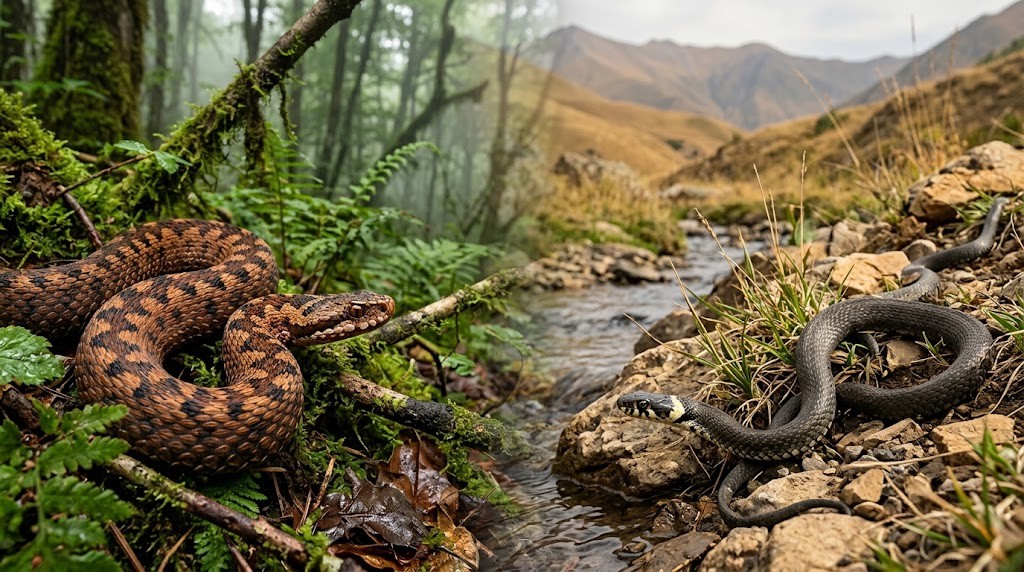
Snakes in Georgia
Venomous or harmless?
Most snakes in the Republic of Georgia are harmless. A vertical pupil and a broad, triangular head occur in some venomous snakes, especially vipers, but neither cue on its own is enough for reliable species identification.
ID
No rule is universal
Telling a venomous snake from a harmless one by photo alone is not always reliable. It is better to consider several cues together: appearance, habitat, region of Georgia, and similar species.
This page gathers common mix-ups and practical cues, but they do not replace guaranteed field identification. It gives special attention to the Levantine viper and the Caucasus viper (Vipera kaznakovi), as well as other venomous species. Many harmless racers, the smooth snake, and the glass lizard are also often mistaken for venomous snakes.
Practice
Next: which snake is it?
This guide is field identification. Photo practice lives on a separate quiz — ten frames, four names.
Signs
What people often check — and why one cue is not enough.
No external mark on its own proves that a snake is venomous. If you are not sure of the species, keep a safe distance and compare several cues in the species profiles.
- 01
Pupil.
Vipers often have a vertical pupil, while many harmless snakes have a round one. But pupil shape is not always easy to see, especially from a distance or in poor light. Also, a vertical pupil is not limited to venomous snakes.
- 02
Head shape.
A broad or triangular head can be typical of vipers, but harmless snakes also often flatten the head defensively. For that reason, venomousness cannot be determined by head shape alone.
- 03
Similar species.
Some harmless or lower-medical-importance species can resemble venomous snakes. For example, Dahl’s whip snake is sometimes confused with vipers, and the glass lizard is taken for a snake. In those cases, compare several cues and open the relevant species profiles.
- 04
When you are not sure of the species.
Do not catch or kill the snake. Most species in Georgia are not dangerous to people. The list of venomous snakes and related safety information is in a separate guide.
Venomous
Giurza → Caucasus viper → other venomous species.
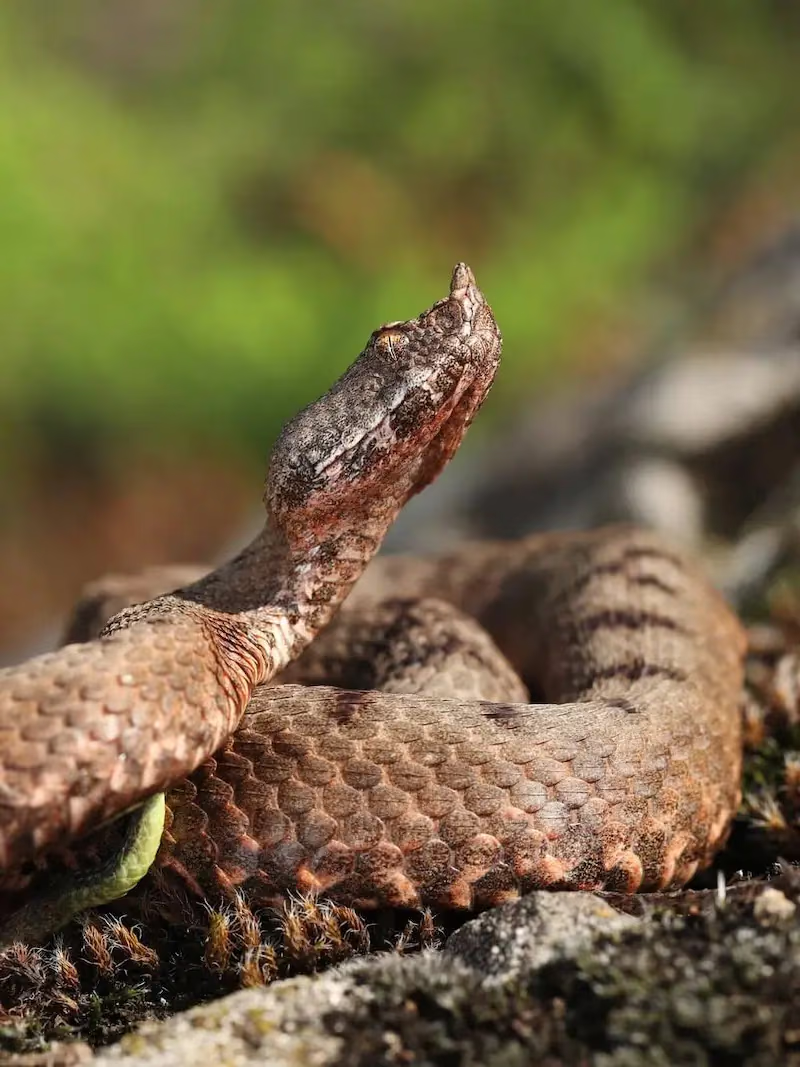
The comparison starts with the medically important Levantine viper, then moves to the Caucasus viper, which is tied to humid forests of western Georgia, and finally to other venomous or venom-bearing species.




Mix-ups
Species that are often confused with one another.
Common mix-ups include racers and vipers, the glass lizard and true snakes, and the Montpellier snake and the Levantine viper. Each comparison links to the relevant detailed species profile.


Myths
Common myths about snake identification.
A single photo or casual advice is not always enough to identify a species accurately. Keep your distance and compare several cues: appearance, range, habitat, and similar species.
Myth: A vertical pupil always means the snake is venomous.
Reality: Many vipers have a vertical pupil, but this cue is not always easy to see and is not limited to venomous snakes. Use several cues together to identify the species.
Myth: A triangular head necessarily means the snake is a viper.
Reality: A harmless snake may flatten its head when threatened and look more triangular. Head shape alone is not a reliable identification mark.
Myth: The Montpellier snake is the Levantine viper.
Reality: The Montpellier snake (Malpolon) and the Levantine viper are different snakes. The Montpellier snake has rear fangs in the back of the mouth; the Levantine viper is a viper with front fangs.
Myth: The glass lizard is a venomous snake.
Reality: The glass lizard is not a snake at all — it is a legless lizard. Unlike snakes, it has movable eyelids and external ear openings. It is not venomous to people.
Related guides
Continue with thematic pages.
Identification, range, safety, and species indexes are grouped on connected pages so you can reach what you need without leaving the topic.
FAQ
What people ask about ID
Short answers — the decision lives on the profile.
The most reliable way to identify a snake is species identification, not one visible mark. Pupil shape and head structure can help, but lighting, viewing angle, and defensive behavior can mislead. Compare the atlas marks, range, and habitat. In case of a bite, do not wait for precise species identification — seek emergency medical care first.
No. The glass lizard is a legless lizard, not a snake. It has movable eyelids and external ear openings — features snakes lack. Because of its large size and long body, it is often mistaken for a snake, but it is not venomous to people.
Start with the Levantine viper, one of the medically most important venomous snakes in Georgia. Then learn the Caucasus viper, which is tied to western Georgia’s Colchic and humid habitats and is sometimes confused with harmless snakes. The remaining species are gathered in the full venomous-snakes guide.
A precise snake identification from a photo is not always possible. Use the atlas to compare visible marks, habitat, and similar species. If a snake has bitten you, do not wait for a perfect ID — seek emergency medical care. Take a photo only from a safe distance and only if doing so creates no additional risk.
Next step
From ID to a profile
Open a species or the venomous guide. First steps after a bite are on a separate page.