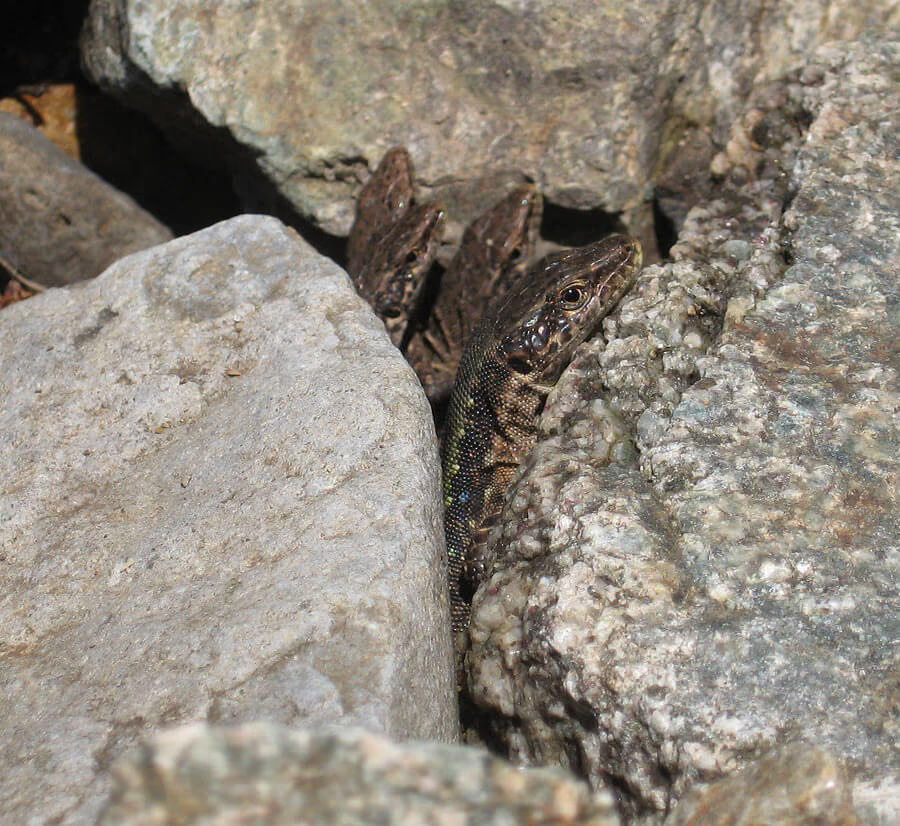
The Meskhetian rock lizard (Darevskia obscura) occurs in Georgia. A 2026 Georgian list places local lizards previously included in a broader D. rudis group under the name Meskhetian rock lizard. This is why older sources may also use the name D. rudis. Treating it as a separate species from D. rudis rests mainly on data from mitochondrial DNA, one type of DNA. Whether genes can pass between the two groups has not yet been studied. The list therefore treats it as a possible separate species: its separation from D. rudis needs checking, not its presence in Georgia. The “Records by Region” table on this page’s map brings together public observations recorded under the name Darevskia rudis obscura and locations added without naming an observer. According to the table, its presence is confirmed in Samtskhe–Javakheti and Adjara. There is one record from Shida Kartli, but its presence across that region is not considered confirmed.
Identification
How to identify Obscure Rock Lizard
You cannot reliably tell D. obscura from other Darevskia species by color alone. To identify the lizard, note exactly where you saw it and photograph it from several angles, especially its head and scales. If these features are not visible, label it “Darevskia sp.” (the exact species is uncertain) or “probably D. obscura.”
Often confused with


Older sources may call it D. rudis or D. rudis obscura. A 2026 list places what was broadly considered D. rudis in Georgia under D. obscura.
D. portschinskii is noticeably smaller, but size alone is not enough to tell the two species apart. In the Tana Valley, there is an area where they interbreed.
Mixing of their genes has also been reported in places where this species meets D. valentini. So do not draw a conclusion from just one feature.

Gallery
Obscure Rock Lizard in photos
The 2026 study names several specific places in Georgia: the Meskheti Range in Akhaltsikhe Municipality, Rveli in the Baniskhevi Valley, Mount Saaghdgomo near Akhalkalaki, and the Borjomi Valley. Samples for another study of reproduction were collected near the Kirkhbulakhi River. A 2026 list treats D. obscura in a broad sense and includes parts of Trialeti, Meskheti, Javakheti, and the Enguri basin in its range. This is a general area; it does not mean samples were collected at every one of those places. The map on this page does not treat that general area as confirmed distribution: it counts a region as part of the species’ range only when its status is confirmed in the records table.
Distribution
Where obscure rock lizard distribution is confirmed in Georgia
45 field records2009–20263 regions
Interactive map is loading.
- Field observation
- Several records in one spot
- Photo record
- Confirmed distribution region
| regions | field records | |
|---|---|---|
| Distribution confirmed | ||
| Confirmed distribution region | 39 | |
| Confirmed distribution region | 5 | |
| Recorded only | ||
| 1 | ||
The obscure rock lizard map combines public iNaturalist observations in Georgia filed as Darevskia rudis obscura with localities that have no observer. Regions come from the records-by-region table: only confirmed status counts as distribution; otherwise a region is not treated as part of the range. Record counts reflect observation effort, not population density.
Data: Reptiles.ge + iNaturalist · Methodology
Biology
Diet, behavior, and conservation
Behavior
In Georgia, 13 females caught near the Kirkhbulakhi River laid 2–5 eggs at a time while temporarily kept in a laboratory. This small group came from just one location, so it cannot tell us how many eggs the species generally lays at a time or what time of year it breeds elsewhere in Georgia.
Questions
Frequently asked questions
Short answers to the most important questions about Obscure Rock Lizard.
Yes. The 2026 Georgian list includes records and specimens of it. “Candidate” means further checking is needed to determine whether it is a separate species.
The places named are the Meskheti Range in Akhaltsikhe Municipality, the Rveli/Baniskhevi Valley, Saagdgomo Mountain near Akhalkalaki, and the Borjomi Valley. According to the records on this page, its presence is confirmed in Samtskhe-Javakheti and Adjara. A single record from Shida Kartli and the general mention of the Enguri basin in the list are not counted as evidence of its range on this map.
It is distinguished from D. rudis mainly by differences in mitochondrial DNA. Where the two forms meet, it has not yet been studied whether they can exchange genes. It has therefore not been conclusively confirmed that they are separate forms.
Do not rely on color or a single partial photo. Note exactly where you saw the animal, and photograph its head and scales from several angles. If you are unsure of the species, record it as Darevskia sp. or probable D. obscura.
No. This atlas labels the species as harmless and does not consider it venomous.
References
Sources
References
Sources
- Tarkhnishvili et al. 2026 — Annotated checklist of Georgia's amphibians and reptiles
- Barateli et al. 2022 — Reproductive effort of unisexual and bisexual rock lizards
- The Reptile Database
- iNaturalist — Darevskia rudis obscura, საქართველოს საჯარო დაკვირვებები
Species profiles are compiled from peer-reviewed literature and established biodiversity databases, and are reviewed as new taxonomic and conservation data become available.
Related guides