


Valentin’s lizard (Darevskia valentini) is found in Georgia’s Samtskhe-Javakheti highlands. It belongs to the true lizard family (Lacertidae). It has no venom and is not dangerous to people. In English, it is called Valentin's lizard or Caucasian rock lizard. A 2026 Georgian list includes it as a confirmed species, rather than merely a possible one. Its subspecies with the same name is D. v. valentini. The specimen used for its scientific description was found in Armenia, at Basarchay / Bazarkent, not in Georgia. The named records from Georgia are in Ninotsminda Municipality: Lake Saghamo and the Kirkhbulaki River. The atlas map marks Samtskhe-Javakheti on the basis of these records. This does not mean the species is found only at those two places. The IUCN classifies it as Least Concern. It is not on Georgia’s 2014 Red List.
Identification
How to identify Valentin's Lizard
A relatively large rock lizard is found in the highlands of Javakheti. Color alone is not enough to distinguish it from other Darevskia species. To identify it in the wild, its scales, size, and where it is found also matter.
Often confused with

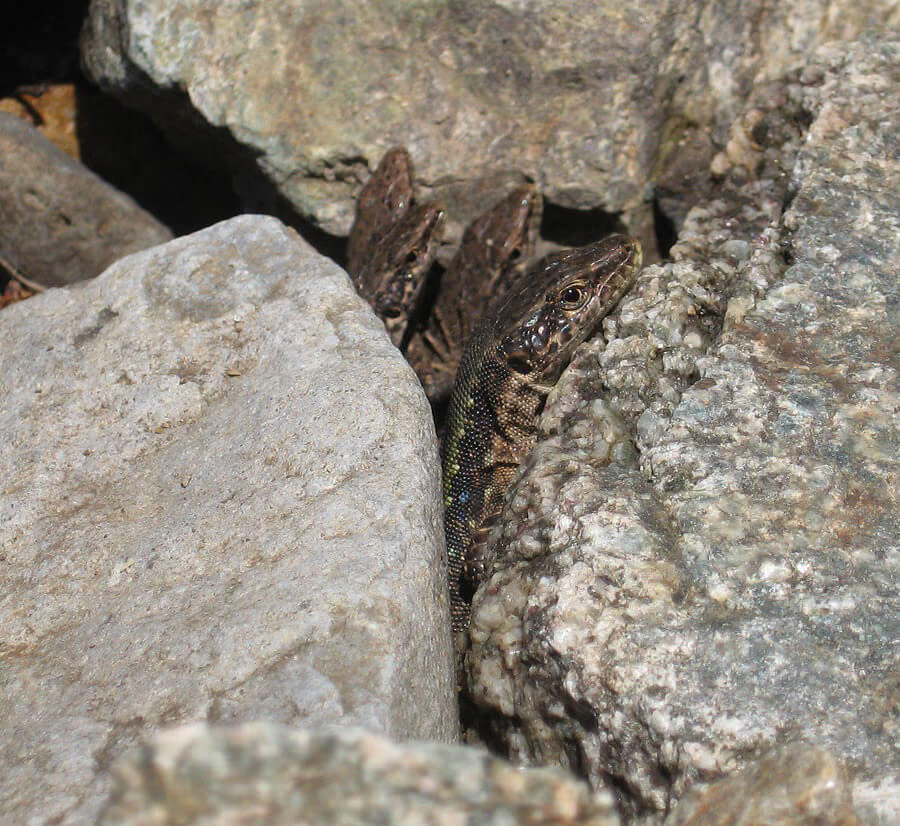

This is a relatively large lizard of the genus Darevskia, with well-developed legs. It lives on cliffs and rocks; it is not a large ground-dwelling Lacerta. Its back is often greenish-brown or bright green, while its belly is yellow or white. A stripe near its temple has dark rings with pale centers. This appearance is typical, but color alone cannot distinguish the species from one another.
The head and body often measure about 6–7 cm from the nose to the cloaca (the shared opening at the rear of the body). One female among the Armenian specimens measured 7.9 cm. Unusually for this genus, females are often larger than males. This page does not provide a complete set of measurements for Georgian specimens. Total length, including the tail, has not been measured here.
Female Armenian rock lizards (D. armeniaca) reproduce without males. One of its parent species is valentini; the other is D. mixta. Both occur at Lake Saghamo. D. armeniaca often has a duller green back than valentini and pale spots on its sides. Between the plate by the ear and the scale in the middle of the temple, it usually has one row of scales, while valentini has several. Color alone is not enough to tell them apart.
The Mtkvari lizard (D. portschinskii) is much smaller and is found only in the central Lesser Caucasus (for example, in Kojori). The Meskhetian rock lizard (D. obscura), from the rudis group, is listed as a possible candidate. All three have been reported to meet in a small area, where their genes mix extensively. They therefore cannot be identified there by color alone. Images in the study show the scales on the head and the plates in front of the anal opening (Saghamo Lake).
The 2026 list includes it as a confirmed species, rather than a possible one. Records of it come from Lake Saghamo and the Kirkhbulak River in Ninotsminda Municipality. This does not mean it occurs throughout Georgia. The Armenian rock lizard (D. armeniaca) also occurs at Lake Saghamo. It reproduces without males. Colour alone is not enough to tell the two lizards apart.
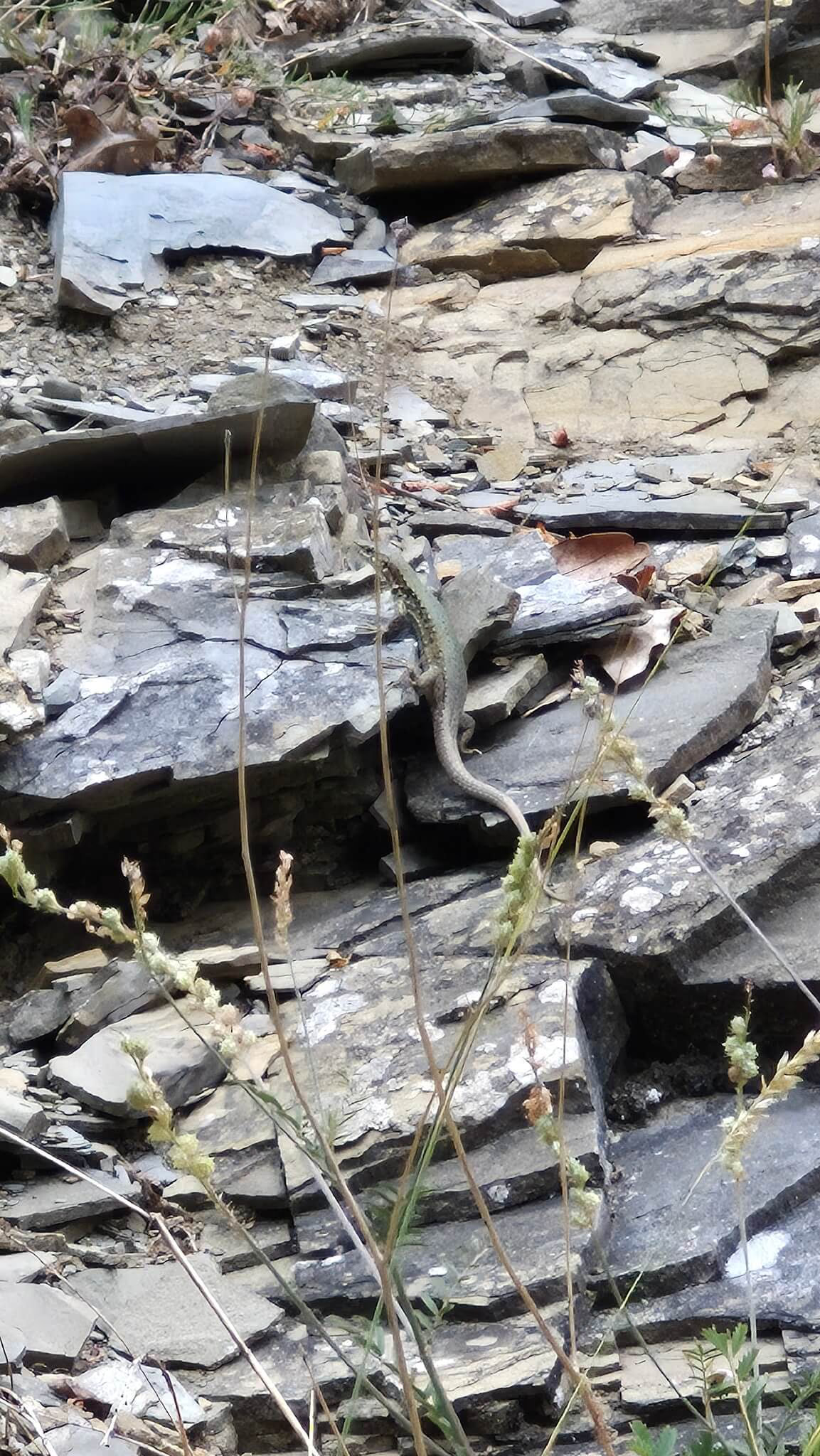
It occurs in Georgia, but its presence should not be assumed in the wet Colchic forests of western Georgia or in the eastern lowlands. A lizard pictured in a 2026 study is from Lake Saghamo in Ninotsminda Municipality; DNA analysis data come from Lake Saghamo and the Kirkhbulak River. Confidence in the distribution data is moderate. The Armenian rock lizard (Darevskia armeniaca), which reproduces without males, has also been recorded at Lake Saghamo. It is a different species, and valentini is one of its parent species. At Lake Saghamo, these lizards have been recorded at about 2,015 metres. In the Lesser Caucasus, the species has often been recorded at 1,900–3,110 metres; IUCN gives a range of 1,300–3,000 metres, including records from Turkey. These do not establish its full elevation limits in Georgia. This page does not give the exact elevation of the location of the DNA data from the Kirkhbulak River. The species lives in high mountain meadows and steppes with rocky hills and cliffs. It also occurs by cliffs beside roads or rivers and along lake shores, but not in barren desert or wet Colchic forest. It may be seen on rocks, where it warms itself and takes shelter. One prediction of its range includes several separate areas of high mountain meadow and steppe, including in southern Georgia. This is a prediction, not another named location where it has been found in Georgia. At present, this atlas’s map shows no other administrative region of Georgia; that does not mean every suitable mountain has been surveyed.
Biology
Diet, behavior, and conservation
Diet
This page does not include results from a study of its stomach contents in Georgia. In the mountains of Armenia, it eats mainly beetles and flies, and rarely other insects, spiders or parts of plants. These findings concern the mountains of Armenia and do not show what it eats in every part of Georgia.
Behavior
It is active during the day. It lives on rocks, warming itself on stone and hiding in crevices when threatened. In Armenia, it emerges after winter between late April and mid-May. It mates soon afterward and lays eggs in the second half of June. It has also been seen there through the end of September. These dates apply to Armenia and may differ in Georgia. In Georgia, a lizard specimen was collected near Lake Saghamo in May–June. There, it laid 2–6 eggs at a time; in Armenia, the average was about six, with up to 12. In both places, it lays eggs only once per season. If caught, it may lose its tail or bite. Watch it, but do not pick it up — leave it where it is.
Conservation
In 2009, the IUCN assessed it as being at low risk because it is widespread and its population is probably large. That assessment is old. It is not listed in Georgia’s 2014 Red List (Resolution No. 190). Tarkhnishvili and coauthors (2026) consider its presence confirmed. Gene exchange with obscura and portschinskii has been reported in a narrow area where they meet. This complicates the boundaries between the species; it is not a threat category. It has not been established here whether its numbers in Georgia are rising or falling. It is not listed under CITES. Do not catch wild lizards.
Questions
Frequently asked questions
Short answers to the most important questions about Valentin's Lizard.
Yes. The 2026 list confirms this with biological data. The figure is associated with Saghamo Lake in Ninotsminda, and the barcodes with Saghamo Lake and the Kirkhbulaki River.
In the highlands of Samtskhe-Javakheti, records from the Ninotsminda area come from around Saghamo Lake and Kirkhbulaki. It has been recorded in rocky meadows, on cliffs and along lake shores. This does not mean it occurs throughout Georgia.
This is a relatively large rock lizard. Color alone is not enough to identify it. Compare it with armeniaca, which occurs at the same lake and reproduces without males, as well as the smaller portschinskii and obscura. The rows of scales near the ear and where the lizard occurs are more reliable clues than the color of its back.
No. It has no venom. If you catch it, it may bite you; its tail may also break off. Leave it where it is.
The head and body are often about 6–7 cm long. In measurements from Armenia, one female reached 7.9 cm. This page does not include the full set of measurements from Georgia.
No. The list says it has been biologically confirmed. obscura is a possible member of this group; valentini is not.
armeniaca reproduces without males (its parent species is valentini). It is also found at Lake Saghamo. Between the plate near the ear and the scale at the temple, armeniaca usually has one row of scales, while valentini has several. Colour alone cannot reliably distinguish them.
It is active during the day. This page does not give a complete account of when it occurs in Georgia during the year. In Armenia, it has been recorded from spring through autumn. A specimen from Lake Saghamo in Georgia was recorded in May–June.
References
Sources
References
Sources
- Tarkhnishvili et al. 2026 — Annotated checklist of Georgia's amphibians and reptiles
- Barateli et al. 2022 — Reproductive effort of unisexual and bisexual Darevskia
- Galoyan et al. 2019 — Natural history of Valentin’s rock lizard in Armenia
- Arribas et al. 2022 — Taxonomy of Darevskia valentini and D. rudis
- Tok et al. 2009 — IUCN Red List, Darevskia valentini
- Petrosyan et al. 2019 — Ecological modelling of D. armeniaca and parental species
- საქართველოს მთავრობის დადგენილება №190 (2014) — წითელი ნუსხა
- Darevsky 1967 — Rock lizards of the Caucasus
- The Reptile Database — Darevskia valentini
Species profiles are compiled from peer-reviewed literature and established biodiversity databases, and are reviewed as new taxonomic and conservation data become available.
Related guides
Continue with related pages

Darevskia adjarica
Ajarian Rock Lizard
Adjara (Shuakhevi) and Abastumani

Darevskia derjugini
Derjugin's Lizard
Lagodekhi, Sioni, Mulakhi, Racha, Baniskhevi, Kintrishi

Darevskia mixta
Mixed Rock Lizard
Western Georgia (not Adjara) — Sairme, Tchkhorotskhu, Baniskhevi

Darevskia raddei
Radde's Lizard
Upper Mtkvari near the Turkish border — Aspindza (Pia), Tmogvi