


The Kura lizard (Darevskia portschinskii) is a rock lizard found in the central part of the Lesser Caucasus in Georgia. It belongs to the family Lacertidae. It has no venom and is not dangerous to people. In English, it is called the Kura lizard or Portschinsky's lizard. A 2026 Georgian list includes it as a confirmed species, not a candidate. Both males and females are found in the wild. This sets it apart from the Dahli lizard (D. dahli), which reproduces without males. The Kura lizard is one of the Dahli lizard's parent species. In adult specimens from Georgia, body length from the head to the base of the tail is usually about 5.4–5.8 cm. Tbilisi, not Armenia, is listed as the location of the specimen used to describe the species (Kessler, 1878). This does not mean the species is found throughout Georgia: Kojori is named in recent records, and in the Tana Valley there is an area where it interbreeds with obscura. The species is found only in the central part of the Lesser Caucasus, including parts of Armenia and Azerbaijan. Its risk of extinction is low (Least Concern). It is not included in Georgia's 2014 Red List.
Identification
How to identify Portschinsky's Lizard
It is a small rock lizard that lives in the forest on Trialeti Mountain. The color of its back alone is not enough to identify it. To tell Darevskia species apart in the wild, its size, where it is found, its sex and the features of its scales matter.
Often confused with


It has a small, flattened body and well-developed legs. It lives on rocks and stones; it is neither a large ground-dwelling Lacerta lizard nor an agama (Paralaudakia). In specimens found in Georgia, head-and-body length is usually about 5.4–5.8 cm; the maximum reported in published sources is about 67 mm. Its size helps distinguish it from obscura and valentini, which are considerably larger. Its tail is longer than its body and breaks off easily. Do not pick up the lizard to count its scales.
Its back is gray, brownish or olive-colored, often with dark spots. Its belly may be yellowish. Descriptions say that the nigrita subspecies has a darker back. Other rock lizards have similar colors, so color alone cannot distinguish this species.
Dahl’s lizard (D. dahli) is often found on the same rock. The two lizards found in Georgia are also similar in size. portschinskii has both males and females, while dahli consists almost entirely of females. They can be reliably told apart by the scales on their heads and features around the anus, but not by color. DNA identification records exist for both in Kojori — they are different species.
The Meskhetian rock lizard (D. obscura) is listed as a possible species in the rudis group and is substantially larger. In the Tana Valley, lizards of different species interbreed, so where they meet, do not identify them by color alone. Valentin’s lizard (D. valentini) lives in the highlands of Javakheti (for example, near Saghamo Lake) and is also larger. The Colchian rock lizard (D. mixta) is found only in western Georgia. It is the second parent species of dahli and is rarely found in the same places as the Kura lizard.
The 2026 list recognizes it as a confirmed species, rather than merely a possible one. It has both males and females. This distinguishes it from the Dahl’s lizard (D. dahli), which reproduces without fertilization. Tbilisi is given as the location of the specimen used to describe the species. Kojоri is named in recent records. This does not mean the species is found throughout Georgia. It occurs only in the central Lesser Caucasus, including parts of Armenia and Azerbaijan. It is therefore not found only in Georgia.

Gallery
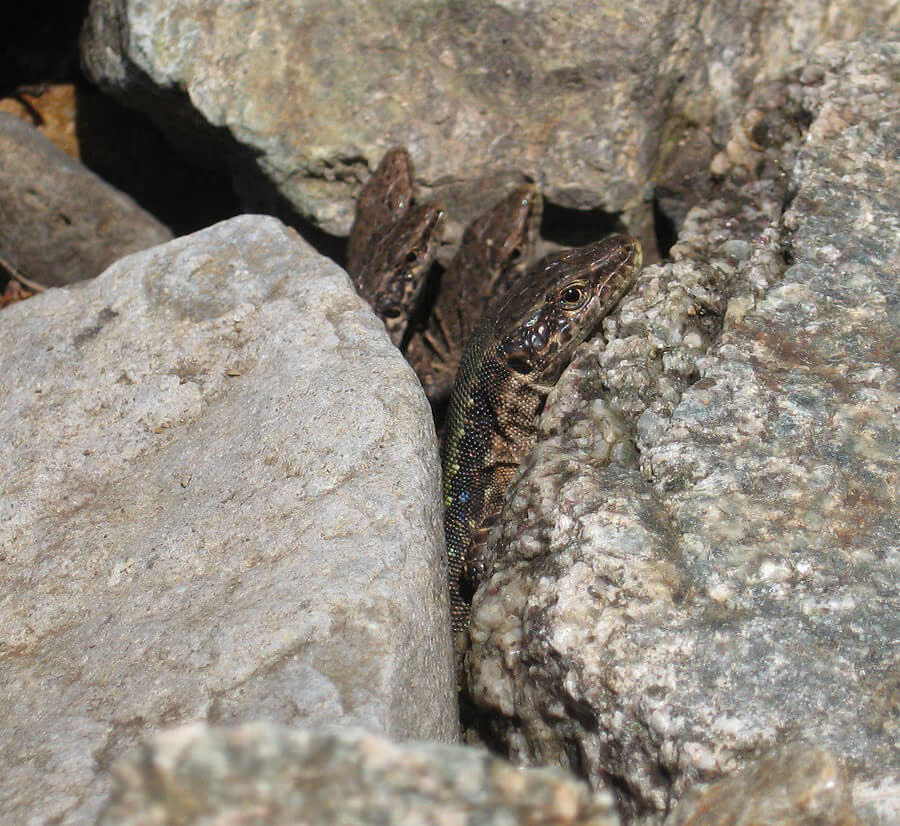
Portschinsky's Lizard in photos
It occurs in Georgia. Do not assume it occurs in the damp forests of western Georgia, Colchis, Adjara, or the high mountains of Javakheti. A 2026 list names the central Lesser Caucasus, but the information about its range is considered moderately reliable. There is also a genetic record from a specimen collected in Kojori. Near Tbilisi, it has been recorded alongside Dahl’s lizard at one rocky site (about 1 ha, 1003–1042 m above sea level) since the 1960s. Dahl’s lizard (dahli) was about five times more numerous there. In a 2008–2009 survey, the two lizards were found together at 28 of the 82 sites where Dahl’s lizard occurred, mostly in Trialeti’s mountain forest. Sites where they occur together are often about 800–1200 m above sea level, but these are not the full elevation limits of its range in Georgia. IUCN gives 300–1700 m for the species; this range also includes Armenia and Azerbaijan. It occurs in rocky parts of mountain forests, on riverside cliffs, and on dry slopes with shrubs — not in the damp forests of Colchis or bare desert. On the same rock, Dahl’s lizard stays closer to water, while the Kura lizard is more evenly spread out and is more common even in places less suitable for it. Bakradze described the subspecies D. p. nigrita in 1976 from the area around Dmanisi (Kvemo Kartli). It has a darker back and occurs in southeastern Georgia and northern Armenia. An IUCN assessment from 2009 names Gori as the western edge of its range and mentions a population isolated from other groups along the middle reaches of the Iori River. That assessment is old and has not been independently checked for this page. The atlas map shows records by region. It does not mean the species is equally common throughout each marked region.
Biology
Diet, behavior, and conservation
Diet
In Georgia, no separate study has examined what food has been found in the stomachs of this species. Its exact diet there has not been established either. Rock lizards usually catch small animals without backbones, including insects, spider-like animals and other animals with jointed legs. According to a 2010 study, this species competes with Dahl’s lizard for food and shelter. The same study does not report any substantial difference between their diets.
Behavior
It is active during the day. This rock lizard warms itself on stones and shelters in crevices. In one area near Tbilisi, it was observed from April to October, during its active periods in spring and autumn. Those observations do not tell us what hours of the day it is active across Georgia. It lays eggs, usually once a season. Earlier accounts give 2–5 eggs at a time; lizards studied in Kojori had 1–3. The Dahli lizard has no males. At the same time, accounts describe a male of this species sometimes biting a lizard that reproduces without fertilization during mating. This does not produce a group that reproduces through mating between males and females. If caught, it may lose its tail or bite. Observe it and leave it where it is. Do not pick it up.
Conservation
In 2009, the IUCN assessed the Mtkvari lizard as Least Concern because it has a wide range. The same assessment says its numbers are declining. The assessment is old. The report mistakenly says that the Mtkvari lizard reproduces without males; that applies to the Dali lizard. The Mtkvari lizard is not on Georgia’s 2014 Red List; the Dali lizard is listed there as Vulnerable (VU). Tarkhnishvili and coauthors (2026) consider the Mtkvari lizard biologically confirmed. Gene transfer between it and obscura and valentini has been described in a small area where they meet. This makes it harder to distinguish the species; it is not a threat category. Changes in its numbers in Georgia have not been measured here. The Mtkvari lizard is not listed under CITES. Do not catch wild lizards.
Questions
Frequently asked questions
Short answers to the most important questions about Portschinsky's Lizard.
Yes. Its presence is confirmed in the 2026 list. Tbilisi is given as the location of the specimen used to describe the species, while more recent records name Kojori. It is not found throughout the country.
It has been recorded in a rocky part of a mountain forest, specifically around Trialeti, at about 800–1,200 m above sea level. It has also been recorded there alongside the Dali lizard. Kojori is a location named in recent records. In the Tana Valley, the areas where it and obscura occur meet. Do not look for it in Abkhazia, Adjara, or the Colchian lowland.
No. It has no venom and poses no risk to health. Do not pick it up: its tail breaks off easily.
It is a small rock lizard, with both males and females. Colour alone is not enough to identify it. Almost all Dali’s lizards on the same rock are female. obscura and valentini are considerably larger and occur in other areas, except around Tana, where their ranges meet.
Adult specimens from Georgia usually have a body length of about 5.4–5.8 cm. Published records give a maximum body length of about 67 mm. They are longer when the tail is included, but the tail breaks off easily, so total length can vary.
Its diet has not been studied separately in Georgian. Rock lizards mainly catch small animals without backbones. It is not venomous.
It is active during the day. In a study near Tbilisi, it was observed from April to October. It lays eggs: 1–3 were recorded in Kojori, while classic works give a range of 2–5. It usually lays eggs once per season.
You cannot tell it apart by color. dahli reproduces without males and is often found on the same rock. obscura and valentini are larger. In the Tana Valley, there is an area where it interbreeds with obscura. No, it is not a candidate for recognition as a separate species.
References
Sources
References
Sources
- Tarkhnishvili et al. 2026 — Annotated checklist of Georgia's amphibians and reptiles
- Tarkhnishvili et al. 2010 — Unisexual rock lizard and its progenitors in Georgia
- Barateli et al. 2021 — habitat occupancy of D. portschinskii and D. dahli near Tbilisi
- Barateli et al. 2022 — Reproductive effort of unisexual and bisexual Darevskia
- Tarkhnishvili et al. 2013 — hybrid zone with D. obscura in the Tana valley, cited in Tarkhnishvili et al. 2026
- Murphy et al. 2000 — phylogenetic constraints on parthenogenesis in lacertids
- Bakradze 1976 — Lacerta portschinskii nigrita
- Darevsky 1967 — Rock lizards of the Caucasus
- Tuniyev et al. 2009 — IUCN Red List, Darevskia portschinskii
- საქართველოს მთავრობის დადგენილება №190 (2014) — წითელი ნუსხა
- The Reptile Database — Darevskia portschinskii
Species profiles are compiled from peer-reviewed literature and established biodiversity databases, and are reviewed as new taxonomic and conservation data become available.
Related guides
Continue with related pages

Darevskia praticola
Meadow Lizard
Eastern and central Georgia — Sioni, Tushurebi

Darevskia adjarica
Ajarian Rock Lizard
Adjara (Shuakhevi) and Abastumani

Darevskia alpina
Alpine Rock Lizard
Western Greater Caucasus — literature; no named locality in the checklist
Darevskia armeniaca
Armenian Rock Lizard
Southern Georgia — Ninotsminda (Saghamo), Akhalkalaki