


The Abkhazian rock lizard (Darevskia alpina) is a non-venomous rock lizard of the high mountains of the western Caucasus. It is listed as a candidate in Georgia’s 2026 checklist. Darevsky first described it in 1967 as a subspecies of the Caucasian lizard. The place named in the original description is Terskol, in Kabardino-Balkaria, Russia, at about 2,200 metres above sea level — not in Georgia. Its Georgian name refers to Abkhazia, while the English name alpine rock lizard and the Russian name “alpine lizard” refer to altitude. The species remains on the list in the 2026 report, but the report gives only brief information about it. It may have arisen from interbreeding between the “caucasica” and “saxicola” groups. The report provides no list of records from Georgia, no DNA data for identifying the species, and no specifically named location. For that reason, this atlas does not shade its map. Other international publications mention the species in the western Caucasus, including Abkhazia and western Georgia, but those reports of its presence do not come from the 2026 report. It has no venom and is not dangerous to people.
Identification
How to identify Alpine Rock Lizard
It is a small rock lizard of the genus Darevskia. Colour alone cannot distinguish the species from one another. Identifying it in the wild requires examining its scales, knowing where it occurs and often using genetic analysis. The 2026 list gives no separate distinguishing feature for this lizard.
Often confused with


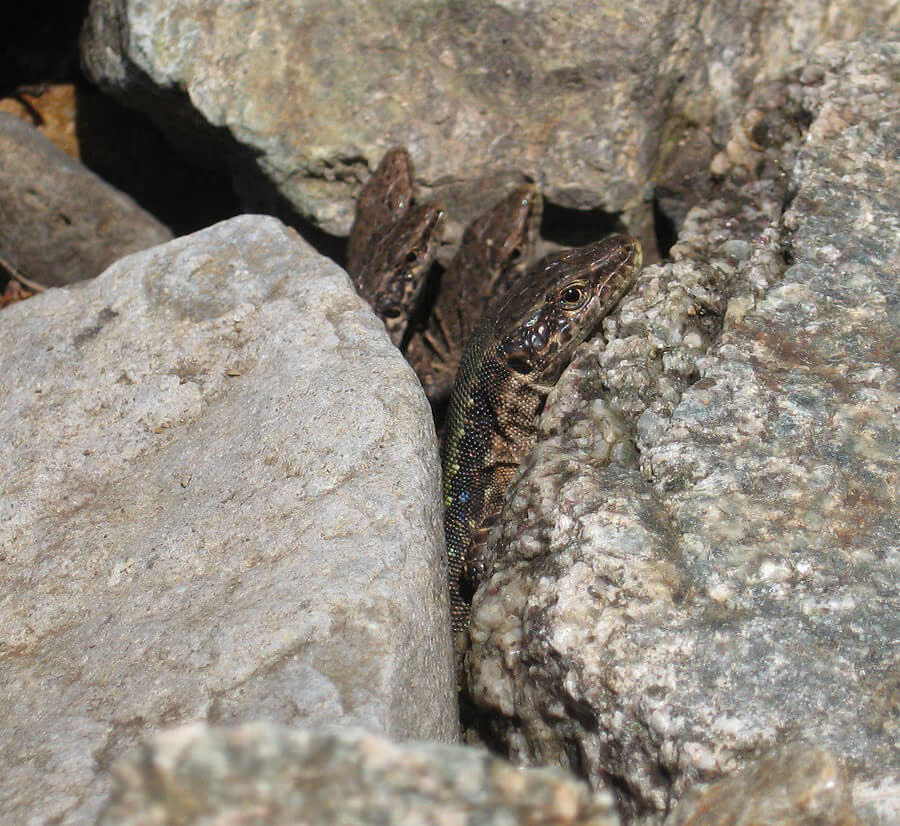
Its body and head have the typical shape of a rock lizard: a flattened body, a long tail and clearly visible legs. This page does not give measurements of lizards from Georgia. Do not identify the species by its colour in a photo alone.
In appearance, it falls between Brauner’s rock lizard (D. brauneri, part of the saxicola group) and the Caucasian lizard (D. caucasica). The other species in the saxicola group also have almost no obvious physical features that make them easy to tell apart.
The Caucasian rock lizard (D. caucasica) is confirmed on the list. The places named for it in Georgia are Truso (Zakagori), Tbatana and Lebarde. Brauner’s rock lizard is listed only as a possibility; the places named for it are Mestia (Manshura), Martvili and Ertso Lake. The two rock lizards may look similar in color.
The Dagestani rock lizard (D. daghestanica) belongs to the caucasica group. Their ranges are continuous along the upper Terek River. The Adjarian rock lizard (D. adjarica) is listed in southwestern Georgia, a different geographic area. Color cannot distinguish these pairs either.
It is not venomous. It poses almost no risk to people if they do not catch it. Watch it in the wild, but do not pick it up.

This species is a high-mountain rock lizard. It occurs in the western part of the Greater Caucasus, west of the Baksan Valley, at roughly 1,650 m and above. Its range is limited to the Western Caucasus: the mountainous parts of Russia, Abkhazia and western Georgia. This describes the species’ overall range, not the regional map in this atlas. The 2026 list gives no specific Georgian municipality, elevation range or genetic barcode. In a 2013 paper, Doronin linked specimens from 1912 to Upper Bachiani / Upper Ksani, at about 2,296 m. This site is separate from the species’ known western range, so it is not shown on the map here. Suitable habitat alone cannot tell us which administrative region of Georgia the species occurs in.
Biology
Diet, behavior, and conservation
Diet
Rock lizards of the genus Darevskia usually catch small animals without backbones, such as insects and spiders. They hunt on rocks, among fallen stones and along the edges of meadows. This page does not include a study from Georgia of this species’ stomachs or droppings.
Behavior
It is active during the day. In warm weather, it can be seen on rocks and in high mountain areas below alpine meadows. It lays eggs. This page does not provide separate information on when it is active in Georgia during the year, where it shelters in winter, or when it lays eggs. It is likely active for only a short part of the year at high elevations, but this has not been measured in Georgia. Do not take a lizard from the wild.
Conservation
In the 2026 list by Tarkhnishvili and coauthors, it is listed as a candidate for recognition as a separate species. It may have arisen through interbreeding between other species, so more evidence is needed to recognize it as a separate species. In 2009, it was assessed as Vulnerable (VU) on the IUCN Red List. Tuniyev’s 2024 assessment gives it the same category. Of the Darevskia species, Georgia’s 2014 Red List includes D. clarkorum, D. dahli and D. mixta, but not D. alpina. This page does not show what status the species has under CITES. A 2013 assessment says that its habitats in the Caucasus are deteriorating because of human activity and climate change. That assessment covers the Caucasus as a whole; it does not establish a separate trend for Georgia. Its numbers in Georgia have not been measured for this atlas.
Questions
Frequently asked questions
Short answers to the most important questions about Alpine Rock Lizard.
The species remains a candidate in the 2026 Georgian list. The account gives no specific location in Georgia, DNA data for identifying the species, or list of records. Tuniyev 2024 and The Reptile Database include Abkhazia and western Georgia / the northwestern Caucasus in its range. This is the range given in those sources, not the shaded map in this atlas.
The high mountain cliffs and meadows of the western Greater Caucasus are plausible places to find it. This species is often found above about 1,650 metres above sea level. The list does not name a specific village. Its Georgian name points to Abkhazia, but a 2026 note does not confirm its presence there.
Color alone is not enough to tell them apart. To distinguish Darevskia species in the wild, people look at their scales and where they are found. In appearance, this species falls between D. brauneri and D. caucasica. One photo is not enough to identify it.
No. It is not venomous and is not dangerous to people. It may bite if you catch it. Do not pick it up.
This page does not include measurements of this species from Georgia. It is a small rock lizard in the genus Darevskia. Its size is not the basis for the species’ name.
Animals in this genus catch small animals without backbones. At high elevations, this species is active during the day in the warm season. Its food in Georgia and the time of year when it is active have not been studied here. It lays eggs.
The list considers it a candidate. The report suggests it may have arisen through mixing between the caucasica and saxicola groups, but does not confirm that it is separate. One type of DNA (mtDNA) often places it in the saxicola group, while its physical features have also been linked to caucasica.
IUCN assessed the species as Vulnerable worldwide in 2009. It is not on Georgia’s 2014 Red List, though it is considered a candidate for inclusion. Do not take in a wild animal.
References
Sources
References
Sources
- Tarkhnishvili et al. 2026 — Annotated checklist of Georgia's amphibians and reptiles
- Iankoshvili & Tarkhnishvili 2021 — Georgian herpetofauna records cited in Tarkhnishvili et al. 2026
- Tarkhnishvili et al. 2016 — Mitochondrial phylogeny of the Darevskia saxicola complex
- Murphy et al. 2000 — Phylogenetic constraints on parthenogenesis in lacertid lizards
- Tarkhnishvili 2012 — Evolutionary history, habitats, diversification, and speciation in Caucasian rock lizards
- Darevsky 1967 — Rock lizards of the Caucasus
- Tuniyev 2024 — High herpetological diversity in the Caucasian Ecoregion
- Doronin 2013 — New records of Darevskia in the Caucasus
- Doronin et al. 2021 — Phylogeography of the Darevskia (caucasica) complex
- Tuniyev et al. 2009 — IUCN Red List, Darevskia alpina
- The Reptile Database — Darevskia alpina
- საქართველოს მთავრობის დადგენილება №190 (2014) — წითელი ნუსხა
Species profiles are compiled from peer-reviewed literature and established biodiversity databases, and are reviewed as new taxonomic and conservation data become available.
Related guides
Continue with related pages

Darevskia adjarica
Ajarian Rock Lizard
Adjara (Shuakhevi) and Abastumani
Darevskia armeniaca
Armenian Rock Lizard
Southern Georgia — Ninotsminda (Saghamo), Akhalkalaki

Darevskia clarkorum
Clark's Rock Lizard
Adjara — Charnali Gorge (Khelvachauri)

Darevskia daghestanica
Daghestanian Rock Lizard
Tusheti; Akhmeta (Tbatana)