


Lizards
Uzzell’s lizard confirmed in Armenia for the first time
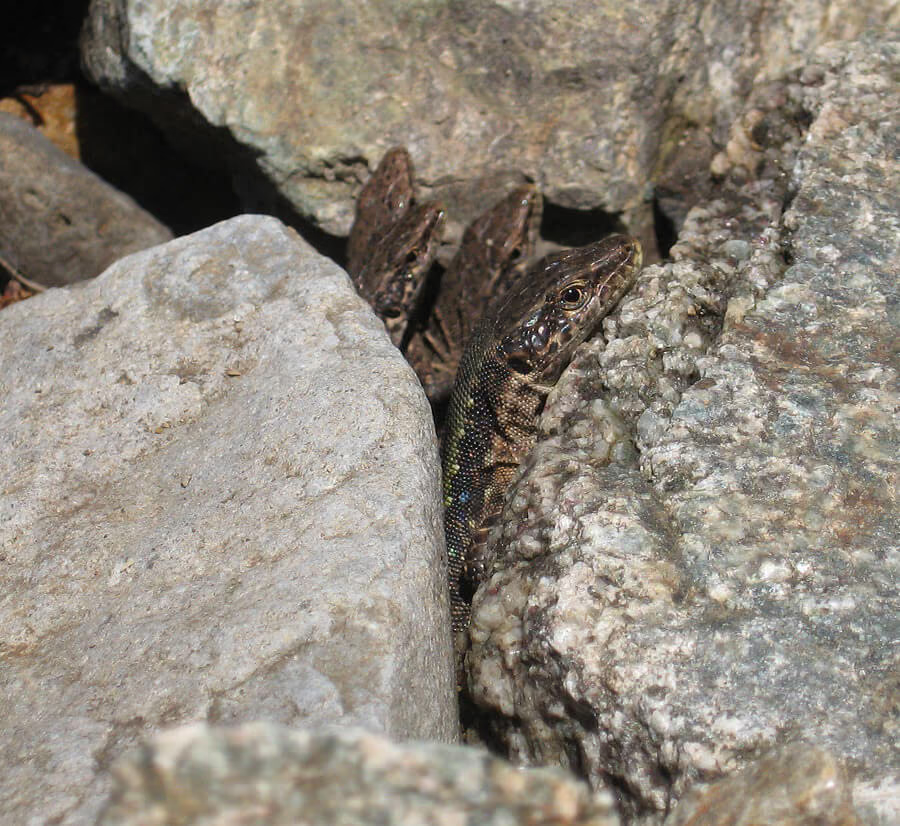
Four parthenogenetic Darevskia uzzelli at one site — a species not confirmed in Georgia at this stage.
Read the article
Darevskia dahli is a nonvenomous rock lizard found in Georgia, mainly in the wooded and rocky areas of the Trialeti Mountains. It is not dangerous to people. Females reproduce without males and lay eggs. It resembles other rock lizards, so it cannot be identified by color alone.
Identification
It is a small rock lizard. You cannot tell it apart from other Darevskia species by the color of its back. To identify it, where you saw it and what the scales on its head and in front of its anus look like both matter. Do not pick it up to check its scales.
Often confused with
It has a small, slender body, a flattened head and well-developed legs. Adult lizards found in Georgia usually have a body length of about 5.4–5.8 cm. The greatest recorded body length is about 63 mm. The tail is longer than the body and breaks off easily. Do not pick up the lizard to count its scales.
The back is gray, brownish or olive-colored, often with dark spots or a netlike pattern. The belly may be yellowish. Other rock lizards have similar coloring, so color alone is not enough to identify the species. Photos taken in Kojori in 2026 show the scales on the head and the plates in front of the anus.
Dali’s lizard has two plates in front of the anus, while D. armeniaca has one broad plate. D. armeniaca is larger (its body length reaches about 74 mm) and also occurs in southern Georgia (Ninotsminda / Saghamo, Akhalkalaki). Do not pick up the animal to check this feature.
D. portschinskii is often found on the same rock as dahli. The two lizards found in Georgia are similar in size. D. portschinskii has both males and females, while almost all dahli lizards are female. To tell them apart reliably, people look at the scales on their heads and features around the rear opening; color alone is not enough.

In Georgia, the lizard called დალის ხვლიკი is found in rocky places, including mountain forests, meadows and areas above the upper edge of the forest. During a survey in 2008–2009, it was found at elevations of 830–1960 m above sea level, mainly in the Trialeti Mountains. In some places, it lives alongside another lizard, მტკვრის ხვლიკი. At one rocky site near Tbilisi, დალის ხვლიკი was found closer to a permanent water source than მტკვრის ხვლიკი.
Distribution
81 field records2008–20264 regions with records
Interactive map is loading.
| regions with records | field records | |
|---|---|---|
| Distribution confirmed | ||
| Confirmed distribution region | 59 | |
| Confirmed distribution region | 12 | |
| Confirmed distribution region | 9 | |
| Recorded only | ||
| 1 | ||
The Dahl's rock lizard map combines precise localities with public iNaturalist photo observations in Georgia. Those public coordinates are obscured by about 28 km, so a point near a regional border does not confirm that region. Precise localities count toward confirmed status. Regions come from the records-by-region table: only confirmed status counts as distribution; otherwise a region is not treated as part of the range. Record counts reflect observation effort, not population density.
Data: Reptiles.ge + iNaturalist · Methodology
Biology
Rock lizards usually catch insects, spiders and other small animals without backbones. The species დალის ხვლიკი competes with მტკვრის ხვლიკი for food and shelter.
It is active during the day: it basks on rocks and hides in crevices. The lizard called დალის ხვლიკი in Georgian arose from a cross between D. mixta and D. portschinskii. Females now reproduce without males and lay eggs. Females collected in Georgia laid 1–4 eggs at a time in captivity.
Questions
Short answers to the most important questions about Dahl's Rock Lizard.
In Georgia, this species is found in the Trialeti Highlands and other rocky areas, including Kojori.
In Georgia, it is found in rocky areas, mountain forests and above them. Confirmed locations include Trialeti, Kojori, Tedzami, Ateni and Zedazeni. During a 2008–2009 study, it was found at elevations of 830–1960 m.
No. It has no venom and is not dangerous to people. Do not pick it up: its tail breaks off easily.
You cannot identify it by colour alone. This lizard has two plates in front of its anus; the Armenian rock lizard has one broad plate there. Do not pick it up to examine its scales.
Adults studied in Georgia have a body length of about 5.4–5.8 cm, excluding the tail. The greatest documented length, also excluding the tail, is 63 mm.
Rock lizards usually catch insects, spiders and other small animals without backbones.
It is active during the day. Females lay eggs without males; females collected in Georgia laid 1–4 eggs at a time in captivity.
Observe it from a distance and, if you can, photograph its head and side. Do not pick it up; leave it where it is. You cannot identify the species by colour alone.
References
Species profiles are compiled from peer-reviewed literature and established biodiversity databases, and are reviewed as new taxonomic and conservation data become available.
Related guides