European yellow sac spider
Cheiracanthium punctorium
Overview
European yellow sac spider in Georgia
Cheiracanthium punctorium is a spider in the family Cheiracanthiidae. A reliable, established Georgian common name is not confirmed for this page, so the scientific name is used. In English it is often called the European yellow sac spider or yellow sac spider. The species is confirmed in Georgia. In the Caucasian Spiders database, records are known from Tbilisi, Betania, Chokhatauri, Sighnaghi, Baghdati, Bakuriani, south of Kutaisi, Poti, and other places. This points to broad occurrence within Georgia, but it does not mean that the species is found evenly in every region. Female body length is about 10–15 mm; male body length is about 7.5–12 mm, excluding the legs. The spider is usually pale yellowish green or yellowish brown; the prosoma may be orange or reddish, and the chelicerae have dark tips. Bites are uncommon, but they can be painful and may cause local redness or swelling. According to modern European data, necrosis is not considered a typical outcome.
Last updated
Gallery
European yellow sac spider in photos
Photo: Armen Seropian
Tbilisi ·
Georgia field photo
Photo: Adam Golenia
Photo: Dominic Pfab
Photo: zsiciarz
Photo: Leda Vanzetta
Identification
How to identify European yellow sac spider
A medium-sized, pale yellowish or yellow-green spider with long front legs and relatively large, dark-tipped chelicerae. It does not build a large round web and is often found in tall grass and shrubs.
Female body length is about 10–15 mm; male body length is about 7.5–12 mm. Legs are not included, so a live individual can look much larger than its actual body length.
The abdomen is usually pale yellowish green. The prosoma may be greenish brown, orange, or reddish. The chelicerae are relatively large and have dark tips.
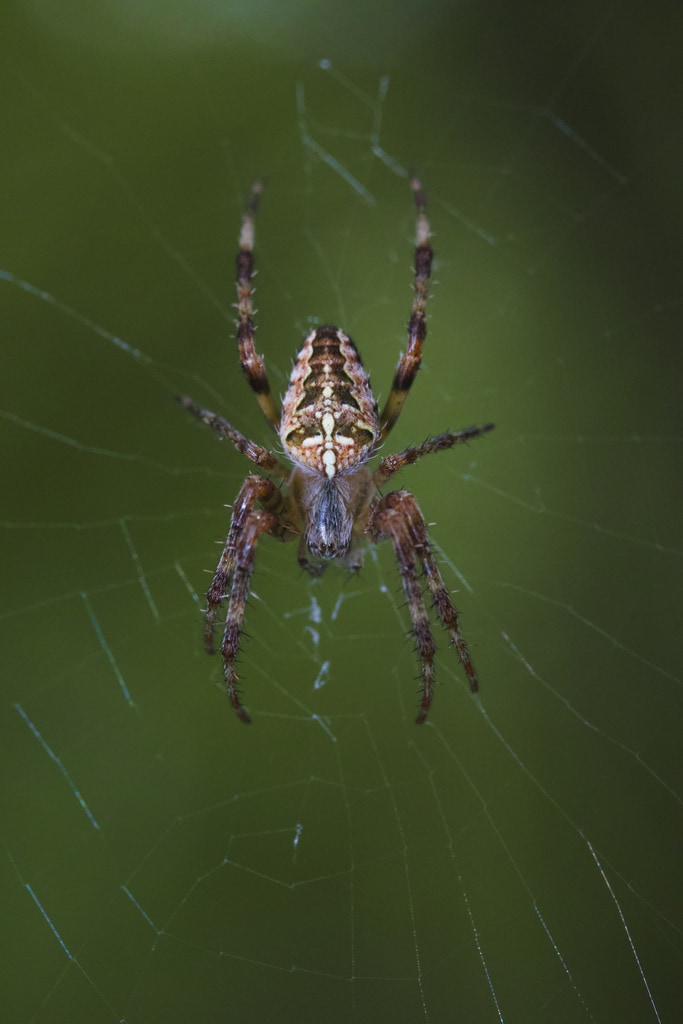
The front legs are long and conspicuous. The species lacks the bold yellow-and-black bands of the wasp spider and the white abdominal cross of the European garden spider.
Wasp spider and lobed argiope sit in large orb webs and have strong body patterns. Cheiracanthium punctorium is not a spider sitting in the centre of that kind of large round web.
Mediterranean black widow and false black widow are dark Theridiidae spiders with a more rounded abdomen. Cheiracanthium punctorium is paler, more elongated, and longer-legged, so it looks clearly different.
Biology
Habitat, diet, behavior, and conservation
Habitat and range
Cheiracanthium punctorium is mainly associated with warm and open habitats. European data place it in tall grass, shrub layer, dry and semi-dry meadows, and vegetation above the ground. It does not build a large orb web for catching prey. In Georgia, records are known from both the west and the eastern and southern parts of the country, including Poti, Chokhatauri, Baghdati, south of Kutaisi, Bakuriani, Sighnaghi, Tbilisi, and Betania. These data do not allow a full Georgian distribution or exact elevation range to be defined. The map should mark only regions where a specific confirmed Georgian locality exists.
Diet
Cheiracanthium punctorium is a predatory spider. It feeds mainly on insects and other small arthropods. It actively searches for prey and uses venom to subdue it. The diet of the Georgian population has not been studied separately in full. This description concerns the species' general biology, not the result of a special diet study carried out in Georgia.
Behavior
The species is more active at night. During the day it often hides in a silk retreat built in vegetation. Females may be more defensive while guarding eggs or young, especially if their silk retreat or egg sac is touched. Cheiracanthium punctorium does not seek out or attack people. Contact is usually accidental, for example when someone touches the spider by hand, disturbs it while cutting grass or shrubs, or finds it in clothing. European data indicate that adults are more noticeable in the warm season, but the sources used on this page do not establish a precise seasonal calendar for Georgia.
Conservation
The current accepted scientific name of the species is Cheiracanthium punctorium. Its range includes Europe, Turkey, the Caucasus, parts of Russia, Iran, and Central Asia. The species is not included in Georgia's 2014 Red List. The sources used here do not define a quantified population trend, specific threats, or special protection status for Georgia. There is no need to kill or catch the spider by hand. If it is found indoors and removal is necessary, act without direct contact.
Questions
Frequently asked questions
Short answers to the most important questions about European yellow sac spider.
Yes. Cheiracanthium punctorium is a confirmed species in Georgia. In the Caucasian Spiders database, records are known from Tbilisi, Betania, Chokhatauri, Sighnaghi, Baghdati, Bakuriani, Poti, and other Georgian localities.
In Georgia, records are known from Tbilisi, Betania, Chokhatauri, Sighnaghi, Baghdati, Bakuriani, Rokiti, south of Kutaisi, Poti, and east of Atsriskhevi. These places point to the species' occurrence and broad distribution in Georgia, but they do not mean that it is found evenly in every region.
A reliably established Georgian common name is not confirmed for this page, so the scientific name is used as the main name in Georgian too: Cheiracanthium punctorium.
A pale yellowish or greenish body, long front legs, relatively large dark-tipped chelicerae, and the fact that the spider is not sitting in a large round web can help with identification. Exact identification from these signs alone may not always be possible, so a good-quality photo or an expert check is more reliable.
Its bite can be painful and may cause local redness or swelling. Severe reactions are uncommon. Seek emergency medical care if pain is strong or increasing, swelling spreads quickly, or your general condition worsens.
According to modern verified European cases, necrosis is not considered a typical outcome of Cheiracanthium bites. Strong or unusual reactions still need medical assessment.
No. Do not touch or disturb the spider by hand. If it must be moved, use a cup and stiff paper or another safe no-touch method.
References
Sources
References
Sources
- World Spider Catalog — Cheiracanthium punctorium (Villers, 1789)
- Nentwig et al. 2026 — Spiders of Europe, Cheiracanthium punctorium
- Otto 2022 — Caucasian Spiders, Cheiracanthium punctorium
- ARAGES / European Society of Arachnology — Spider of the Year 2023
- Nentwig et al. 2013 — verified spider bites in Europe
- საქართველოს მთავრობის დადგენილება №190 (2014) — წითელი ნუსხა
Species profiles are compiled from peer-reviewed literature and established biodiversity databases, and are reviewed as new taxonomic and conservation data become available.
Related guides