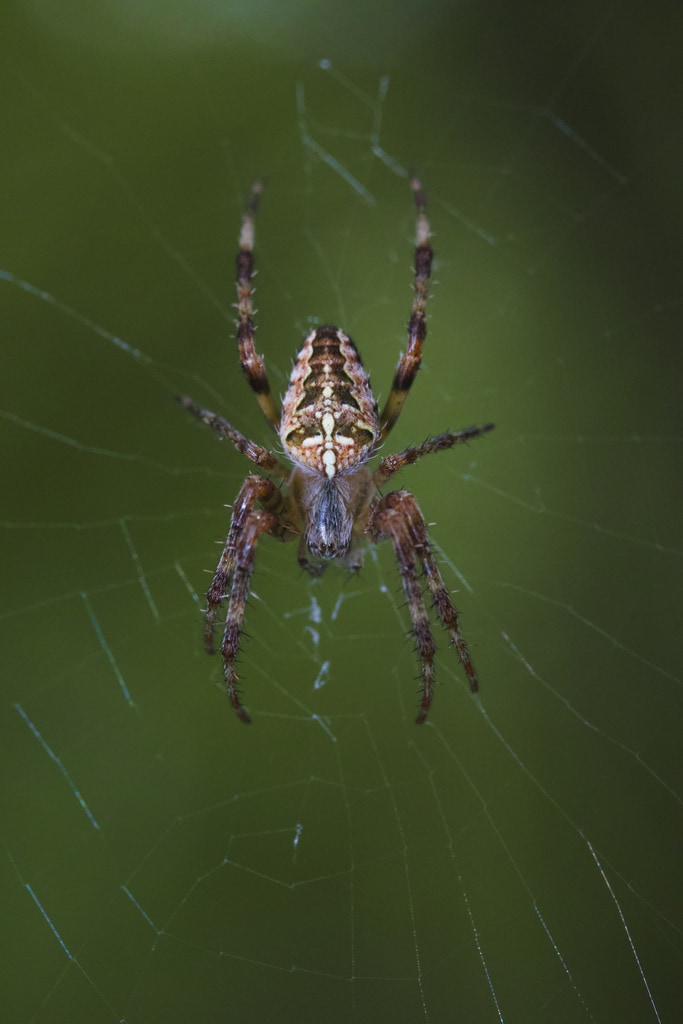
South Russian tarantula
Lycosa singoriensis
Overview
South Russian tarantula in Georgia
The South Russian tarantula or Songarian wolf spider (Lycosa singoriensis) is a wolf spider in the family Lycosidae. In Georgian, “tarantula” is often used more broadly, but on this page it means Lycosa singoriensis specifically, not tropical Theraphosidae spiders. The species is confirmed in Georgia. Sourced records are known from Kvemo Kartli and Kakheti, although this does not mean it is evenly distributed across every region of the country. At species level, female body length is about 18–31 mm and male body length is 14–27 mm. Legs are not included in that size.
Last updated
Identification
How to identify South Russian tarantula
A large, darkly patterned wolf spider with strong legs. It does not sit in a capture orb web and is often found on the ground or near a burrow entrance.
At species level, female body length is about 18–31 mm and male body length is 14–27 mm. Legs are not included in that size.
The body is hairy, the legs often have a ringed pattern, and the abdomen is dark and spotted. Wolf spiders also have a characteristic eye arrangement: the middle pair is relatively large and visible from the front.
The tarantula does not spin a capture orb web. If a large spider with bold yellow-and-black colouring is sitting at the center of an orb web, you are more likely seeing Argiope, not Lycosa singoriensis.
Biology
Habitat, diet, behavior, and conservation
Habitat and range
The tarantula is associated with dry, open habitats: steppe and semi-steppe grassland, dry plains, and soil where it can dig a burrow. In Georgia, the sourced confirmed regions are Kvemo Kartli and Kakheti. These records do not mean the species is distributed throughout the whole country.
Diet
The tarantula is an active predator and does not use an orb web to catch prey. It mainly hunts insects and other small invertebrates on the ground or near the burrow entrance. The diet of this species in Georgia has not been separately fully studied.
Behavior
Large Lycosa species often live in silk-lined soil burrows and hunt from the entrance. The female carries the egg sac on the rear of the body, and newly hatched spiderlings stay on the mother’s back for a while, a behavior typical of wolf spiders. A full seasonal activity calendar for the species in Georgia is not described separately.
Questions
Frequently asked questions
Short answers to the most important questions about South Russian tarantula.
Yes. Lycosa singoriensis is a confirmed species in Georgia. Sourced records are known from Kvemo Kartli and Kakheti.
No. On this page, “tarantula” means Lycosa singoriensis, a large wolf spider. It does not belong to the tropical Theraphosidae spiders that are also often called tarantulas in English.
At species level, female body length is about 18–31 mm and male body length is 14–27 mm. Legs are not included in that size.
A bite is usually not life-threatening, but it can cause local pain, redness, or swelling. Do not pick it up. If symptoms are strong or keep increasing, swelling is significant, or breathing becomes difficult, call 112.
The tarantula is mainly found in dry, open places where it can dig a burrow. In this atlas, the sourced confirmed regions are Kvemo Kartli and Kakheti.
Argiope sits in a large orb web and often has bold yellow-and-black colouring. Lycosa singoriensis is a ground-living wolf spider and does not build a capture orb web.
References
Sources
References
Sources
- World Spider Catalog — Lycosa singoriensis (Laxmann, 1770)
- Nentwig et al. 2026 — Spiders of Europe, Lycosa singoriensis
- Otto 2022 — Caucasian Spiders (database version 02.2022)
- Otto 2022 — Georgia country checklist
- Seropian, Bulbulashvili, Otto, Krammer, Kachlishvili & Datunashvili 2023 — CaBOL spiders of Georgia, Part II
- Georgian Biodiversity Database — Lycosa singoriensis
- Mcheidze 2014 — Georgian Spiders (Otto ed.)
- Wikimedia Commons — Lycosa singoriensis, Bulakhivskyi Lyman, Ukraine (Sergii Markov, CC BY-SA 4.0)
Species profiles are compiled from peer-reviewed literature and established biodiversity databases, and are reviewed as new taxonomic and conservation data become available.
Related guides