


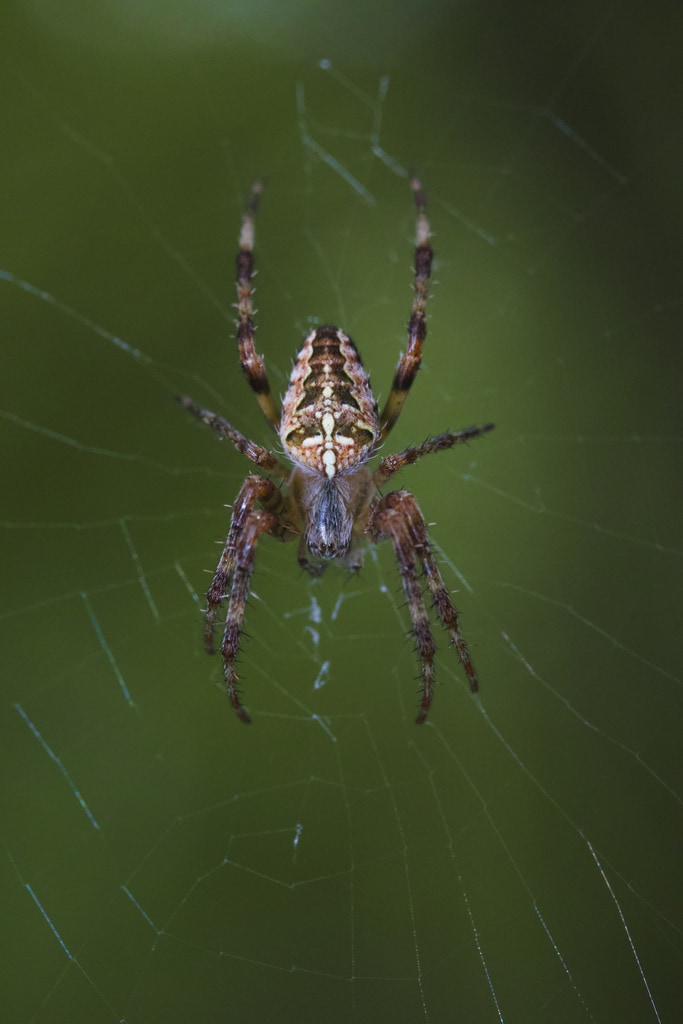


The diet of the lobed argiope in Georgia has not been fully studied separately. At species level, the female mainly catches flying and jumping insects in the orb web. Prey is first wrapped in silk and then bitten.


Zakro Songulashvili · Sète–Marseillan, Hérault, France
Risk to humans
HarmlessNo medical venom risk
No medically significant venom. Do not pick it up anyway — watch it and leave it where it is.
A silvery orb-weaver with a lobed abdomen. It is confirmed in Georgia and is not a medical risk to people.
Key facts in one look
- Size
- Female 17–26 mm
- Diet
- Insects in the web
- Status in Georgia
- Confirmed
- Habitat
- Warm grass / dry shrub
- Family
- Araneidae
- Human risk
- Harmless
The lobed argiope (Argiope lobata) is an orb-weaving spider in the family Araneidae. There is no widely established Georgian name; in this atlas the name "lobed argiope" is used descriptively for the lateral lobes of the abdomen. At species level, female body length is about 17–26 mm, and male body length is about 5–8 mm. Legs are not included in that size. This page does not have a separate measured series for Georgia. The species is confirmed in Georgia. It uses venom to subdue prey, but it is not medically significant for people. IUCN has not assessed its status, and it is not included in Georgia's 2014 Red List.
Identification
Lobed argiope: how to identify it
A large, conspicuous orb-weaving spider. The female has a silvery abdomen with distinct lateral lobes. The male is much smaller and its abdomen is not lobed.

At species level, female body length is about 16.8–25.5 mm, and male body length is 5.2–7.5 mm. Legs are not included in this size. This page does not have a separate measured series for Georgia.
The female's cephalothorax is shiny silver, and the abdomen is silver or grey. The abdomen has clearly visible lateral projections — lobes — which are one of the main identification marks of the species. The legs are yellowish-brown with black rings. The male is smaller and more uniform in colour, and it lacks lateral lobes on the abdomen.
The lobed argiope spins a large orb web, often in grass or on low shrubs. A white zigzag stripe — the stabilimentum — may sometimes be visible in the middle of the web. The adult female often sits in the centre of the web, head down.
In Georgia it is most likely to resemble the wasp spider (Argiope bruennichi). A. bruennichi has bold yellow-and-black transverse bands on the abdomen and no lateral lobes. Other garden orb-weavers have different patterns. Widow spiders (Latrodectus) are smaller, with a rounded abdomen and no lateral lobes.
The lobed argiope is associated with warm, relatively dry grassy and shrubby habitats. Confirmed Georgian records are known south of Lake Nadarbazevi, east of Gori, and at the entrance to Vashlovani National Park. These records do not mean the species is evenly distributed across the country.
The adult female often sits in the centre of the web by day, head down. A white zigzag stabilimentum may sometimes be visible in the middle of the web. Adult females are mainly conspicuous in the warm season. The named Georgian record on this page is from September, but a complete seasonal calendar for the country is not available.
IUCN has not assessed the lobed argiope. The species is not included in Georgia's 2014 Red List. Several records are known across the Caucasus, but that does not separately show the size or trend of the Georgian population.
Zakro Songulashvili · Ioane Rostiashvili · Aenea289 · Christian Ferrer
Questions
Frequently asked questions
Short answers to the most important questions about Lobed argiope.
Yes. The lobed argiope is a confirmed species in Georgia.
Confirmed Georgian records are known south of Lake Nadarbazevi, east of Gori, and at the entrance to Vashlovani National Park. Look for the species in warm, dry grassy places and shrubland. Distribution in other regions is not shown as confirmed on this page.
The female has a silvery abdomen with distinct lateral lobes. The male is much smaller and has no abdominal lobes. The similar Argiope bruennichi has yellow-and-black bands, but no lateral lobes on the abdomen.
At species level, female body length is about 17–26 mm, and male body length is about 5–8 mm. Legs are not included in that size. This page does not have a separate measured series for Georgia.
Yes, it has venom and uses it to subdue prey. For people, its bite usually does not pose a serious medical risk. Bites are rare and mostly cause local pain, redness, or slight swelling. Do not pick it up. If severe or general symptoms occur, call 112.
Adult females are most visible in the warm season. The Georgian record named on this page is from September. A complete seasonal calendar for the country has not been described separately.
IUCN has not assessed the species. The lobed argiope is not included in Georgia's 2014 Red List.
References
What this profile is based on
Species profiles are compiled from peer-reviewed literature and established biodiversity databases, and are reviewed as new taxonomic and conservation data become available.
Prepared by the Reptiles.ge editorial team from the sources listed here.


