
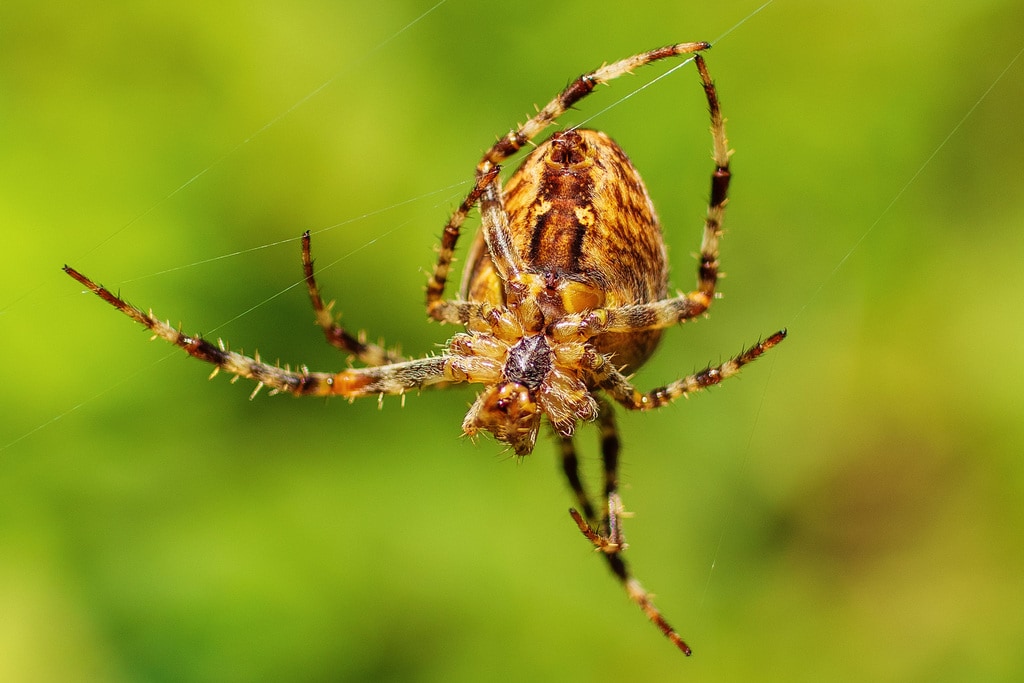
European garden spider
Araneus diadematus
Overview
European garden spider in Georgia
The European garden spider (Araneus diadematus), also called the cross spider or cross orb-weaver, is an orb-weaving spider in the family Araneidae. In Georgian, the word ჯვრიანა also appears in the name of another animal, so this page is specifically about the spider. The species is confirmed in Georgia. A published specimen is known from Mitarbi near Bakuriani, from a mountain meadow at about 1,500 m. The species is also included in the updated spider checklist of Lagodekhi Reserve. The main identification mark is the white cross-shaped pattern on the upper side of the abdomen. Body colour is quite variable: it may be yellowish, brown, reddish, or almost black. Females are much larger than males: female body length is about 10–22.5 mm, male body length 4–11 mm. It uses venom to subdue prey. It is not considered a medically significant species for people, and bites are rare. The species has not been globally assessed by the IUCN and is not included in Georgia's 2014 Red List.
Last updated
Identification
How to identify European garden spider
A medium to large orb-weaving spider. Body colour is variable, but the upper side of the abdomen often has a clear white cross-shaped mark. The legs are ringed, and females are much larger than males.
Female body length is about 10–22.5 mm; male body length is 4–11 mm. Legs are not included in this measurement. The female has a larger, rounder abdomen, while the male is comparatively smaller and slimmer.
Colour is highly variable: it may be pale yellowish, brown, reddish, or almost black. Even so, the white cross-shaped mark on the upper side of the abdomen is usually clear and is one of the main identification features.
The legs are distinctly ringed. The abdomen is slightly angular at the front and is widest around the front third.
It builds a large, round, orb-shaped web. It is often found in gardens, forest edges, and other vegetated places, where it may be seen sitting in the centre of the web.
The wasp spider has bold yellow-and-black cross-bands and often a white zigzag in the web. The lobed argiope is recognized by obvious side lobes on the abdomen. The main mark of the European garden spider is the white cross-shaped pattern on the upper side of the abdomen; it has neither Argiope-like bands nor the side lobes of the lobed argiope.


Biology
Habitat, diet, behavior, and conservation
Habitat and range
The European garden spider builds a large, round web in gardens, shrubland, forest edges, meadows, and other vegetated places. The web is often stretched between plants, branches, or fences. The most precise published Georgian record presented here is from Mitarbi near Bakuriani, from a mountain meadow at about 1,500 m. The species is also confirmed in the spider list of Lagodekhi Reserve. These data are enough to confirm that the species occurs in Georgia, but not enough to build an exact distribution map for every region of the country. Therefore, do not assume that the European garden spider is evenly distributed across all Georgian habitats and elevation belts.
Diet
The European garden spider catches insects and other small arthropods in its web. It secures prey with silk and uses venom to subdue it. The diet of the Georgian population has not been studied separately in full. In general, it is a sit-and-wait predator that uses its web to catch flying animals or small animals moving through vegetation.
Behavior
Adult females often sit in the centre of the web and sense prey through web vibrations. When disturbed, the spider may hide or shake the web. It does not try to attack people. European data show adults as especially conspicuous from summer into autumn. A full seasonal calendar for Georgia is not available, although the published Mitarbi specimen was collected on 21 July. Females lay eggs in a silk sac. Young spiders disperse in the following season; this is general species biology, not data studied separately for the Georgian population.
Conservation
The current scientific name of the species is Araneus diadematus. Its native range is broad and includes Europe, Turkey, the Middle East, the Caucasus, much of Russia, Iran, Central Asia, China, and Japan. It is considered introduced in North America. The IUCN has not globally assessed the European garden spider, and it is not included in Georgia's 2014 Red List. The sources used on this page do not define a quantified population trend or a special national protection status for Georgia. There is no need to catch a wild spider or move it elsewhere. If the web is not creating a problem, it is better to leave it in place.
Questions
Frequently asked questions
Short answers to the most important questions about European garden spider.
Yes. The European garden spider is confirmed in Georgia. A published specimen is known from Mitarbi near Bakuriani at about 1,500 m. The species is also included in the updated spider checklist of Lagodekhi Reserve.
The confirmed published locality presented here is Mitarbi near Bakuriani. In general, the species is associated with gardens, forest edges, shrubland, and meadows, but these data cannot produce an exact distribution map for every Georgian region.
Look at the upper side of the abdomen: the species often has a clear white cross-shaped pattern. Body colour may vary from pale yellowish to dark brown, reddish, or almost black, but the cross-shaped mark is usually still visible.
Female body length is about 10–22.5 mm; male body length is 4–11 mm. Legs are not included in this measurement.
Yes, it has venom, like most spiders, but it uses it to subdue prey. It is not considered a medically significant danger to people.
As a rule, no. Bites are rare and mostly happen when the spider is picked up, pressed, or accidentally disturbed. If strong or unusual symptoms occur, call 112.
Adults, especially females, are most conspicuous in the warm season. A full seasonal calendar for Georgia is not available, although the published Mitarbi specimen was collected in July.
The IUCN has not globally assessed the European garden spider, and it is not included in Georgia's 2014 Red List.
References
Sources
References
Sources
- World Spider Catalog — Araneus diadematus Clerck, 1757
- Nentwig et al. 2026 — Spiders of Europe, Araneus diadematus
- Otto 2022 — Caucasian Spiders, Georgia country checklist
- Otto & Japoshvili 2018 — Spiders of Lagodekhi Reserve, Georgia
- Seropian, Otto & Bulbulashvili 2023 — CaBOL spiders of Georgia, Part I
- Ilia State University — Georgian Biodiversity Database, Araneus diadematus
- საქართველოს მთავრობის დადგენილება №190 (2014) — წითელი ნუსხა
Species profiles are compiled from peer-reviewed literature and established biodiversity databases, and are reviewed as new taxonomic and conservation data become available.
Related guides


