


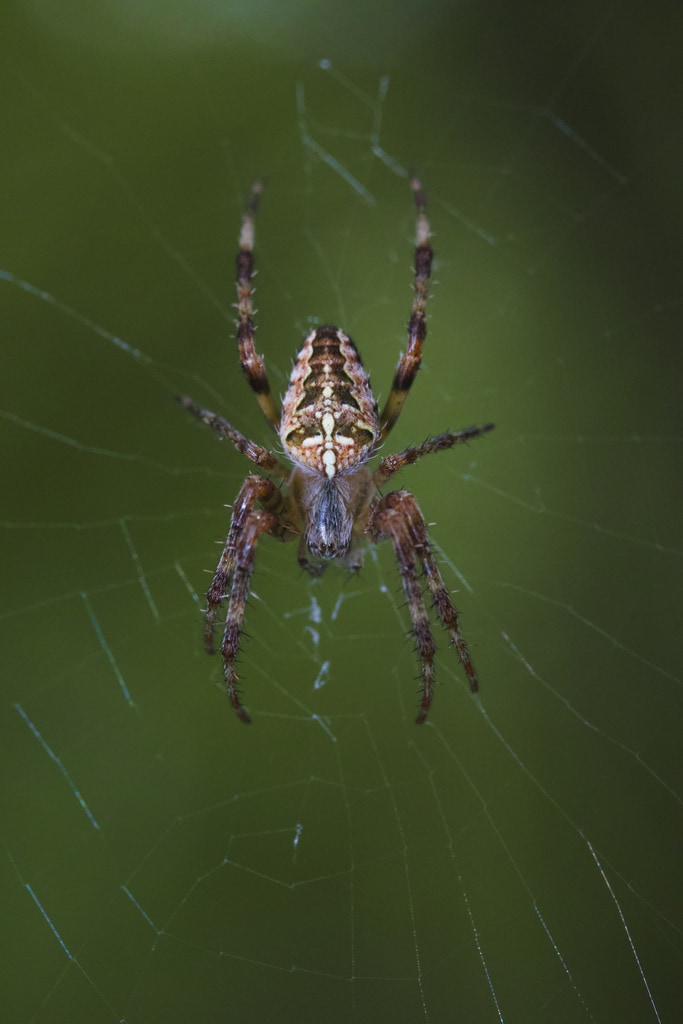


The wasp spider catches its prey in an orb web. It feeds mainly on various insects, including wasps, flies, grasshoppers and other fairly large invertebrates that get caught in the web. The spider usually wraps captured prey in silk first and then bites it. This describes the species in general. The wasp spider does eat insects, but it is wrong to treat it as a deliberate “biological control” tool against garden pests.


Zauri Khachidze · Borjomi-Kharagauli National ParkGeorgia field photo
Risk to humans
HarmlessNo medical venom risk
No medically significant venom. Do not pick it up anyway — watch it and leave it where it is.
A yellow-and-black banded spider that builds an orb web. It is native in Georgia and is not a medical risk to people.
Key facts in one look
- Size
- Female 10–22 mm
- Diet
- Insects in the web
- Status in Georgia
- Native
- Habitat
- Humid meadow / grass
- Family
- Araneidae
- Human risk
- Harmless
The wasp spider (Argiope bruennichi) is a spider that builds an orb web. In Georgian it is called არგიოპა, and also ბრუნიქის არგიოპა (“Brünnich's argiope”). Females are especially easy to recognize: their abdomen has bold yellow and black bands. These bands are where the English name “wasp spider” comes from. The species is widely distributed in Georgia and is considered native. It is described as a very common species in Georgia. This does not mean that it occurs in equal numbers in every region of the country: how many wasp spiders live in a given place depends on the local environment and habitat. The female's body is about 10–22 mm long, while the male is much smaller, about 7–8 mm. These measurements do not include the legs. The wasp spider has venom and uses it mainly to subdue prey, especially insects. For people, its bite is usually not considered a medically significant danger. Even so, do not handle the spider. Argiope bruennichi has not been assessed by the IUCN. The species is not included in Georgia's 2014 Red List.
Identification
Wasp spider: how to identify it
A large spider that builds an orb web and has bold yellow-and-black cross-bands on the abdomen. A white zigzag band is often visible in the middle of the web. The female is much larger than the male.

The female's body length is about 10–22 mm, while the male is about 7–8 mm. Legs are not included in this measurement. These are general species data.
On the upper side of the female's abdomen, bold white and yellow cross-bands stand out on a black or dark background. These bands give the species its typical “wasp-like” look. The male is much less colourful: mostly silvery-grey or yellowish, with the abdominal bands less clearly visible.
The wasp spider builds a large orb web, often in grass and fairly close to the ground. A white zigzag band, the stabilimentum, is often visible in the middle of the web. An adult female usually sits in the centre of the web, head down. A web like this, with its zigzag band and a head-down female, is one of the easiest ways to recognize the wasp spider in the field.
Georgia has another species in the same genus — Argiope lobata. Females of both species are large and sit in the centre of the web, so size and web posture are not enough to tell them apart. The female Argiope lobata has pronounced side projections, or lobes, on the abdomen. Its abdomen is a plain silvery grey, sometimes with brownish colour around the lobes. It does not have the bold yellow-and-black “wasp-like” bands typical of female Argiope bruennichi. These features apply mainly to females. Males of both species are small, with a plain yellowish or silvery-grey abdomen. Specialists tell the males apart by the structure of the pedipalp, the male's mating organ. Other orb-weaving spiders, including species of the genus Araneus, often have a cross-shaped or different pattern on the abdomen. The wasp spider is not a wasp: it has eight legs and no wings, and it usually sits in its own web.
The lobed argiope (Argiope lobata) has its own profile in this atlas.
Colour
YellowWhiteGreyBrown
The female's cephalothorax is silvery and shiny. The upper side of her abdomen carries many white or yellow cross-stripes, and these stripes give the spider its wasp-like look. The underside of the abdomen is dark brown, with yellow lengthwise stripes and a few spots. The legs are yellowish with brown rings. The male is far less colourful: his abdomen is a single shiny colour, silvery grey or yellowish.
Swatches are illustrative. Do not identify a species by colour alone.
The wasp spider is often found in low grass and meadows, where the female builds her orb web close to the ground. Its habitat is described above all as humid meadow vegetation. This is a general description of the species, not an elevation belt defined for Georgia. In Georgia, records of Argiope bruennichi are known from Tbilisi, Kvemo Kartli, Kakheti, Adjara, Guria, Imereti, Mtskheta–Mtianeti, Samegrelo and Abkhazia. Individual records also exist from Samtskhe–Javakheti, Shida Kartli and Racha–Lechkhumi–Kvemo Svaneti. This list does not mean that the wasp spider cannot occur in other regions. Likewise, “widely distributed in Georgia” does not mean that the wasp spider occurs equally in every habitat and at every elevation belt in the country.
Recorded (photo observations)field records
Too few records · 3
The wasp spider map combines Reptiles.ge editorial photo records with public iNaturalist observations. Regions are taken from the records-by-region table, and only regions with enough records are shaded on the map.
Data: Reptiles.ge + iNaturalist · Methodology
Interactive map is loading.
- Field observation
- Several records in one spot
- Region with records
By day the female often sits in the centre of the web, head down. A white zigzag band, the stabilimentum, is often visible in the middle of the web. Why the spider makes this band is not fully settled. It may help attract prey, make the web more visible, or help other animals notice the web. Adult females become especially easy to spot in the second half of summer. In Georgia, for example, there is a record from 20 July 2006 near David Gareja. The female lays her eggs in a large, brown sac that looks like paper. The sac is flask-shaped and hangs in the vegetation near the web. The young spiders hatch before winter but do not leave the sac: they spend the winter inside it and come out in spring. The male is much smaller than the female. During the mating period he often appears near her web. The female may eat the male during mating. This is general species behaviour and has not been separately confirmed by observation in Georgia. There is no need to handle the wasp spider — it is better to watch it calmly at its web.
The IUCN has not assessed Argiope bruennichi globally, so its status is NE — Not Evaluated. At national level the species is assessed as LC*, but this is not an official state Red List status. Argiope bruennichi is not included in Georgia's 2014 Red List. Among arachnids, that list includes the fen raft spider (Dolomedes plantarius), which has VU — Vulnerable status. In northern Europe, the wasp spider has expanded its range in recent decades, spreading into new areas. Genetic studies treat the Caucasus as one of the important regions of diversity for this species. The samples behind this conclusion include samples from Georgia. Do not catch wild spiders; leave them in their natural environment.
Nika Gagloshvili
Zauri Khachidze · Borjomi-Kharagauli National Park
Zauri Khachidze · Borjomi-Kharagauli National Park
Zauri Khachidze · Borjomi-Kharagauli National Park
Nika Gagloshvili · Zauri Khachidze · Close to wildlife · Ramo Gogitidze · Anamarija Koprivnjak · Vasiko Beridze
Yes. The wasp spider (Argiope bruennichi) is confirmed in Georgia and is considered a native species. This is an assessment for the country as a whole. It does not mean that the wasp spider is equally distributed in every region or habitat.
The wasp spider is recorded in Tbilisi, Kvemo Kartli, Kakheti, Adjara, Guria, Imereti, Mtskheta–Mtianeti, Samegrelo–Zemo Svaneti and Abkhazia. Individual records are also known from Samtskhe–Javakheti, Shida Kartli and Racha–Lechkhumi–Kvemo Svaneti, but those regions do not yet have enough records to be shaded on the map. You are most likely to see it in summer in grassy places and meadows. At that time adult females become more conspicuous.
The female is easy to recognize by the bold yellow-and-black cross-bands on her abdomen. Her orb web often has a white zigzag band as well. The male is much smaller and plainer in colour. In Georgia the wasp spider can be confused with the lobed argiope (Argiope lobata). The lobed argiope female is also large and sits in the centre of the web. The difference is that she has pronounced lobes on the sides of the abdomen, and her abdomen is plain silvery grey, without the characteristic yellow-and-black bands. Males of both species are small and plain, so this difference applies mainly to females.
The female's body length is about 10–22 mm, while the male is about 7–8 mm. Legs are not included in this measurement. These are general species data.
Yes, the wasp spider has venom, which it uses to subdue prey. For people, its bite is not considered a medically significant danger. Bites are rare and usually cause only a local reaction. Do not handle the spider. If strong or unusual symptoms occur, call 112.
Adult females become especially conspicuous in the second half of summer. In Georgia, a July record is also known from the David Gareja area.
The IUCN has not assessed Argiope bruennichi globally. The species is not included in Georgia's 2014 Red List. At national level the species is assessed as LC*, but this is not an official state status.
References
What this profile is based on
Species profiles are compiled from peer-reviewed literature and established biodiversity databases, and are reviewed as new taxonomic and conservation data become available.
Prepared by the Reptiles.ge editorial team from the sources listed here.


