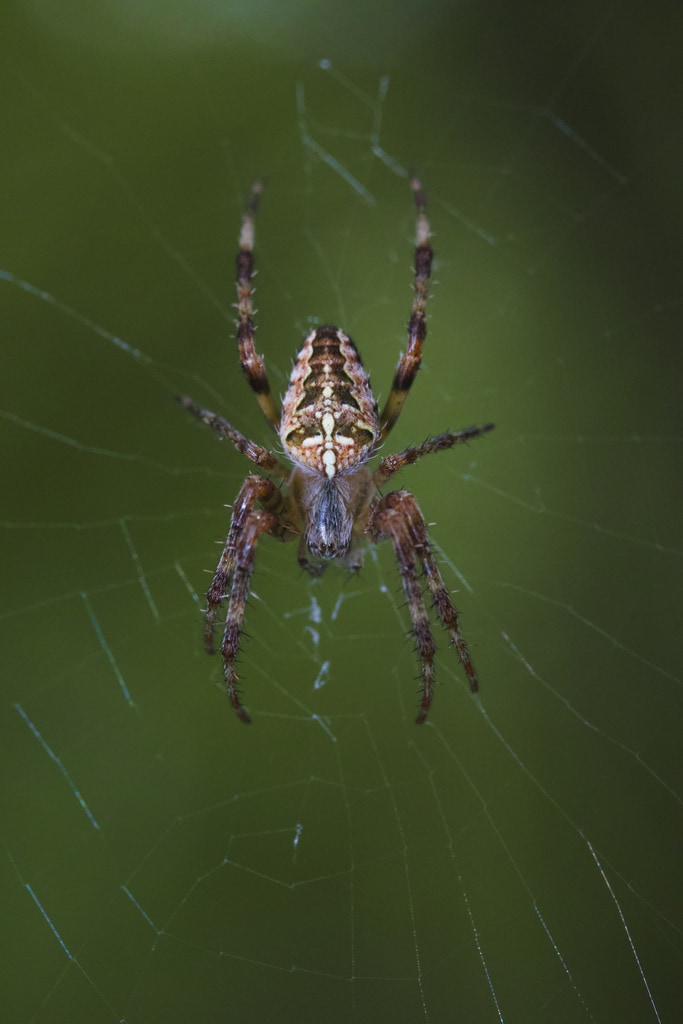
It catches insects and other small prey in an irregular web.


DinaKuzia · Rosh HaNikra, Israel
Risk to humans
Moderate riskA bite can be painful
It has venom. Do not touch it or pick it up. Seek medical care if pain is severe or symptoms worsen. Call 112 immediately if breathing becomes difficult or the face or throat swells severely.
112 · if bittenA cobweb spider with a globular abdomen, often mistaken for a true widow. It is confirmed in Georgia; a bite can be painful, but this is not the karakurt.
Key facts in one look
- Size
- Female 8–13 mm; male 4.5–8.4 mm
- Diet
- Insects in a cobweb
- Status in Georgia
- Confirmed
- Habitat
- Dry grass / crevices
- Family
- Theridiidae
- Risk to people
- Bite may be painful; not the karakurt
Steatoda paykulliana occurs in Georgia — in 8 regions. The female has a dark, rounded abdomen, often with a red or yellow stripe along its front edge. It resembles the karakurt, but belongs to a different genus; color alone cannot always tell them apart. Steatoda paykulliana is venomous, and its bite can be painful. Do not touch an unfamiliar spider.
Identification
False black widow: how to identify it
It is a small, dark spider with a rounded abdomen. It often has a red or yellow stripe on the front of its abdomen. The female is larger than the male. It looks like a karakurt, but it is not one.

The female’s body is about 8–13 mm long, while the male’s is 4.5–8.4 mm long. These measurements do not include the legs.
The male’s palps are relatively small and may be hard to notice from above.
This spider’s irregular web is often found under a stone, in a crevice or close to the ground. A large, symmetrical, round web with a white zigzag in the middle is more typical of Argiope.
The false black widow may resemble Latrodectus tredecimguttatus. Females of Latrodectus tredecimguttatus often have red spots on their abdomens, but sometimes the spots are not visible at all. Color alone is not a reliable way to tell the two apart. Other Steatoda species are also found in Georgia. If you are unsure which spider it is, do not touch or pick it up.
Colour
BlackBrownRedYellowWhite
The female has a dark purplish-brown to black front body and brown legs. Her abdomen is black, with a red or yellow band around the front; a lengthwise row of angular marks sometimes appears. The male has a dark brown to black front body, yellow-brown legs and a black abdomen with a whitish front band and a jagged lengthwise band. The underside of his abdomen is dark brown with reddish-brown marks.
Swatches are illustrative. Do not identify a species by colour alone.
Often confused with
The species is found mainly in dry and semi-dry places: dry meadows, rocky slopes and crevices in rocks. It is also occasionally found in untended gardens. In Georgia, its presence has been confirmed in Tbilisi, Sighnaghi, Kodiani and Kveda Chkhutuneti.
Recorded (photo observations)field records
Too few records · 3
The false black widow map uses public iNaturalist observations. Regions are taken from the records-by-region table, and only regions with enough records are shaded on the map.
Data: Reptiles.ge + iNaturalist · Methodology
Interactive map is loading.
- Field observation
- Several records in one spot
- Photo record
- Region with records
Bernard DUPONT · Dobres, Cantabria, Spain
0959kedi · İzmir, Turkey
0959kedi · İzmir, Turkey
DinaKuzia · Rosh HaNikra, Israel
Questions
Frequently asked questions
Short answers to the most important questions about False black widow.
Yes. The presence of Steatoda paykulliana in Georgia has been confirmed.
It occurs in Georgia — in 8 regions. It is found mainly in dry places, such as dry meadows and near cracks in rocks.
Female false black widows often have a red or yellow stripe along the front edge of the abdomen. The red spots of a karakurt are sometimes not visible at all, so color alone is not a reliable guide. Do not touch a spider you cannot identify.
The female’s body is about 8–13 mm long, and the male’s is 4.5–8.4 mm long. These measurements do not include the legs.
Yes, it is venomous, and its bite can be painful. Seek medical care if the pain is severe or symptoms worsen. If you have trouble breathing or significant swelling of the face or throat, call 112 immediately.
No. The species is not listed in Georgia’s 2014 Red List. It has not been assessed globally.
References
What this profile is based on
Species profiles are compiled from peer-reviewed literature and established biodiversity databases, and are reviewed as new taxonomic and conservation data become available.
Prepared by the Reptiles.ge editorial team from the sources listed here.