


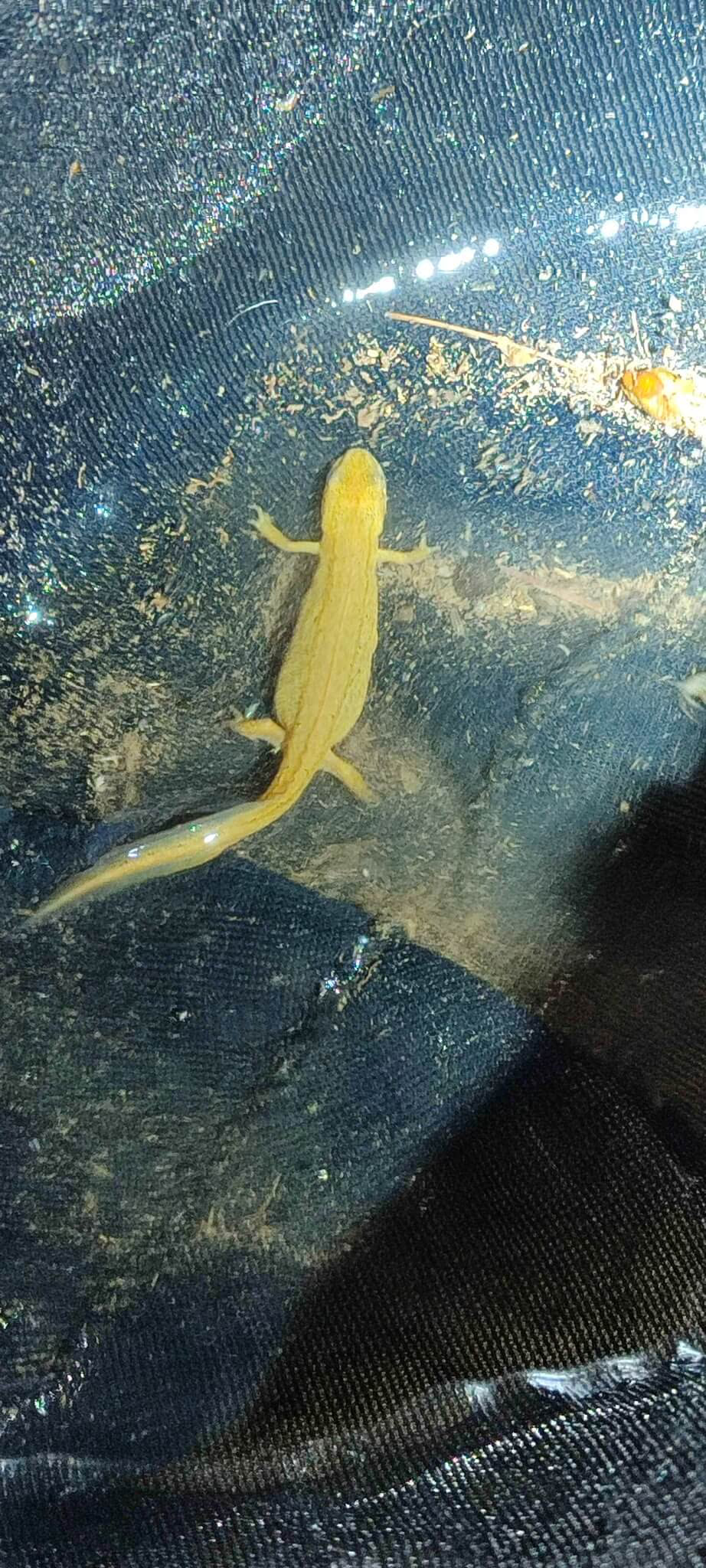
The Caucasian smooth newt (Lissotriton lantzi) is a small, harmless newt of forest ponds and lakes in Georgia. Adults are usually about 7–11 cm long; breeding males may reach about 12 cm. It is not dangerous to people. In the field this is Georgia’s small, smooth-skinned pond newt — not the banded newt and not the crested newt. The 2026 Georgian checklist treats it as a candidate species: a geographically isolated lineage of the smooth newt (Lissotriton vulgaris) complex. Older books listed it as Triturus vulgaris lantzi. Wolterstorff’s 1914 type material came from Novorossiysk, Poti and Borjomi.
Identification
How to identify Caucasian Smooth Newt
Georgia’s smallest newt. The skin is smooth or finely granular. There is no pale flank stripe. The male’s breeding crest is low. Do not confuse it with the banded or crested newt.
Often confused with


The body is slim and elongate. The skin is smooth or finely granular, not coarse like a crested newt. In water the tail is flattened side to side and is about as long as the body. Adults are usually about 7–11 cm in total length; breeding males are described up to about 12 cm. Separate Georgian measurements are not given on this page.
The back is olive, brownish or yellowish with small dark specks or spots. There is no silvery flank stripe — that is the main difference from the northern banded newt (Ommatotriton ophryticus). The belly is yellow to orange. Males have large dark belly spots; females have very small ones.
In the breeding season the male grows a low, wavy or finely notched crest, not a tall comb. The tail tapers into a thin filament (up to about 7 mm). The toes have skin fringes. The female lacks this crest and is plainer, with finer spotting.
The northern banded newt is larger, has a pale flank stripe, an unspotted belly and a very high, notched male crest. Karelin’s crested newt (Triturus karelinii) is larger and coarser-skinned, with big dark belly spots and a high, notched crest. The Caucasian salamander (Mertensiella caucasica) has yellow spots, a round tail in cross-section and lives by streams, not in ponds.
The European smooth newt (L. vulgaris) does not occur in Georgia. In the field the Caucasian form looks similar; the reliable difference is mostly geography, not a single obvious field mark.

In Georgia this is a newt of still water in the forest belt. Look for it in fish-free or lightly stocked ponds, small lakes, ditches and slow water, often beside deciduous or mixed woodland. On land it hides under stones, logs and leaf litter. The 2026 checklist’s DNA-confirmed record is Mtskemsi Lake (Tbilisi); Bakuriani is cited as a homologous sequence; the paper’s figure locality is Tabaruki / Mtskemsi. That is not the whole Georgian range. Tarkhnishvili 1996 lists 17 Georgian localities, including Batumi, Sukhumi, Gagra, Pitsunda, Kutaisi, Bakuriani, Poti, Mukhuri, the Sakochavi lakes, Didi Mitarbi, the village of Tba, Kobuleti, Lagodekhi, Sataplia, Chiantba near Telavi, Satovle near Tbilisi and Ertatsminda on Trialeti. Some eastern populations were already treated as lost by then, for example near Kvareli. Skorinov et al. 2014 compile 42 localities in Georgia, from the Colchis lowland through Imereti, Borjomi–Bakuriani, Trialeti, Manglisi and Kakheti. This atlas marks Abkhazia, Samegrelo — Zemo Svaneti, Guria, Adjara, Imereti, Samtskhe — Javakheti, Shida Kartli, Mtskheta — Mtianeti, Kvemo Kartli, Kakheti and Tbilisi. There is no separate record in the sources used here for Racha — Lechkhumi — Kvemo Svaneti. Elevation in Georgia runs from the coast to about 1,800 m (Bakuriani about 1,760 m; Kakhisi Lake); higher records exist in the Russian Caucasus. The range continues in the North Caucasus. Old records exist for Armenia, Azerbaijan and north-eastern Turkey; recent confirmation there is scarce and some populations are treated as extinct.
Biology
Diet, behavior, and conservation
Diet
There is no separate Georgian diet study on this page. At species level, aquatic adults take small water invertebrates — insect larvae, crustaceans and worms; on land they take soil and litter invertebrates. Captive animals are often fed chironomid larvae. Do not treat that as a menu for every Georgian population.
Behavior
It is in water when breeding; at other times it is often on land. Accounts describe it as more aquatic than the northern smooth newt. A full calendar for every Georgian population is not given here. In the north-western Caucasus, courtship runs from late winter to early summer, often peaking in February–April; at higher elevation the season is later. Eggs are laid singly on water plants. Larvae grow in water and leave it after metamorphosis. Paedomorphosis — adults that keep larval traits, including gills — has been recorded in some populations. If you find one, watch it and leave it where it is. Do not pick it up or move it between water bodies: that spreads disease. Skin glands produce a defensive secretion; wash your hands after any contact. It is not a medical risk to people.
Conservation
Candidate species in the checklist: it occurs in Georgia, but species rank within the L. vulgaris complex is not fully settled. Some authors treat it as a full species (e.g. Wielstra et al. 2018; Frost), others as a subspecies (Mars et al. 2025; Speybroeck et al. 2020), and some treat the name as a synonym of L. vulgaris. This atlas follows the 2026 Georgian checklist and keeps L. lantzi as a candidate. IUCN does not assess L. lantzi separately; L. vulgaris is Least Concern. Skorinov et al. 2014 state that it is absent from the Georgian Red List and recommend listing. It is listed in the Red Data Book of Russia. Main threats are destruction or infilling of ponds, fish stocking, deforestation and the pet trade. Local decline in eastern Georgia was already described in the 1990s.
Questions
Frequently asked questions
Short answers to the most important questions about Caucasian Smooth Newt.
Yes. It is a candidate species in the 2026 checklist. The DNA barcode is from Mtskemsi Lake (Tbilisi); Bakuriani is also cited. The literature has many older and newer records from the west as far as Kakheti.
At forest-belt ponds, small lakes and slow water — from the coast up to Trialeti and Bakuriani. The map marks several regions, not only Tbilisi. Present-day occupancy is not confirmed at every old site; decline near Kvareli was already noted in the 1990s.
No. It has no venom and is harmless to people. Skin secretion can irritate. Do not pick it up. Wash your hands after contact.
A small, smooth-skinned newt without a pale flank stripe. Breeding males have a low crest and a thin tail filament. The banded newt has a flank stripe; the crested newt is larger and coarser-skinned.
Adults are usually about 7–11 cm in total length; breeding males are described up to about 12 cm. Separate Georgian measurements are not given on this page.
In water — small aquatic invertebrates. On land — soil invertebrates. There is no Georgian diet study on this page.
It is in water when breeding, mostly in spring; at other times it is often on land. A full calendar for every Georgian population is not given here. At higher elevation the season is later.
It is an isolated lineage in the L. vulgaris complex. Some authors treat it as a species, others as a subspecies or a synonym. The checklist keeps it as a candidate until rank is tested further.
Watch it and leave it where it is. Do not pick it up or move it to another pond. It is not a medical risk to people.
References
Sources
References
Sources
- Tarkhnishvili et al. 2026 — Annotated checklist of Georgia's amphibians and reptiles
- Tarkhnishvili 1996 — The distribution and ecology of the amphibians of Georgia and the Caucasus
- Iankoshvili & Tarkhnishvili 2021 — Georgian herpetofauna records cited in Tarkhnishvili et al. 2026
- Skorinov et al. 2014 — Distribution and conservation status of Lissotriton lantzi
- Pabijan et al. 2017 — Isolation and gene flow in a speciation continuum in newts
- Wielstra et al. 2018 — Distributions of the smooth newt species complex
- Speybroeck et al. 2020 — Species list of the European herpetofauna
- Mars et al. 2025 — Phylogenomics of Lissotriton
- AmphibiaWeb — Lissotriton lantzi
- IUCN Red List — Lissotriton vulgaris
Species profiles are compiled from peer-reviewed literature and established biodiversity databases, and are reviewed as new taxonomic and conservation data become available.
Related guides


