


Snakes
New study: how accurately do we know where Georgia's snakes occur?
A new Ecology and Evolution study shows how incomplete records can change estimates of the Area of Occupancy for snakes in Georgia.
Read the article
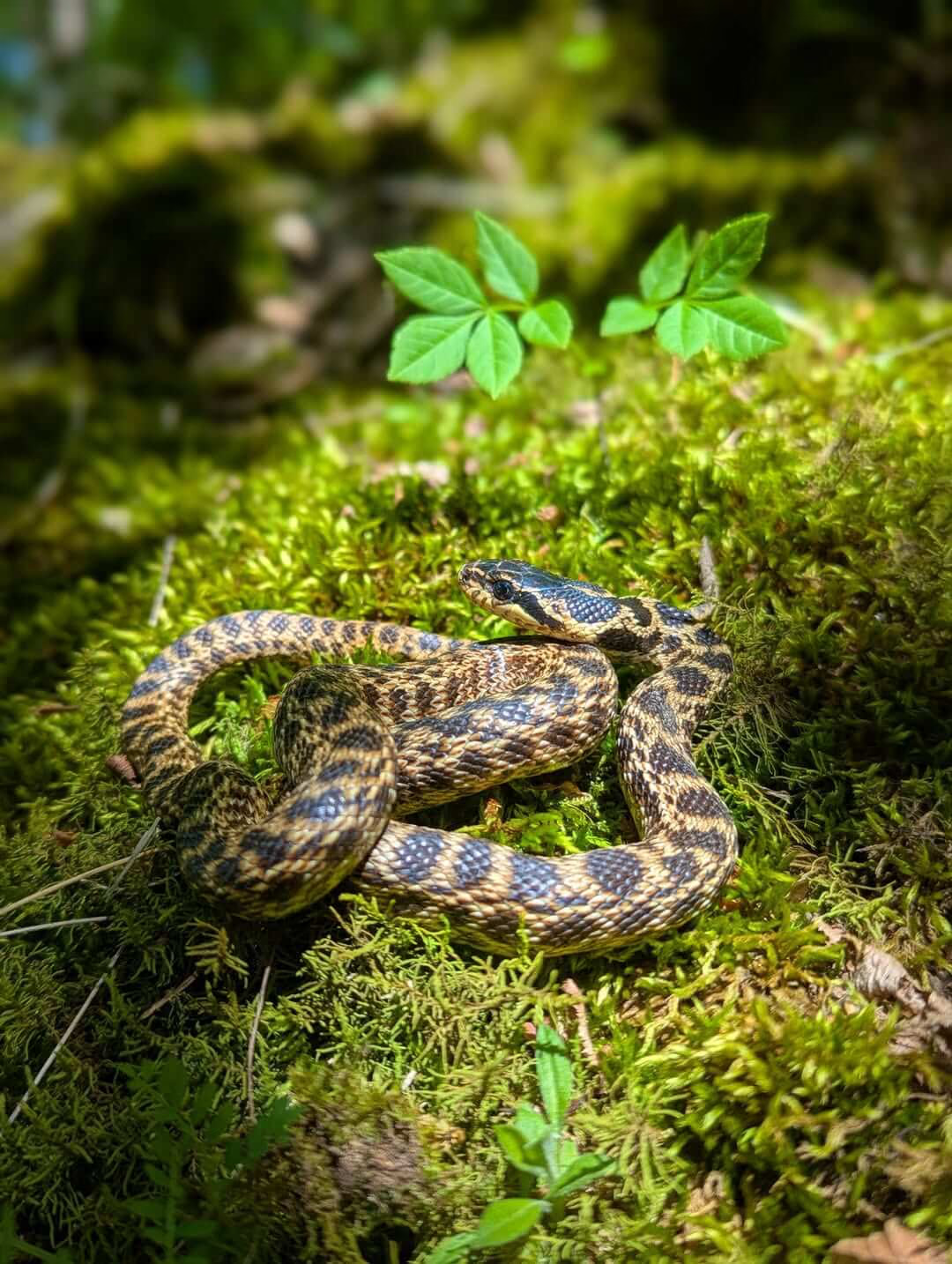
The Urartu snake (Elaphe urartica) is a large, spotted snake. In Georgia, it is known mainly from dry and semi-dry areas of eastern Georgia. It belongs to the group of snakes called the family Colubridae. In 2019, it was separated as a species from Elaphe sauromates, although it looks very similar to it. In the modern Georgian list, E. sauromates is not listed as a separate species living in Georgia. The 2026 list includes E. urartica, but it is still treated as a species whose status needs clarification, because the northwestern Caspian transition zone has not been studied enough. From head to tail, its length is usually about 80–120 cm. It is not venomous to humans.
Identification
The Urartu racer is a large, non-venomous snake. It has round pupils, a dark head, and large rounded spots on its back. In Georgia, the dry environment of the east and its typical spotted coloring are especially helpful for identifying it. Unlike the blunt-nosed viper, the Urartu racer has round pupils, but when identifying a snake, do not rely only on pupil shape.
Often confused with
Its length is usually about 80–120 cm and rarely exceeds 1.2 m. The head is large compared with the body and stands out clearly from the neck. From the side, the nose often looks slightly hooked, and the pupil is round. In the middle of the body, the scales are arranged in 23–25 rows. The scales in 18–21 of these rows have a small raised line down the middle.
The body is usually yellowish or whitish, rarely bright yellow. The back has about 50–65 large, round brown or black spots, often with pale edges. On the rear part of the body, the spots may be more stretched from side to side. The top of the head is dark, sometimes almost black. A dark stripe behind the eye runs toward the corner of the mouth. The belly is whitish or pale yellow; on the sides it may have small spots with a marble-like pattern.
The steppe ratsnake (Elaphe dione) is also found in the same dry eastern areas, but it usually has a finer pattern: it often shows four stripes running along the body and relatively small spots crossing from side to side. The red-bellied racer (Dolichophis schmidti) is a slimmer snake; adults often have a reddish belly. The blunt-nosed viper (Macrovipera lebetina) is venomous, has a heavier body, and its pupil is vertical, like a narrow slit. The smooth snake (Coronella austriaca) is much smaller and has smoother scales.
Elaphe sauromates looks very similar to the Urartian ratsnake, so it is hard to tell these two species apart by sight alone. In Georgia, local snakes from this group are now treated as E. urartica, while E. sauromates is found farther west. For this reason, location is an important clue for identification. Do not pick up a snake to count its scales or look closely at other features.
It has no venom. If it is defending itself, it may bite; the bite can be painful, but it is not venomous. Because it can be confused with a gyurza, watch any unknown large, spotted snake from a safe distance. Do not go close just to check the eye pupil or other signs.

In Georgia, the Urartian racer is mainly linked with dry and fairly dry places in the east of the country: dry grassy plains, semi-desert, areas where woodland and open plains alternate, open juniper woods, rocky slopes, and the edges of dry forest. On this page’s map, confirmed distribution is only Kakheti: that is the only region with confirmed status in the records table. Public observations come from Dedoplistsqaro, Sagarejo, Kvareli, and Lagodekhi municipalities. In the 2026 list, DNA-checked samples come from Chankani village in Dedoplistsqaro Municipality; published sources also name Shiraki. Tbilisi has separate observations, including one at Lisi Lake, but the region’s status is not confirmed, so it is not treated as distribution. In Kvemo Kartli the public points are either obscured coordinates whose locality text says Kakheti, or a Tbilisi (Isani–Samgori) locality that falls near the border; that status is not confirmed. Samtskhe–Javakheti has no records. To the west, older sources describe the edge of the range toward the Trialeti and Tsalka plateaus, but those regions are not treated as distribution on this map. Across its whole range, the species has been described from about −25 m to 2,600 m above sea level.
Distribution
29 field records2013–20263 regions with records
Interactive map is loading.
| regions with records | field records | |
|---|---|---|
| Distribution confirmed | ||
| Confirmed distribution region | 24 | |
| Recorded only | ||
| 2 | ||
| 2 | ||
The Urartian ratsnake map uses public iNaturalist photo observations in Georgia. Regions come from the records-by-region table: only confirmed status counts as distribution; otherwise a region is not treated as part of the range. Some public coordinates are obscured or approximate, so a point near a border does not by itself confirm a new region. Record counts reflect observation effort, not population density.
Data: Reptiles.ge + iNaturalist · Methodology
Biology
Other Elaphe species eat rodents, small birds, chicks and eggs; sometimes they also catch lizards. So this list does not mean that the Urartu snake in Georgia feeds exactly on these things. It does not use venom: like other Elaphe species, it holds its prey with its body. Elaphe species can also climb bushes and trees.
It is active in the warm season. When threatened, it usually tries to escape. If caught, a large snake can bite hard, so do not pick it up. The Urartian racer lays eggs.
According to the 2025 global assessment, Elaphe urartica has a low risk of extinction across its whole range: the species is widespread and can adapt to different environments, while threats are mostly local. The same assessment says it is not known whether its numbers are increasing, decreasing, or remaining stable. This is a global assessment, not a national assessment for Georgia. Neither E. urartica nor E. sauromates is included in Georgia’s 2014 Red List. In the 2026 Georgian list, E. urartica is marked as a candidate species, because in the northwestern Caspian area it is still not well enough studied where the boundary between E. urartica and E. sauromates lies.
Questions
Short answers to the most important questions about Urartian ratsnake.
Yes. The Urartu swimmer has been confirmed in Georgia and is found mainly in the eastern part of the country. It is included in the 2026 Georgian list, but its species status is still marked as candidate. It is not found throughout all of Georgia.
It is found mainly in the dry and relatively dry areas of eastern Georgia. On this page’s map, confirmed distribution is only Kakheti, including observations from Dedoplistsqaro, Sagarejo, Kvareli, and Lagodekhi municipalities. Published sources also name Shiraki. Tbilisi has separate records, but the region is not treated as confirmed distribution. Kvemo Kartli and Samtskhe–Javakheti are not marked as distribution on this map. This species is not associated with the humid areas of Colchis.
No. It has no venom and is not venomous to humans. If it is defending itself, it may bite, so do not pick it up. Because it can be confused with the blunt-nosed viper, watch any unfamiliar large spotted snake from a safe distance. Do not approach it just to check the shape of its pupil.
The main body color is yellowish or whitish. It has about 50–65 large, rounded spots on its back. The head is dark, and the pupil is round. Its total length is usually about 80–120 cm. The dice snake has a finer pattern and often has four stripes running along the body. The blunt-nosed viper has a vertical pupil, but do not rely on just one feature for identification.
In measured specimens, the total length is about 80–120 cm and usually does not exceed 1.2 m. Males have a relatively longer tail, while females have, on average, more scales on the belly. However, these features are not enough to easily tell the sex in the wild.
Elaphe urartica and Elaphe sauromates look very similar, so it is difficult to tell them apart reliably by appearance alone. In Georgia’s current list, the groups found here are treated as E. urartica, while E. sauromates is found farther west. The 2026 list follows this division, but still treats E. urartica as a likely separate species rather than a fully settled one, because the northwestern Caspian area where these forms come close to one another has not yet been studied enough.
The Urartu racer lays eggs. Other Elaphe snakes feed on rodents, small birds, and eggs.
References
Species profiles are compiled from peer-reviewed literature and established biodiversity databases, and are reviewed as new taxonomic and conservation data become available.
Related guides

Coronella austriaca
6 regions

Eirenis collaris
Southeastern Georgia

Eirenis modestus
Eastern and central Georgia

Natrix natrix
Abkhazia, Samegrelo — Zemo Svaneti, Guria, Adjara, Imereti, Samtskhe — Javakheti, Mtskheta — Mtianeti, Kvemo Kartli, Kakheti, Tbilisi