


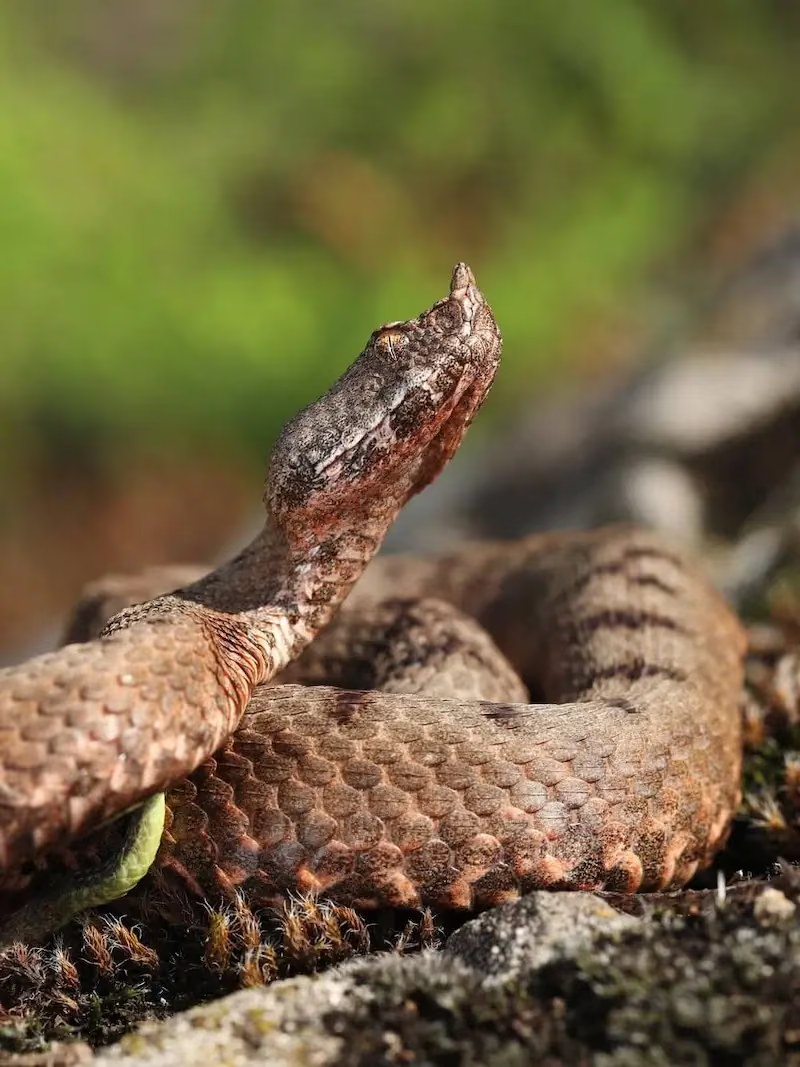


Snakes
New study: how accurately do we know where Georgia's snakes occur?
A new Ecology and Evolution study shows how incomplete records can change estimates of the Area of Occupancy for snakes in Georgia.
Read the article
The smooth snake (Coronella austriaca) is a nonvenomous snake found in Georgia. Because of its coloring, it is often mistaken for a viper. Do not rely on color alone to identify it. Look at its smooth scales, round pupils and the pattern on its head. It is usually about 50–70 cm long and rarely grows to 90 cm. Worldwide, it faces little threat. The smooth snake is not included in Georgia’s 2014 Red List.
Identification
The smooth snake belongs to the same family as grass snakes and is harmless to people, though it sometimes looks like a viper. To tell them apart, look at the scales, the shape of the pupil and the markings on the head. You do not need to pick up the snake to count its scales.
Often confused with
The copper snake has smooth scales on its back, with no raised line down the middle. Vipers have a small raised line on each scale along the back. The copper snake’s head is narrower than a viper’s and less clearly set off from its neck, though it may flatten its head when threatened. Head shape alone is therefore not a reliable way to tell them apart.
The smooth snake has round pupils, while vipers in Georgia have narrow, vertical pupils. A dark stripe often runs from its eye toward the back of its head. It may also have a dark crown- or heart-shaped marking on top of its head.
Its color may be coppery, brownish or gray. It often has two rows of small dark spots along its back rather than one continuous zigzag. Its belly is often dark gray or reddish. The markings on young copper snakes may be more distinct. It is usually about 50–70 cm long, though it rarely approaches 90 cm.
The nose-horned viper may also have separate dark spots on its gray back. It has a clearly visible horn on its nose, a raised ridge down the middle of its scales, and vertical pupils. The Transcaucasian racer also often has two rows of dark spots on its back and a dark stripe behind its eye. Do not identify a snake by its back pattern alone, and do not approach a snake you do not recognize.
The smooth snake is not venomous. If you encounter one, keep your distance and let it pass. You might mistake it for a viper, so do not pick up a snake you cannot identify.

Gallery
On this page’s map, a region is marked as having a confirmed range if there are at least five records from it—photos from the editors or public observations. There are at least five such records from Adjara, Mtskheta-Mtianeti, Samtskhe-Javakheti, Kakheti, Kvemo Kartli and Samegrelo-Zemo Svaneti. There are fewer than five records from Guria, Shida Kartli, Imereti and Abkhazia; this does not mean the species is absent there. It is found at forest edges, in open woodland, among bushes, on rocky slopes and in foothills. It often hides under rocks, tree stumps and other cover. It is found more often in damp and mountainous areas than in the very dry semi-desert of the southeast.
Distribution
125 field records2012–202610 regions
Interactive map is loading.
The smooth snake map combines Reptiles.ge editorial photo records with public iNaturalist observations. Regions are taken from the records-by-region table, and only regions with confirmed status are treated as distribution.
Data: Reptiles.ge + iNaturalist · Methodology
Biology
The smooth snake mainly hunts lizards. It wraps its body around its prey to hold it. Adults may also eat small mammals and, rarely, other small snakes.
The smooth snake is secretive and often hides under a stone or other cover. It may come out briefly during the day to warm up. When threatened, it flattens its head and sometimes looks more like a viper. If caught, it may bite, but it has no venom. It usually gives birth to 2–15 live young.
Questions
Short answers to the most important questions about Smooth snake.
Yes. According to 2026 records, the spilendza has been confirmed in Georgia.
On this page’s map, its presence is marked as confirmed in Adjara, Mtskheta-Mtianeti, Samtskhe-Javakheti, Kakheti, Kvemo Kartli and Samegrelo-Zemo Svaneti. In Guria, Shida Kartli, Imereti and Abkhazia, there are too few records to mark its presence as confirmed on the map. You may encounter it at forest edges, in open woodland and scrub, on rocky slopes, and in foothills.
No. The slow worm has no venom and is not dangerous to people. It may bite if you catch it, so don’t pick it up.
Look for smooth scales, round pupils and small dark spots arranged in two rows along the back. Vipers have a raised ridge down the middle of their scales and vertical pupils. Colour or head shape alone is not a reliable way to tell them apart.
The smooth snake is usually about 50–70 cm long, though it rarely approaches 90 cm.
It mainly eats lizards. It may also eat small mammals and, rarely, other small snakes.
Spilendza young hatch from eggs inside the mother’s body and are born alive. Usually, 2–15 young are born at a time.
If you come across a smooth snake, keep your distance and let it pass. Don’t kill it or pick it up. Don’t touch a snake you don’t recognize to find out what it is — it could be a viper.
References
Species profiles are compiled from peer-reviewed literature and established biodiversity databases, and are reviewed as new taxonomic and conservation data become available.
Related guides