




Snakes
New study: how accurately do we know where Georgia's snakes occur?
A new Ecology and Evolution study shows how incomplete records can change estimates of the Area of Occupancy for snakes in Georgia.
Read the article
The cat snake (Telescopus fallax) is a slender snake that is active mainly at night. In Georgia, it is found mostly in dry, rocky places in the east. It belongs to the Colubridae family. A 2026 Georgian checklist confirms the species’ presence, though the accuracy of information about its range is rated as moderate. According to a 2021 Georgian study, the cat snake is found in rocky or grassy places with a dry climate. This page does not provide a specific record of the snake from western Georgia or Colchis. The “Records by Region” table on this page’s map confirms its distribution in Kakheti, Kvemo Kartli, Mtskheta-Mtianeti and Tbilisi. For Shida Kartli, only isolated sightings have been recorded so far; these are not considered confirmation of its distribution there. Cat snakes living in the Caucasus are often assigned to the subspecies T. f. iberus. Tbilisi (“Tiflis”) is listed as the location of the specimen on which the description of this subspecies is based. The cat snake has venom fangs at the back of its mouth and uses its venom to subdue prey. It is not considered a significant threat to human health, but there is no need to pick it up. It is usually about 60–100 cm long. According to the IUCN, the species is of Least Concern.
Identification
It has a slender body and large eyes. It is active mainly at night. Its pupils are vertical, so it may be mistaken for a viper. To identify it, don’t rely on the pupils alone: look at its body shape, smooth scales and the large scales on its head.
Often confused with
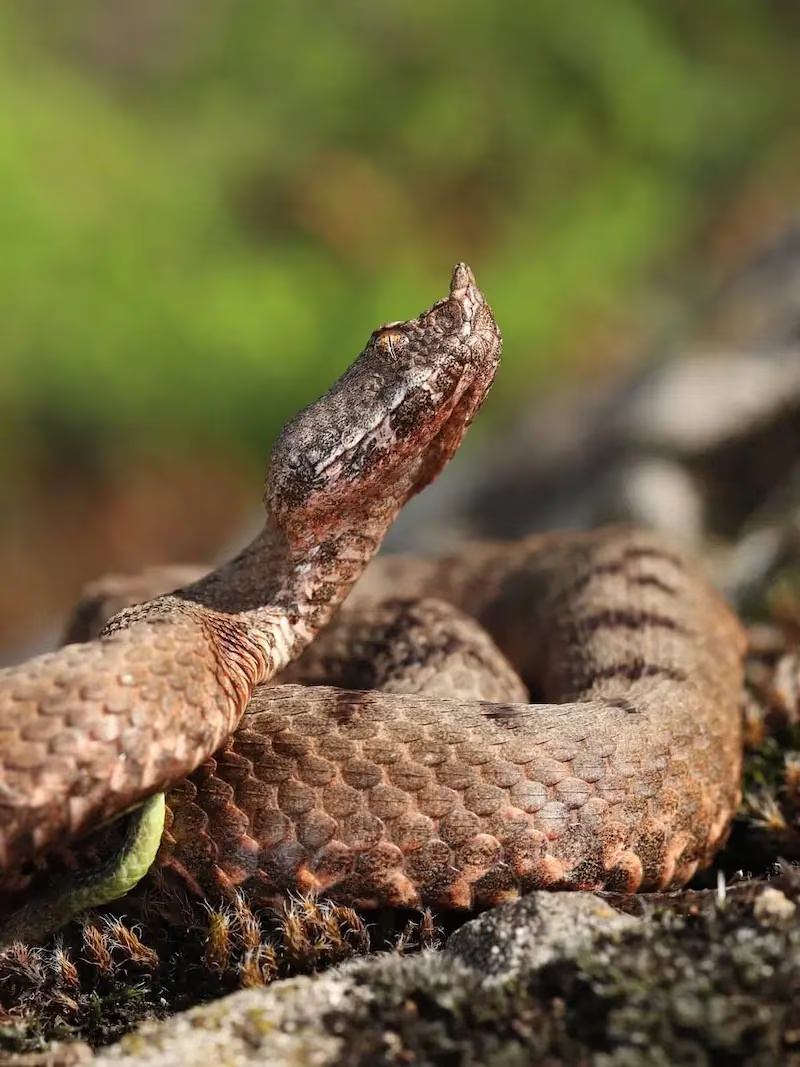
The body is slender and almost cylindrical. The head is flat and oval. The boundary between the head and neck is visible but not sharp. The eyes are large. The pupils are vertical and become narrow slits in bright light. The scales on the back are smooth. Around the middle of the body, they are often arranged in about 19 rows. Large scales are arranged symmetrically on top of the head. Vipers often have smaller scales on top of their heads. Do not pick up a snake to count its scales.
Its body may be gray, sand colored, brownish or olive colored. It has dark spots or bands across its back, often becoming less distinct toward the rear of the body. There are often dark markings on its head. A dark, slanting stripe runs from the eye toward the corner of the mouth. Its belly is pale and may have small dark dots. These markings are usually more distinct in young ones. This species is usually about 60–100 cm long. The greatest length measured in Georgia is not listed separately on this page.
The nose-horned viper (Vipera transcaucasiana) and other vipers have thicker bodies than the cat-eyed snake. Their back scales have a raised line down the middle, and their heads are broader and triangular. The gyurza (Macrovipera lebetina) is an even thicker venomous snake, and its bite poses a serious risk to human health. The cat-eyed snake has a slender body, large eyes and smooth back scales. The copper snake (Coronella austriaca), patterned racer (Elaphe dione) and olive-colored racer (Platyceps najadum) have round pupils. When identifying an unfamiliar snake, do not rely on just one feature.
The cat-eyed snake has fangs at the back of its mouth. It uses its venom mainly to subdue prey. Its venom is not considered a significant threat to human health, though its bite can be painful. Do not pick it up. If you cannot identify a snake with vertical pupils, keep a safe distance and leave it room to pass.
Yes. The cat-eyed snake’s presence in Georgia is confirmed, as noted in the 2026 Georgian list. According to a 2021 Georgian study, it is found mainly in dry, rocky or grassy areas of eastern Georgia and is active at night. This page provides no specific record of its presence in western Georgia or Colchis. Cat-eyed snakes in the Caucasus are often assigned to the subspecies T. f. iberus. Tbilisi is listed as the place where the specimen used to describe this subspecies was collected.

Gallery
In Georgia, the cat-eyed snake is found mainly in dry, rocky or grassy places. It may be seen on rocky slopes, near crevices, among bushes, at open forest edges, in ruins and near stone walls. It climbs rocks and walls well. During the day, it often hides under stones, in crevices or under bark. The map counts only regions where its presence has been confirmed as places where it occurs. At present, these are Kakheti, Kvemo Kartli, Mtskheta-Mtianeti and Tbilisi. There are photographs of it from Mtatsminda and Mount Iagluja near Rustavi. This page has no specific record of its presence in Samtskhe-Javakheti. Across its wider range, it has been recorded at elevations up to about 2,000 m, but the elevations where it occurs in Georgia have not been established separately.
Distribution
49 field records2017–20265 regions
Interactive map is loading.
| regions | field records | |
|---|---|---|
| Distribution confirmed | ||
| Region with records | 19 | |
| Region with records | 12 | |
| Region with records | 10 | |
| Region with records | 5 | |
| Recorded only | ||
| 3 | ||
The European cat snake map combines Reptiles.ge editorial photo records, hand-curated localities, and public iNaturalist observations. Regions are taken from the records-by-region table, and the status column separates confirmed distribution from recorded-only regions.
Data: Reptiles.ge + iNaturalist · Methodology
Biology
The cat snake’s diet has not been studied separately in Georgia. Elsewhere in its range, it hunts mainly lizards. It also catches small snakes, young birds and small mammals. In the Mediterranean region, it often eats geckos too, but it has not been confirmed that cat snakes in Georgia eat them. It holds its prey with its body and uses the venomous fangs at the back of its mouth to subdue it.
The cat-eyed snake hides during the day and hunts in the evening and at night. Its large eyes and vertical pupils are linked to its activity in low light. When threatened, it usually tries to escape or hide. It may sometimes curl up, breathe out loudly, or bite in self-defense, so do not pick it up. The cat-eyed snake lays eggs. Published sources about the species often say it lays 5–9 eggs. However, no separate information has been published on the mating season or number of eggs for cat-eyed snakes in Georgia. The sources used for this page also do not make clear how it spends winter in Georgia.
According to the IUCN, the cat-eyed snake faces a low risk of extinction (Least Concern). It is not included in Georgia’s 2014 Red List. In Europe, the cat-eyed snake is listed in Appendix II of the Bern Convention and Annex IV of the EU Habitats Directive. However, EU laws do not automatically apply in Georgia. The 2026 Georgian list identifies the cat-eyed snake as a species confirmed to occur in Georgia.
Questions
Short answers to the most important questions about European cat snake.
Yes. The cat-eyed snake is listed as a species confirmed in Georgia in the 2026 Georgian list. This page gives no specific record of it being found in western Georgia or Colchis.
The map’s “Records by region” table says that distribution is confirmed in Kakheti, Kvemo Kartli, Mtskheta-Mtianeti and Tbilisi. In Shida Kartli, there are currently only isolated records, which do not count as distribution. This page includes photos from Mtatsminda and Mount Yagluja near Rustavi. No record from Samtskhe-Javakheti is listed on this page.
The cat-eyed snake has venom, and its venomous fangs are at the back of its mouth. However, it is not considered a serious danger to people. When threatened, it usually tries to flee or hide. Do not pick it up. Vipers also have vertical pupils. If you are not sure it is a cat-eyed snake, keep a safe distance.
You can recognize it by its slender body, large eyes, vertically elongated pupils, smooth scales on its back, large scales on top of its head, and dark marks running across its back. It is mainly active in the evening and at night. Vipers usually have thicker bodies and scales with a raised ridge down the middle. The smooth snake and many racers active during the day have round pupils.
Animals of this species are usually about 60–100 cm long. The sources used on this page do not provide a separate set of size measurements for animals of this species living in Georgia.
It is mainly active at dusk and at night. According to a 2021 Georgian study, it is a nighttime animal. During the day, it often hides under a stone, in a crack or in another hiding place. People sometimes find it by chance when lifting a stone or see it on a wall. If you find a snake under a stone, do not touch it with your hands.
The cat-eyed snake lays eggs. Accounts of this species often report 5–9 eggs. It eats mainly lizards, but what cat-eyed snakes in Georgia eat and how many eggs they lay have not been fully studied separately.
Do not approach or pick up a cat-eyed snake. It does not seek out people and usually avoids confrontation. If a snake has vertical pupils and you are not sure what species it is, keep your distance for safety and let it pass.
References
Species profiles are compiled from peer-reviewed literature and established biodiversity databases, and are reviewed as new taxonomic and conservation data become available.
Related guides