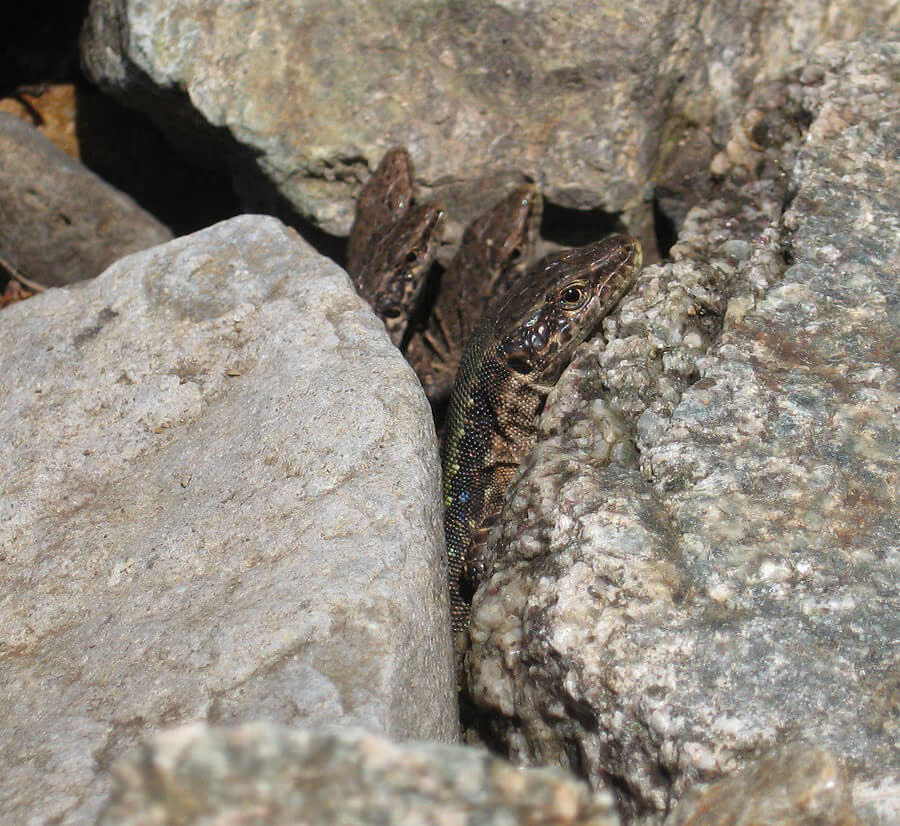
The Caucasian green lizard (Lacerta media) is a large, harmless lacertid found in Georgia, mainly in the semiarid east. It belongs to the true lizard family (Lacertidae). It has no venom and is not dangerous to people. Other English names include medium lizard, three-lined lizard and Levant green lizard. The 2026 Georgian checklist treats it as a candidate species: it is formally listed as a separate species, but the contact zone with the Lacerta trilineata group has not been studied well enough to settle rank. In this atlas it keeps its own profile and should not be treated as a settled species split. The nominotypical subspecies is L. m. media. The type locality is in Georgia: the lectotype is from the Kvabishevi valley near Borjomi, at about 1,025 m. IUCN lists it as Least Concern. It is not on Georgia’s 2014 Red List.
Identification
How to identify Caucasian Green Lizard
A large ground Lacerta. Juveniles often show three longitudinal stripes; adults are often green. It is a candidate — colour alone is not enough.
Often confused with


A robust lacertid with well-developed limbs — not a Darevskia rock lizard and not a skink. Adults are often plain green or olive-green; females may be more olive-brown, with lateral spots that fade with age. In Iranian material, adult males lack pale dorsal lines or spots. At species level snout–vent length is often about 10–12 cm; total length with the tail can reach about 40–50 cm. This page has no Georgian measurement series.
Juveniles in the L. trilineata complex often have three longitudinal stripes — hence the English name three-lined lizard. Young striped lizards (Lacerta strigata) usually have five narrow pale stripes. Green adults are easy to confuse; stripes fade with age. Colour alone is not enough.
The striped lizard (Lacerta strigata) is confirmed in Georgia and is described from semiarid habitats throughout the country. L. media is larger, a candidate, and mainly eastern semiarid, with sporadic records in the northwest. Where both occur, compare size, juvenile stripe count and the two profiles.
The sand lizard (Lacerta agilis) is widespread in western Georgia; in the east the 2026 checklist places it only above about 600–800 m. It is smaller. Young can be striped, but it is not the large green Lacerta of this complex.
The snake-eyed lizard (Ophisops elegans) is smaller, lives on open dry ground in the southeast, and has fused eyelids — the eye looks lidless. Rock lizards (Darevskia) are smaller and usually on rock or walls. None of these lizards is venomous.

Gallery
Caucasian Green Lizard in photos
It occurs in Georgia. Do not assume it in every region or in humid Colchic forest. Tarkhnishvili et al. 2026 place it widely in semiarid habitats of eastern Georgia and sporadically in the northwest, with medium distribution confidence. The checklist figure is from Tmogvi village (Aspindza, Samtskhe — Javakheti). Barcodes are from Tmogvi and Pantishara Gorge — Pantishara is in Kakheti, in the Dedoplistskaro area. This atlas map currently marks those named records; it does not mean the species is limited to two regions. No named northwest point is given on this page. The 2009 IUCN account names only northeastern Georgia; that is narrower than the 2026 checklist and is treated here as an older summary. The species was described in 1920 from Caucasian “green lizard” material; the syntype series included the Chorokh valley between Batumi and Artvin, Borjomi, the environs of Tbilisi, the Araks valley and other sites. Doronin and Doronina (2019) place the lectotype in the Kvabishevi valley. Look for it in bushy semiarid ground, river edges, and garden or field margins — not on barren desert. An Iranian synthesis (Šmíd et al. 2014) says the species avoids dry or arid habitats and uses grassy, shrubby, wooded valleys, field edges and gardens. IUCN lists woodland with scrub, grassland, rocky ground and cultivated land, and ties southern populations to moister sites. Species-level elevation is often given as about 600–2,000 m; a measured Georgian range is not published on this page. Dagestan records run from 840–2,250 m — that is a Russian measurement, not a Georgian limit.
Biology
Diet, behavior, and conservation
Diet
This page has no Georgian stomach-content study. At species level it eats small invertebrates, mainly arthropods, and rarely a small vertebrate. That is a range-wide description, not a menu for every Georgian site.
Behavior
It is active by day. It is a large, fast ground Lacerta, often basking by bushes, stones or walls. A Georgian hourly and seasonal calendar has not been published separately. In a highland Turkish population activity is described from about mid-May to mid-September — that is a local window, not a Georgian calendar. At species level IUCN reports two clutches a year of about 9–18 eggs and maturity at about two years. Armenian populations have been noted with two clutches a year. Georgian clutch size and incubation are not measured here. If grabbed, the tail may break and the lizard may bite. Watch it and leave it where it is. Do not pick it up.
Conservation
IUCN assessed it as Least Concern in 2009 (Agasyan and co-authors) because of a wide range and a presumably large population. It is not on Georgia’s 2014 Red List (Resolution No. 190). Tarkhnishvili et al. 2026 treat it as a candidate: separate status is supported indirectly by phylogeny and parapatry in western Anatolia, but the contact zone with the L. trilineata group remains unexplored (Ahmadzadeh et al. 2013). Cytochrome b difference from L. trilineata reaches 6.5% — that does not confirm species rank in this atlas. Cyrén raised it to species in 1933; later authors often kept it as a subspecies of L. trilineata until Schmidtler (1986) restored species rank. Local threats in Georgia are not measured on this page; habitat conversion is an obvious pressure. It is not listed on CITES. Do not catch wild lizards.
Questions
Frequently asked questions
Short answers to the most important questions about Caucasian Green Lizard.
Yes. It is in the 2026 checklist. The named figure is from Tmogvi; barcodes are from Tmogvi and Pantishara Gorge.
In semiarid eastern country — bushy ground, valleys, field or garden edges. This atlas maps Samtskhe — Javakheti and Kakheti from named records. The northwest is sporadic; no named point is given here. Do not assume it in wet western forest.
A large ground Lacerta. Juveniles often have three stripes; adults are often green. Compare the striped lizard, whose young usually have five stripes. Colour alone is not enough.
No. It has no venom. If grabbed it may bite, and the tail can break. Leave it where it is.
At species level snout–vent length is often about 10–12 cm; total length with the tail can reach about 40–50 cm. This page has no Georgian measurement series.
It belongs to the L. trilineata complex. The contact zone is unstudied. Genetic distance does not settle rank here. The checklist keeps a separate name until contact is analysed.
L. strigata is confirmed and described from semiarid habitats throughout the country. L. media is a larger candidate, mainly eastern. Juveniles: three stripes versus five; green adults overlap.
By day. A Georgian seasonal calendar is not on this page. Other regions describe activity from spring to autumn — that is not a calendar for every Georgian site.
References
Sources
References
Sources
- Tarkhnishvili et al. 2026 — Annotated checklist of Georgia's amphibians and reptiles
- Lantz & Cyrén 1920 — Note sur les Lacerta viridis du Caucase
- Doronin & Doronina 2019 — Review of type specimens of Lacerta media
- Ahmadzadeh et al. 2013 — Multiple dispersal out of Anatolia (Lacerta trilineata group)
- Agasyan et al. 2009 — IUCN Red List, Lacerta media
- Schmidtler 1986 — Orientalische Smaragdeidechsen 2. Zur Systematik und Ökologie der Lacerta trilineata-Gruppe
- Šmíd et al. 2014 — Annotated checklist and distribution of the lizards of Iran
- Mazanaeva & Askenderov 2016 — Distribution and ecology of Lacerta media in Dagestan
- საქართველოს მთავრობის დადგენილება №190 (2014) — წითელი ნუსხა
- The Reptile Database — Lacerta media
Species profiles are compiled from peer-reviewed literature and established biodiversity databases, and are reviewed as new taxonomic and conservation data become available.
Related guides