


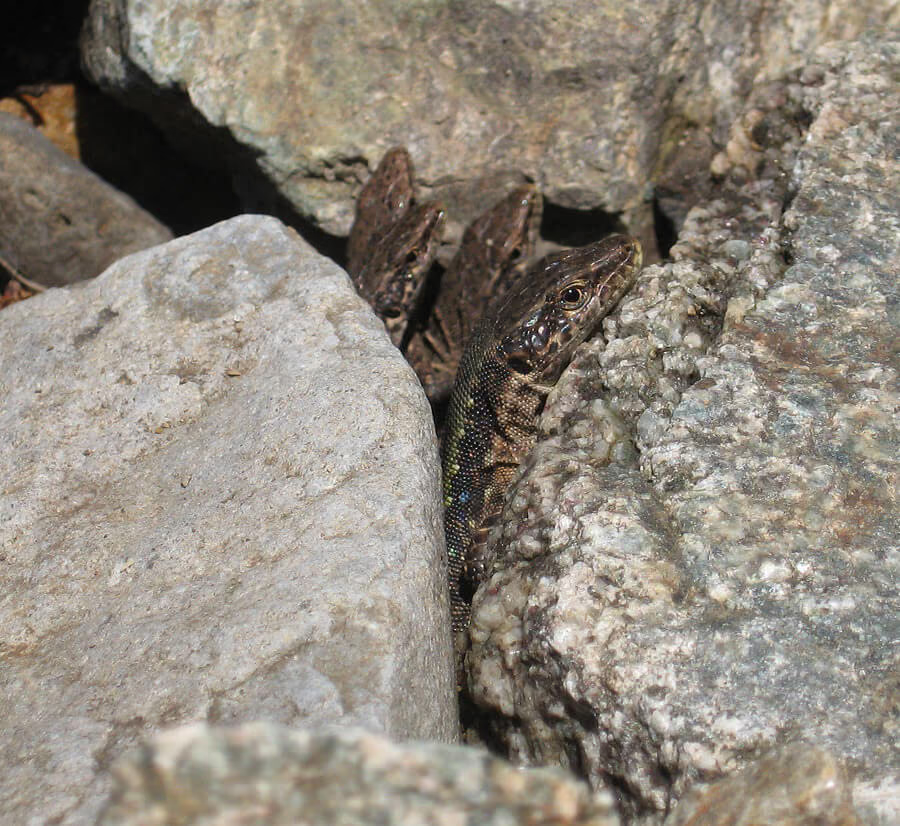
Lacerta agilis is not venomous. It is widespread in western Georgia; in the east, it occurs above roughly 600–800 m. It has a stocky body and a relatively short head. During the breeding season, males’ sides often turn green, but identifying Lacerta agilis by color alone is difficult.
Identification
How to identify Sand Lizard
It has a stocky body and a relatively short head. During the breeding season, males often develop greenish sides; females are usually brownish or gray. Color alone is not enough to tell it apart from the lizards called ზოლიანი ხვლიკი and საშუალო ხვლიკი.
Often confused with


Females and young lizards often have dark spots with pale centers on their sides. A male’s green coloring changes with the seasons; in some males, green covers more of the body. To identify the lizard, look at its body shape, markings and surroundings. Do not pick it up to identify it.
Lacerta strigata is also found in semi-arid areas. In the east, the lizard called მარდი ხვლიკი is found at higher elevations, but both species were seen at the same site near Tianeti in 2018. So do not identify a lizard’s species by its location and color alone.
Lacerta media is a larger green lizard. It is found mainly in semi-arid areas in the east and is listed as a candidate species in the 2026 list. Where it occurs alongside another green lizard, look at their size and body shape to help tell them apart.

In the west, this species has also been recorded along the Black Sea coast and in the Colchis Lowland. It lives in a variety of places, including meadows, shrubland and forest edges. In sunny spots, you may find it near grass or a bush where it can hide. It does not live only in sandy places. A 2018 study found the Iori Valley subspecies on the northern outskirts of Tianeti at an elevation of 1,119–1,185 m; it was not found more than 2 km from Tianeti.
Distribution
Where sand lizard distribution is confirmed in Georgia
140 field records2007–202610 regions with records
Interactive map is loading.
- Field observation
- Several records in one spot
- Photo record
- Confirmed distribution region
The sand lizard map uses public iNaturalist photo observations in Georgia. Regions come from the records-by-region table: only confirmed status counts as distribution; otherwise a region is not treated as part of the range. Record counts reflect observation effort, not population density.
Data: Reptiles.ge + iNaturalist · Methodology
Biology
Diet, behavior, and conservation
Behavior
It is active during the day, warms itself in the sun and hunts. The time it emerges from its winter shelter varies by location. Emergence in the south and in the mountains has been recorded in March–April. A female may lay eggs once or twice a year, 4–14 each time. In general, this species’ eggs hatch in about 50–55 days.
Conservation
A 2009 global assessment found the species to be at low risk, although its numbers were declining. It is not on Georgia’s 2014 Red List. It is listed in Annex II of the Bern Convention. The Iori Valley subspecies lives in a small area. In 2018, it was thought that there was only one population of this subspecies near Tianeti, with fewer than 1,000 animals. This estimate applied only to the area around Tianeti, not to the species as a whole. Reported threats to the species include habitat loss, intensive farming and deaths on roads.
Yes. It is widespread in the west, while in the east it has been recorded above roughly 600–800 m.
It has a stocky body and a relatively short head. During the breeding season, the male’s sides often turn greenish, while the female is usually brownish. Color alone cannot distinguish it from the lizards called ზოლიანი ხვლიკი and საშუალო ხვლიკი in Georgian.
No. It has no venom and is not dangerous to people. If you pick it up, it may bite or lose its tail; leave it where it is.
The head and body, excluding the tail, are usually about 7–9 cm long. Including the tail, the total length is about 18–25 cm.
In the east, the lizard called მარდი ხვლიკი is found at higher elevations, while the one called ზოლიანი is also found in semi-arid areas. Both have been seen together near Tianeti, so location or coloring alone cannot reliably tell them apart.
The 2026 list names three subspecies: grusinica in the west, brevicaudata in the south and center, and ioriensis in the east. A single feature of their DNA is not enough to distinguish these subspecies completely.
During the day. The time it comes out of its winter shelter varies from place to place. In the south and in the mountains, it has been observed coming out in March–April.
References
Sources
References
Sources
- Tarkhnishvili et al. 2026 — Annotated checklist of Georgia's amphibians and reptiles
- Doronin, Doronina & Bekoshvili 2019 — New data on the distribution of lizards in Caucasus
- Agasyan et al. 2010 — IUCN Red List, Lacerta agilis
- Peters & Muskhelischwili 1968 — Lacerta agilis ioriensis
- Doronina et al. 2023 — DNA barcoding of green Lacerta lizards
- Muskhelishvili 1970 — Presmykajushchiesya vostochnoi Gruzii
- საქართველოს მთავრობის დადგენილება №190 (2014) — წითელი ნუსხა
- The Reptile Database — Lacerta agilis
- Naturalis — Reptiles and Amphibians of the British Isles, Lacerta agilis
- iNaturalist — Lacerta agilis observations in Georgia
Species profiles are compiled from peer-reviewed literature and established biodiversity databases, and are reviewed as new taxonomic and conservation data become available.
Related guides
Continue with related pages

Darevskia adjarica
Ajarian Rock Lizard
Adjara (Shuakhevi) and Abastumani
Darevskia armeniaca
Armenian Rock Lizard
Southern Georgia — Ninotsminda (Saghamo), Akhalkalaki

Darevskia brauneri
Brauner's Rock Lizard
Western and central Greater Caucasus — Mestia (Manshura), Martvili, Ertso Lake

Darevskia caucasica
Caucasian Rock Lizard
Greater Caucasus