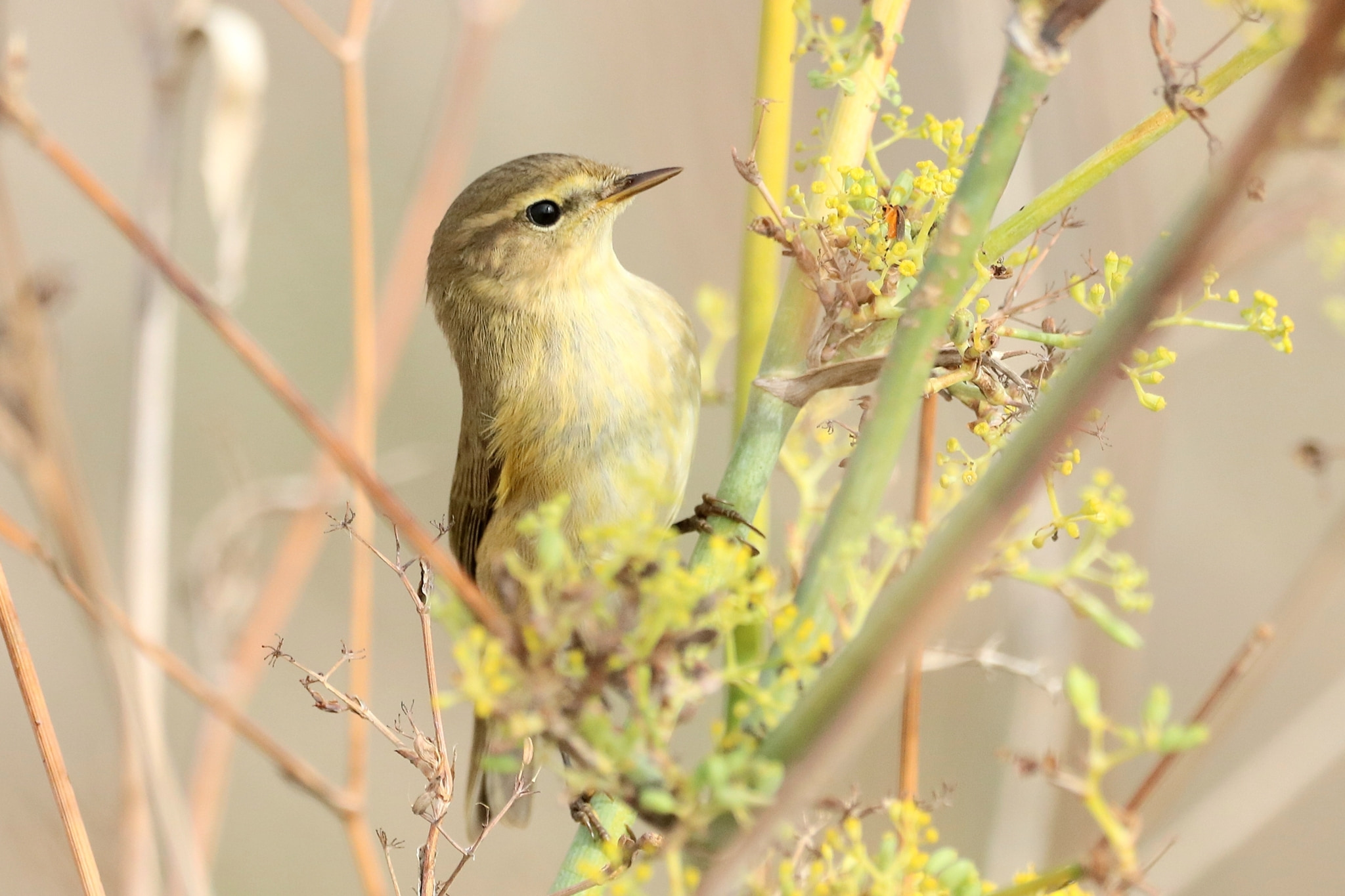
Greenish warbler
Phylloscopus trochiloides


rupperrt78 · Po Toi
Key facts in one look
- Diet
- Small insects, spiders, molluscs
- Status in Georgia
- Undefined, presence unconfirmed
- Size
- About 10 cm
- Habitat
- Deciduous, mixed and conifer forest, canopy
- Family
- Phylloscopidae
- Protection
- Globally LC, 2017; in Georgia LC, 2021
The greenish warbler is a well-known example of a ring species: its populations seem to have spread around the Tibetan Plateau from the east and the west and met again in the north. It breeds in north-eastern Europe and Asia and spends the winter in India. In Georgia its status is undefined, and its presence is not backed by documentary evidence. The mountain forests of the Caucasus hold its relative, the green warbler, once treated as its subspecies. If you see a greenish warbler in Georgia, look at the belly: the green warbler has much more yellow below.
Identification
Greenish warbler: how to identify it
A typical leaf warbler about 10 cm long and 8 g in weight: grey-green above, whitish below. A yellowish supercilium and a single narrow pale wing bar are its main marks. It is most easily confused with the green warbler.

Length about 10 cm, wingspan 15–21 cm, weight up to 8 g. It is slightly smaller and stockier than a wood warbler. Males and females look alike.
The back is olive-green, the belly greyish white. A dark stripe runs through the eye, with a long yellowish supercilium above it. Southern and western populations have a single pale wing bar, which sets them apart from most similar warblers. The legs are brownish, unlike the pale legs of the willow warbler.
The Arctic warbler (Phylloscopus borealis) also has a wing bar, but it is slightly larger and has a heavier bill with a dark tip to the lower mandible. The green warbler is brighter, much more yellow below, and has one strong and one faint wing bar. On a bird in Georgia that looks like a greenish warbler, check the belly first: a yellow breast points to a green warbler.
Colour
Swatches are illustrative. Do not identify a species by colour alone.
Often confused with


It is a forest bird: it picks deciduous, mixed and conifer woodland, parks and gardens too, and keeps mostly to the tree canopy. It breeds in the middle and southern taiga from eastern Central Europe to the Pacific, and in Central Asia also in mountain conifer forest. In recent decades its range has spread west as far as Germany, where a few pairs breed every year. South-east of the Himalayas some non-breeding birds spend the summer in Bhutan's fir forests, up to 3800 m and higher. Its presence in Georgia is not confirmed.
No records yet
The atlas has no confirmed observation of this species yet, so we do not know which regions of Georgia it lives in.
Share an observationSeen this species? A photo and the place are enough.
Like all leaf warblers, it eats insects. It takes small insects, spiders and molluscs. It searches for food mostly in the tree canopy, among the leaves.
It is a long-distance migrant. It reaches its breeding grounds in late May or early June and from August flies back south to South Asia, mostly to India. In some years it appears in Central Europe in large numbers, and it is seen in Britain every year. The song is a high, jerky trill, in some populations with down-slurred notes. It nests on the ground in a low shrub or in a natural hollow close to the ground: a burrow, a hole under a stone, a tree cavity. In towns it also uses old stone walls. The nest is built of moss, grass stems and horsehair. June clutches hold 6 eggs on average, later ones fewer. Incubation lasts about 13 days.
Globally the greenish warbler's risk of extinction is rated low (LC, 2017). It is a widespread bird from north-eastern Europe to the Pacific, and its range has spread westwards in recent decades. In Georgia's national assessment (2021) its risk is also rated low (LC), and its numbers are stable. In the list of the birds of Georgia its status is undefined, and its presence is not backed by documentary evidence.
Related guides
Continue with related pages
It is not confirmed. In the list of the birds of Georgia its status is undefined, and its presence is not backed by a photo, a sound recording or other evidence. Its close relative, the green warbler, breeds in the country's mountain forests and also passes through on migration. So treat a greenish warbler seen in Georgia with caution.
By the colour of the belly. The green warbler is brighter and much more yellow below, while the greenish warbler is whitish below. The green warbler has one strong and one faint wing bar, especially in young birds. The greenish warbler usually has a single narrow bar.
Small insects, spiders and molluscs. It searches for food mostly in the tree canopy, among the leaves. Like other leaf warblers, it depends entirely on live food. That is why it flies to warm South Asia for the winter.
On the ground in a low shrub, or in a natural hollow close to the ground: a burrow, a hole under a stone, a tree cavity. In towns it also uses old stone walls. It builds the nest of moss, grass stems and horsehair. June clutches hold 6 eggs on average.
In South Asia, mostly in India. It leaves its breeding grounds from August and returns in late May or early June. South-east of the Himalayas some non-breeding birds spend the summer in the mountains and come back down to the lowlands in winter.
No, it is harmless to people. Globally its risk of extinction is low (LC, 2017). In Georgia's national assessment (2021) its risk is also low (LC), and its numbers are stable. Do not catch wild birds.
References
What this profile is based on
Species profiles are compiled from peer-reviewed literature and established biodiversity databases, and are reviewed as new taxonomic and conservation data become available.
Prepared by the Reptiles.ge editorial team from the sources listed here.