


Radde's warbler
Phylloscopus schwarzi


Dmitry Dubikovskiy · Kemerovo District
Key facts in one look
- Size
- 12–13 cm
- Diet
- Spiders and insects
- Status in Georgia
- Accidental visitor
- Habitat
- Open woodland with dense undergrowth, forest edges
- Family
- Phylloscopidae
- Protection
- Globally LC, 2016; in Georgia NE, 2021
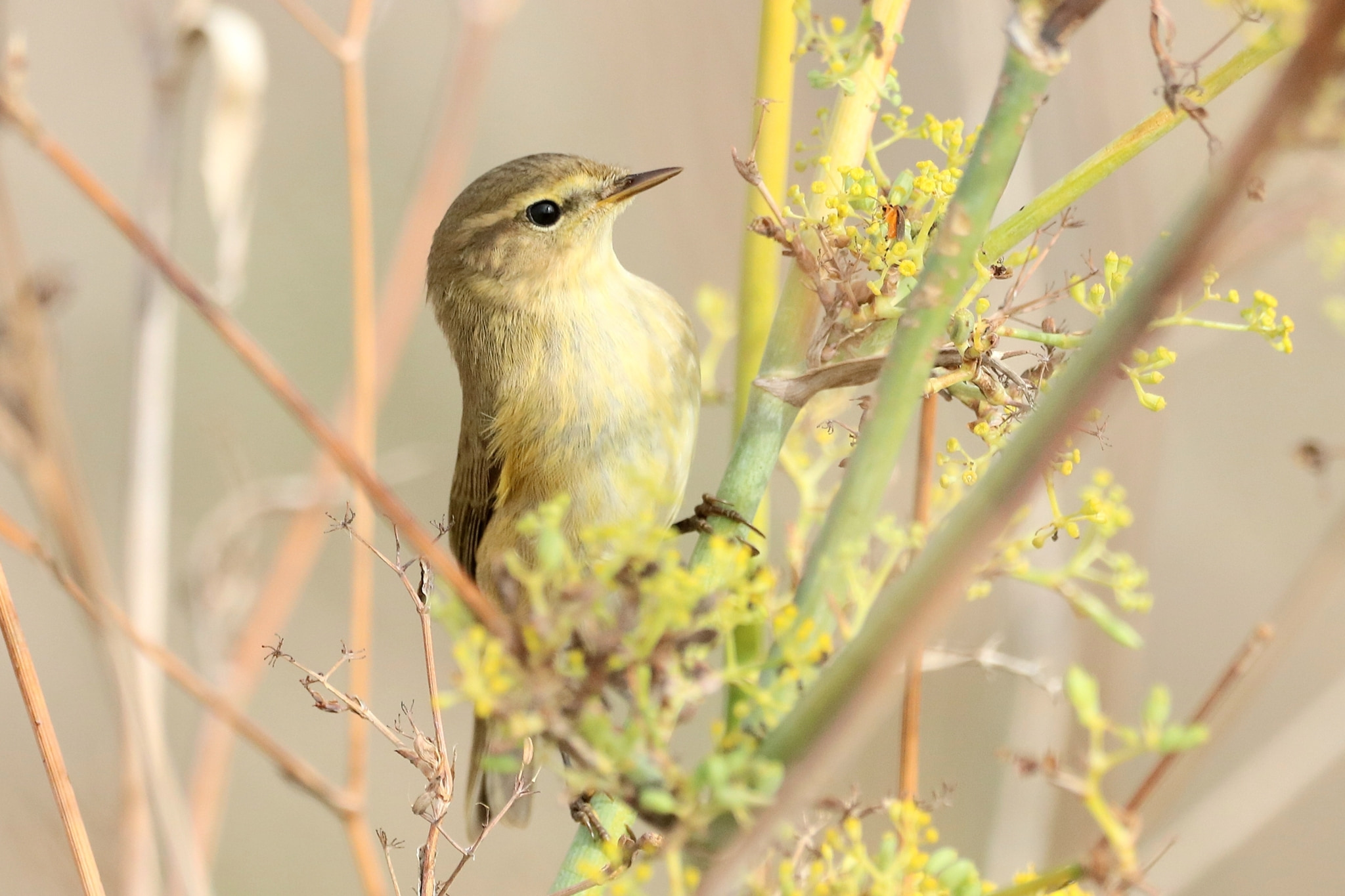
Radde's warbler is a leaf warbler 12–13 cm long, with a brown back, buff underparts and a very long whitish eyebrow. Its bill is thick and its legs pale and large, because it feeds close to the ground. It breeds from southern Siberia to Sakhalin, in northeast China and northern Korea, and winters in Southeast Asia. In Georgia it is an accidental visitor. The species was described by Gustav Radde, a naturalist who later settled in Tbilisi.
Identification
Radde's warbler: how to identify it
A leaf warbler 12–13 cm long, about the size of a willow warbler. The back is plain brown and the underparts buff. It has a long whitish eyebrow, a pointed, thick bill and large, pale legs.

Length 12–13 cm, about the size of a willow warbler. Males weigh on average almost 14 g, females 13 g. The bill is pointed and thick, heavier than that of the similar dusky warbler.
Adults have a plain brown back and buff underparts. The most striking mark on the face is a very long whitish eyebrow. The legs are paler than the dusky warbler's and look large.
Male and female look alike. Young birds are like the adults but yellower below. The call is a soft "chick".
Colour
Swatches are illustrative. Do not identify a species by colour alone.
Often confused with

It breeds in open woodland, often deciduous, with a well-developed layer of herbs and bushes, and along bushy forest edges, often near water. It also lives on the fringes of the taiga, and in mountains it climbs to the tree line. In winter it uses forest edges, thick scrub and bushy places near woodland.
Radde's warbler is an accidental visitor to Georgia. All records come from Adjara, from Shuamta near Batumi, and all date from a single day, 6 October 2014.
Data: Reptiles.ge + iNaturalist · Methodology
- Field observation
- Several records in one spot
- Region with records
It eats spiders and insects. It looks for food mostly in the grass and the lower layer of the bushes, lower down than many other leaf warblers. Its large feet suit this life close to the ground. In winter too it feeds along forest edges and in thick scrub.
It is a strong migrant. It leaves its breeding grounds from September and reaches the northern edge of its winter range at the end of October. It starts back in mid-March and returns to the breeding grounds from mid-May. The call is a soft "chick". Its feet are large, which reflects a more ground-bound life than its relatives lead: it looks for food mostly in the grass and the lower layer of the bushes. It builds its nest low in a bush. It lays about five eggs. They are greyish, mottled and streaked all over with fine brownish-olive marks that nearly hide the base colour, and they measure about 17 × 13 mm. In October some birds lose their way and wander more than 3,000 km from their breeding grounds, as far as western Europe.
Globally Radde's warbler's risk of extinction is rated low (LC, 2016). It breeds widely in southern Siberia, the Russian Far East, northeast China and northern Korea. It does not breed in Europe; only stray birds turn up there. In Georgia's national assessment (2021) it was not assessed (NE). The list of the birds of Georgia gives it as an accidental visitor, with its occurrence documented by photograph and ringing data.
Related guides
Continue with related pages
Rarely. It is an accidental visitor to Georgia, and its occurrence is documented by photograph and ringing data. It breeds in southern Siberia and the Russian Far East and winters in Southeast Asia. In autumn some birds lose their way and fly far to the west.
By its long whitish eyebrow and thick bill. The back is plain brown and the underparts buff. The similar dusky warbler has a thinner bill and darker legs. The call is a soft "chick".
Spiders and insects. It looks for food mostly in the grass and the lower layer of the bushes. In winter it feeds along forest edges and in thick scrub.
Low in a bush. It lays about five eggs. They are greyish with fine brownish-olive marks and measure about 17 × 13 mm.
Gustav Radde was a German naturalist and explorer of Siberia who described this species in 1863. In 1864 he settled in Tbilisi and founded the Caucasus Museum. The species' Latin name, though, honours the astronomer Ludwig Schwarz.
No, it is harmless to people. Globally its risk of extinction is low (LC, 2016). In Georgia's national assessment (2021) it was not assessed (NE). Do not catch wild birds.
References
What this profile is based on
Species profiles are compiled from peer-reviewed literature and established biodiversity databases, and are reviewed as new taxonomic and conservation data become available.
Prepared by the Reptiles.ge editorial team from the sources listed here.


