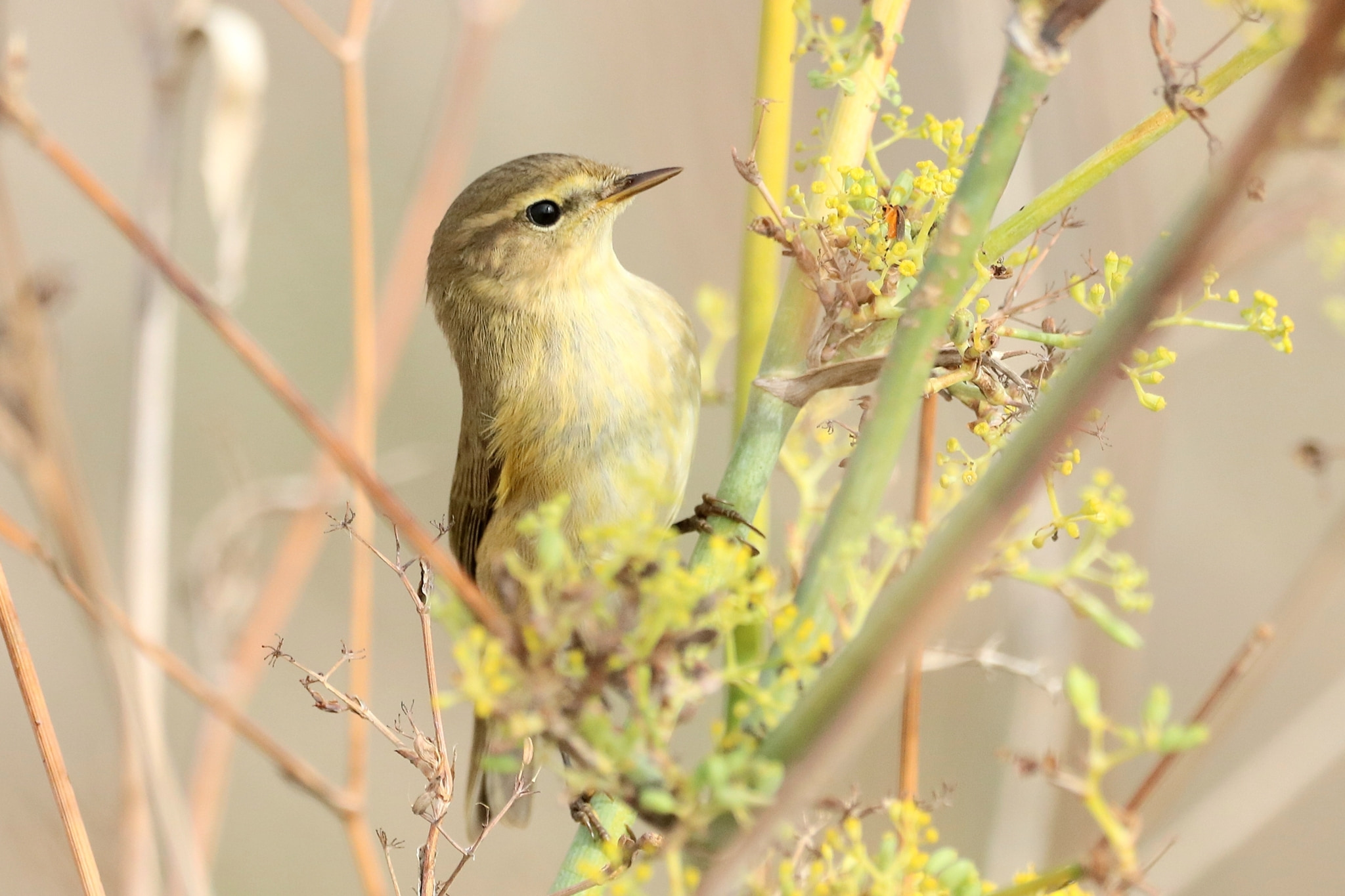
Yellow-browed warbler
Phylloscopus inornatus


Rejoice Gassah · Assam
Key facts in one look
- Size
- 9.5–11 cm
- Diet
- Insects
- Status in Georgia
- Rare, irregular passage migrant
- Habitat
- Lowland and mountain forest, scrub, gardens
- Family
- Phylloscopidae
- Protection
- Globally LC, 2021; in Georgia NE, 2021
The yellow-browed warbler is one of the smallest leaf warblers: smaller than a chiffchaff, it weighs 4–9 g. It breeds from just west of the Urals to Siberia, Mongolia and north-eastern China, and winters mostly in south-east Asia. In Georgia it is a rare migrant, recorded only irregularly. A long yellow eyebrow and two pale wing bars on a green back are its main marks. If a tiny green bird in the branches answers with a piercing two-note "tsee-weest", look for the wing bars.
Identification
Yellow-browed warbler: how to identify it
A tiny leaf warbler, 9.5–11 cm long and 4–9 g. The upperparts are greenish, the underparts white. It has a long yellow eyebrow and two pale wing bars.

Length 9.5–11 cm, weight 4–9 g. It is smaller than a chiffchaff and slightly larger than Pallas's leaf warbler. The bill is brown with a yellow base, the legs reddish brown.
The upperparts are olive green, the underparts white or yellowish white. A long yellow eyebrow and two wing bars, one long and one short, are its main marks. The tertials are edged yellow, and some birds show a faint pale green crown stripe. Young birds show less yellow and green.
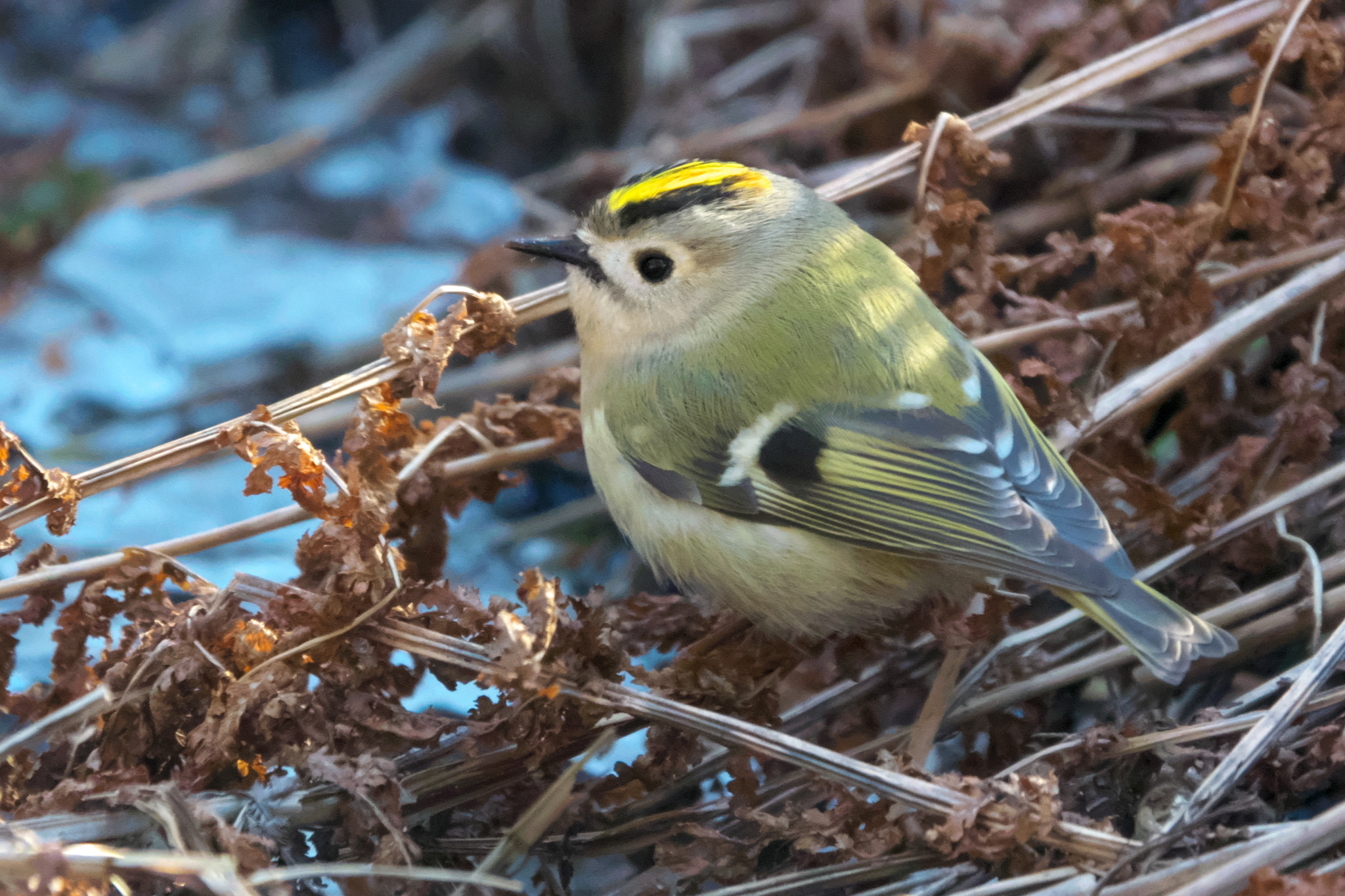
Hume's leaf warbler is duller, with a faint second wing bar and dark legs and lower mandible. Pallas's leaf warbler has a yellow crown stripe and a yellow rump: if no yellow rump shows, it is a yellow-browed warbler.
Colour
Swatches are illustrative. Do not identify a species by colour alone.
Often confused with

It breeds in lowland and mountain forest: open conifer, mixed and light woodland, scrub, gardens and groves. It avoids very open country and dense, dark conifer forest. In summer it reaches about 2,440 m; in winter it occurs up to 1,525 m and also uses more open woods. In Georgia it is seen only on passage, rarely and irregularly.
The yellow-browed warbler is a rare, irregular passage migrant in Georgia. All records come from Adjara, around Batumi, and fall in autumn migration: two in September, the rest in October. The oldest dates from October 2022.
Data: Reptiles.ge + iNaturalist · Methodology
- Field observation
- Several records in one spot
- Region with records
Like most leaf warblers, it eats insects. It searches for them among the leaves and twigs of trees and shrubs. It keeps to insects in winter too, which is why it flies so far to warm countries.
It is a strong migrant. Most birds travel 5,500–6,000 km to south-east Asia for the winter. A small part of the western population winters in western Europe instead: birds reach Britain in late September and October after a 3,000–3,500 km journey from the Urals. The call is a piercing, often two-note "tsee-weest", loud for so small a bird. The song is a high medley of whistles that ends in a buzzing trill. It nests in dense vegetation, often at the foot of a tree or an old stump. The nest is a loose dome of fallen twigs, dry grass stems, moss, rotten wood and conifer needles, lined with grass and sometimes hair. The eggs are white with brown and dark red spots. The female incubates for 11–14 days, both parents feed the young, and the chicks leave the nest at 12–13 days old.
Globally the yellow-browed warbler's risk of extinction is rated low (LC, 2021). It is common over most of its range. The European population west of the Urals has spread westward in recent decades: "fairly scarce" in 1950, it numbered 45,000–46,000 pairs in 1990. In Georgia's national assessment (2021) it was not assessed (NE). The list of the birds of Georgia gives it as a rare migrant, recorded irregularly.
Related guides
Continue with related pages
Yes, but rarely. In Georgia it is a migrant recorded only irregularly, and it does not breed here. Its breeding range starts west of the Urals and runs to Siberia.
It is a tiny green-backed leaf warbler with white underparts. It has a long yellow eyebrow and two pale wing bars, one long and one short. The loud two-note "tsee-weest" call is a good mark too.
Both are tiny and have two wing bars. Pallas's leaf warbler has a yellow central crown stripe and a yellow patch at the base of the tail. The yellow-browed warbler has no yellow rump, and only some show a faint pale green crown stripe. If no yellow rump shows in flight, it is a yellow-browed warbler.
Insects. It searches for them among the leaves and twigs of trees and shrubs. It feeds on insects in winter too. That is why it flies so far for the winter, mostly to south-east Asia.
Most birds travel 5,500–6,000 km to south-east Asia for the winter. A small part of the western population winters in western Europe. From the Urals to Britain is 3,000–3,500 km. For a bird of 4–9 grams that is an enormous distance.
No, it is harmless to people. Globally its risk of extinction is low (LC, 2021). In Georgia's national assessment (2021) it was not assessed (NE). Do not catch wild birds.
References
What this profile is based on
Species profiles are compiled from peer-reviewed literature and established biodiversity databases, and are reviewed as new taxonomic and conservation data become available.
Prepared by the Reptiles.ge editorial team from the sources listed here.