


Green warbler
Phylloscopus nitidus


inna_birds · Gunib District
Key facts in one look
- Size
- 10–11 cm
- Diet
- Small insects and larvae
- Status in Georgia
- Breeding bird, migrant
- Habitat
- Mountain deciduous and mixed forest, subalpine scrub
- Family
- Phylloscopidae
- Protection
- Globally LC, 2024; in Georgia LC, 2021
The green warbler has a small world range: it breeds in the Caucasus, north-eastern Turkey, northern Iran and south-western Central Asia. In Georgia it is a breeding migrant that spends the summer here and leaves for the winter. In the Caucasus it lives in deciduous and mixed forest of the upper mountain belt and in scrub above the tree line, at 900–3,000 m. It looks like its close relative, the greenish warbler, but is brighter, with much yellower underparts. If a tiny yellow-breasted bird in a mountain forest shows you one thin wing bar, it may well be a green warbler.
Identification
Green warbler: how to identify it
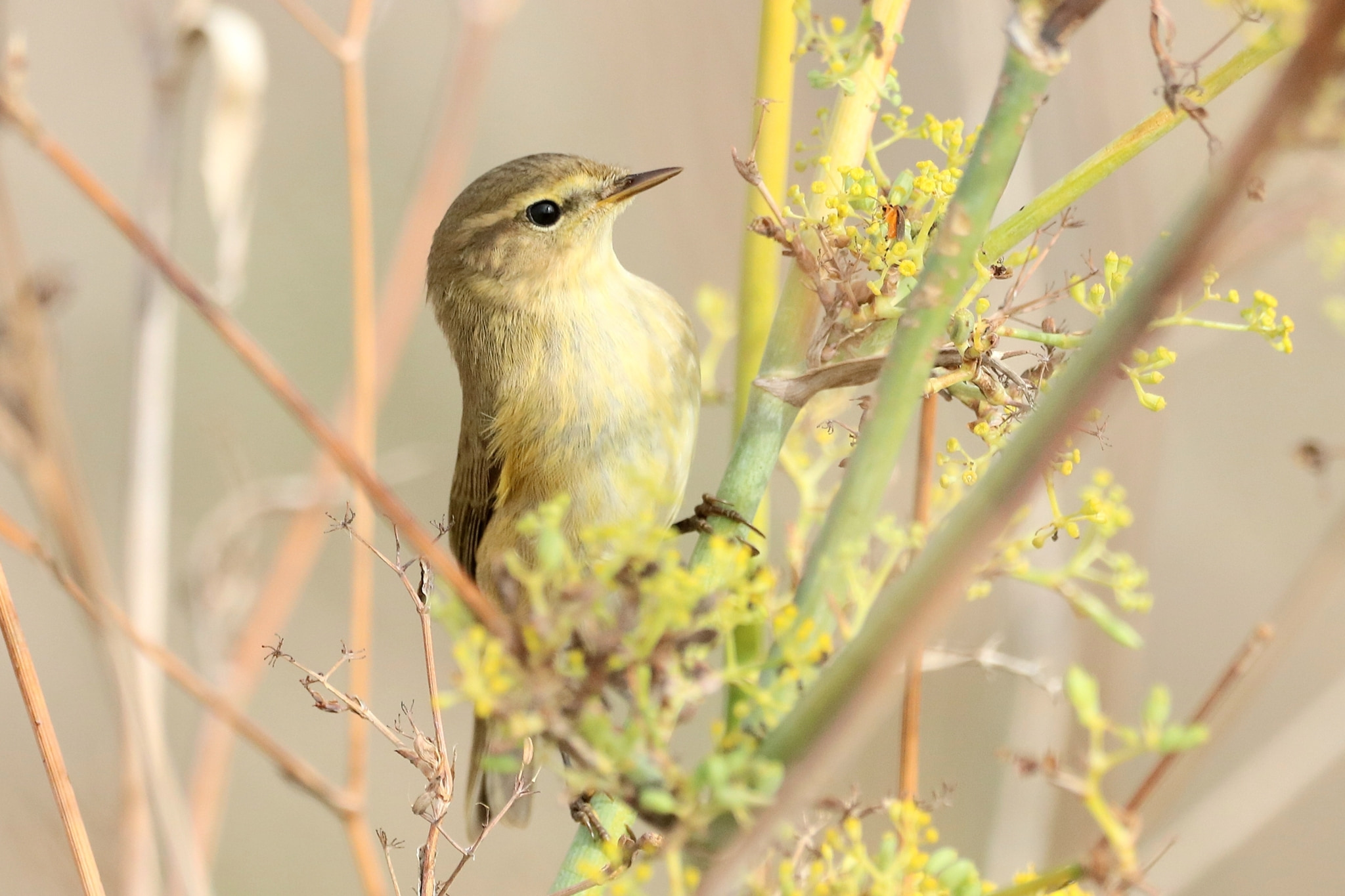
A small leaf warbler, 10–11 cm long and about 7.5 g. The upperparts are green, the underparts and sides of the head lemon yellow. It has one thin yellow wing bar.

Length 10–11 cm, wingspan about 19 cm, weight about 7.5 g. The lower mandible is pale yellowish brown, the legs brownish, the iris dark brown.
The upperparts are green, the sides of the head and the underparts washed lemon yellow. It has one thin yellow wing bar and a second, short, yellowish one that shows more in young birds. In worn plumage the upperparts turn brown and the underparts dingy.
It looks very like the greenish warbler but is brighter, with much yellower underparts. Their voices are almost the same: to tell them apart, look at the yellow breast and belly.
Colour
Swatches are illustrative. Do not identify a species by colour alone.

It is a mountain bird: it breeds in deciduous and mixed forest of the upper belt and above the tree line, in the scrub zone. In the Caucasus it breeds at 900–3,000 m. It also breeds in town parks where it finds shelter. In Georgia it breeds in summer and does not stay outside the breeding season.
The green warbler is a breeding migrant in Georgia. Records run from April to October, with most in May and in August and September; there are none from November to March. Most records come from Mtskheta-Mtianeti, Adjara, Kakheti, Samegrelo-Zemo Svaneti, Samtskhe-Javakheti and Kvemo Kartli. In Adjara they fall mainly in August and September, during autumn migration. It has also been found in Imereti, Tbilisi, Racha-Lechkhumi and Kvemo Svaneti, Abkhazia, Shida Kartli and Guria. The oldest record is a museum specimen collected near Dusheti in 1909.
Data: Reptiles.ge + iNaturalist · Methodology
- Field observation
- Several records in one spot
- Photo record
- Region with records
It eats small insects and their larvae. Like other leaf warblers, it searches for food among the leaves of trees and shrubs. It depends on insects, which is why it flies to warm countries for the winter.
In Georgia it is a breeding bird and a migrant: it arrives for the summer, breeds and leaves for the winter. Both song and call are a sharp two-note phrase, very like the greenish warbler's. So the two are hard to tell apart by voice; go by the colours. It nests in a natural shelter: a burrow, a crack under a stone, a hollow in the ground or a low tree hole. In town parks it also uses gaps in old stone walls. The nest is made of moss, grass stems and horsehair. June clutches hold 6 eggs on average, later ones fewer. Incubation takes about 13 days.
Globally the green warbler's risk of extinction is rated low (LC, 2024). It is a species with a small world range: Georgia has two such species, this one and the Caucasian chiffchaff. In Georgia's national assessment (2021) its risk is also rated low (LC), and its numbers are stable. The list of the birds of Georgia gives it as a breeding bird and a migrant.
Related guides
Continue with related pages
Yes. In Georgia it is a breeding bird and a migrant: it spends the summer here and leaves for the winter. It has a small world range and breeds in the Caucasus, north-eastern Turkey, northern Iran and south-western Central Asia. In the Caucasus it breeds at 900–3,000 m.
It is a small green-backed leaf warbler with lemon-yellow underparts and sides of the head. It has one thin yellow wing bar, sometimes with a second, short one. It looks like the greenish warbler but is brighter and much yellower. The two are hard to tell apart by voice, so trust the colours.
Small insects and their larvae. It searches for them among the leaves of trees and shrubs. It depends on insects. That is why it does not spend the winter in Georgia.
In a natural shelter: a burrow, under a stone, in a hollow in the ground or a low tree hole. In town parks it also uses gaps in old stone walls. The nest is made of moss, grass and horsehair. June clutches hold 6 eggs on average.
It has a small world range. It breeds only in the Caucasus, north-eastern Turkey, northern Iran and south-western Central Asia. Georgia has just two such species, the other being the Caucasian chiffchaff. So Georgia's mountain forests are one of its main homes.
No, it is harmless to people. Globally its risk of extinction is low (LC, 2024). In Georgia's national assessment (2021) its risk is also low (LC), and its numbers are stable. Do not catch wild birds.
References
What this profile is based on
Species profiles are compiled from peer-reviewed literature and established biodiversity databases, and are reviewed as new taxonomic and conservation data become available.
Prepared by the Reptiles.ge editorial team from the sources listed here.


