Pallas's leaf warbler
Phylloscopus proregulus


Dmitry Dubikovskiy · Kemerovo District
Key facts in one look
- Size
- 9–10 cm
- Diet
- Small insects and spiders
- Status in Georgia
- Accidental visitor
- Habitat
- Conifer taiga; in winter forest and scrub
- Family
- Phylloscopidae
- Protection
- Globally LC, 2016; in Georgia NE, 2021
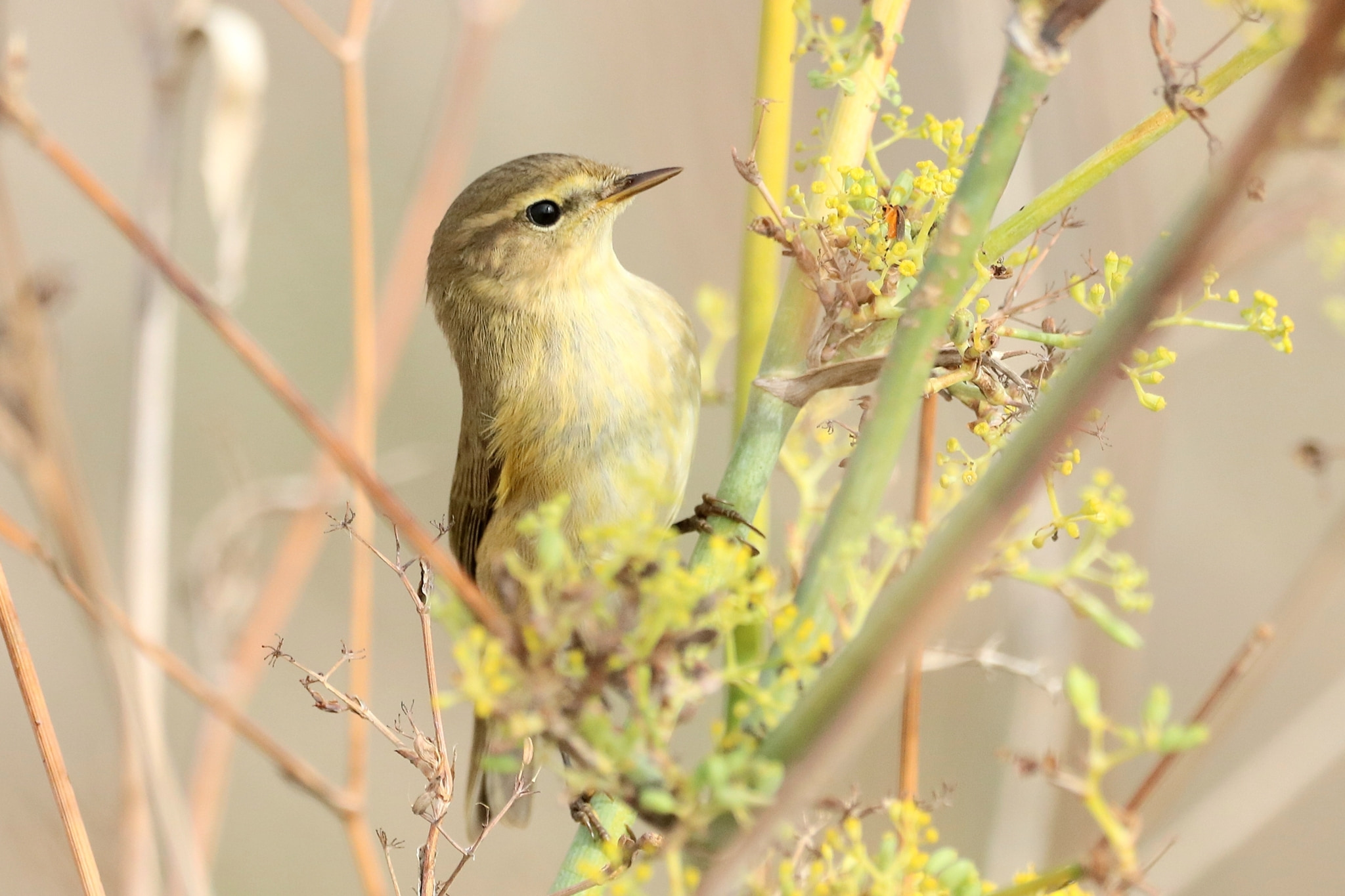
The Pallas's leaf warbler is one of the smallest leaf warblers: 9–10 cm long and 4–7 g, barely larger than a goldcrest. It has a lemon-yellow rump, two yellow wing bars, a yellow eyebrow and a crown stripe. It breeds in the conifer taiga of Siberia, northern Mongolia and northeast China and winters in south China and Indochina. In Georgia it is an accidental visitor. If you see a tiny greenish bird with a yellow rump hovering by the leaves, it may be this one.
Identification
Pallas's leaf warbler: how to identify it
A tiny leaf warbler, 9–10 cm long and 4–7 g, with a big head and a short tail. The back is greenish and the underparts white. It has two yellow wing bars, a yellow eyebrow, a crown stripe and a lemon-yellow rump.

Length 9–10 cm, weight 4–7 g. It is among the smallest leaf warblers: slightly smaller than the yellow-browed warbler and barely larger than a goldcrest. The head is big, the tail short. The bill is blackish brown, the legs brown with a green or greyish tinge.
The upperparts are greenish, the underparts white. It has two bold pale yellow wing bars, a thick yellow eyebrow and a yellow stripe along the middle of the crown. The lemon-yellow rump shows when the bird is low down or hovering; at other times you may not see it.
Male and female look alike. Young birds have a brownish tinge above, greyish-white underparts and a duller eyebrow. Similar yellow-rumped warblers in Asia are told apart by voice and by the colour of the head stripes.
Colour
Swatches are illustrative. Do not identify a species by colour alone.
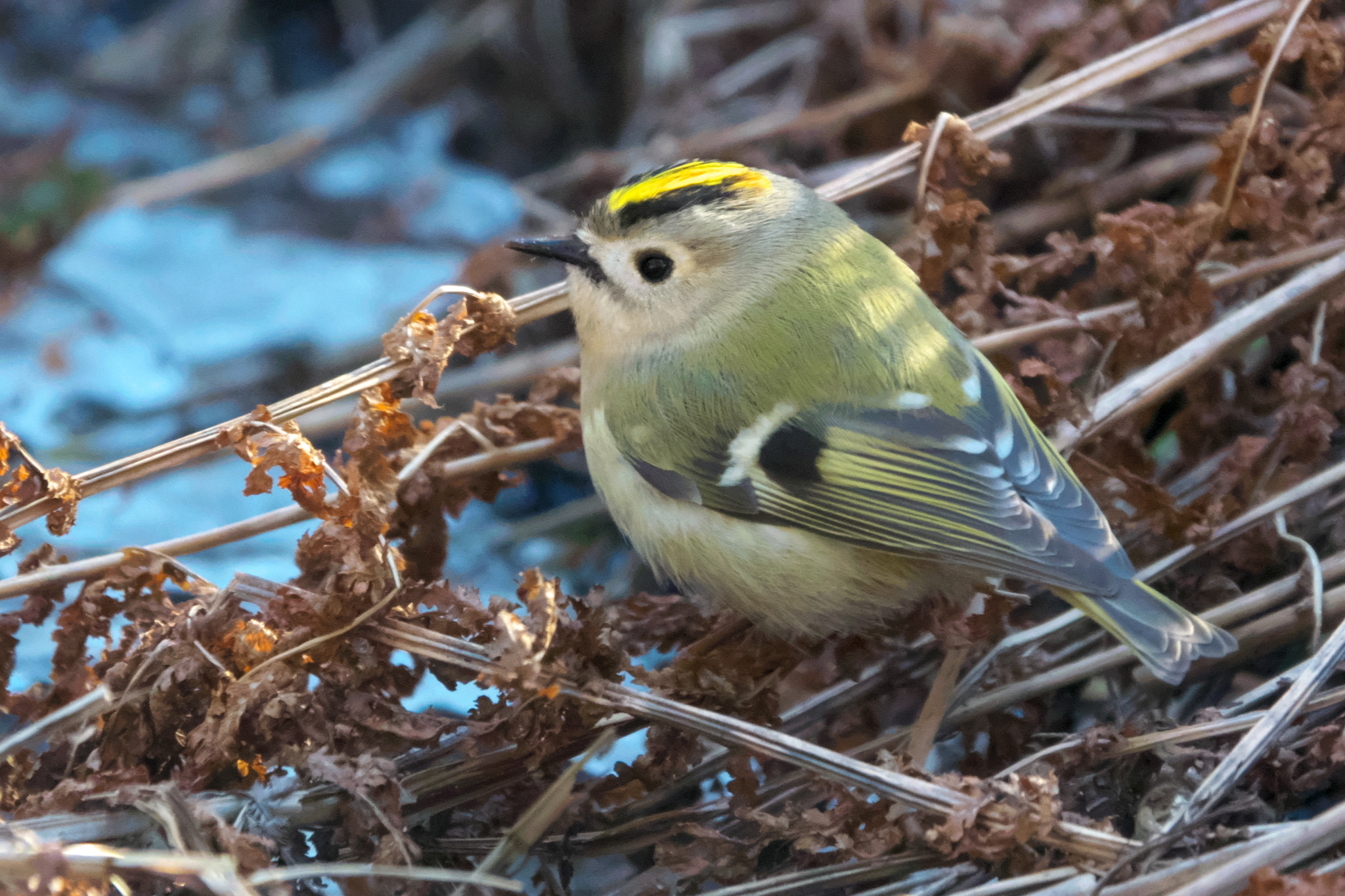
Often confused with

It is a bird of the conifer taiga: it breeds in fir, spruce, pine and larch forest, or in mixed forest where willow and alder grow among many conifers. In southern and far-eastern Russia it breeds from sea level up to 1,500–1,700 m. In winter it uses a wider range of places: broadleaf forest, scrub and conifers, and it comes down to sea level in river valleys.
Pallas's leaf warbler is an accidental visitor to Georgia. All records come from Adjara, in and around Batumi, and all fall in October: 29–31 October 2015 and 2 October 2017.
Data: Reptiles.ge + iNaturalist · Methodology
- Field observation
- Several records in one spot
- Region with records
It eats insects: the adults, larvae and pupae of small insects, among them flies, moths and aphids, and also spiders. It searches for food in bushes and trees. It picks insects from leaves or catches them in short flights or while hovering. Outside the breeding season it often joins mixed flocks with tits, goldcrests and other warblers.
It is always on the move: it creeps through the foliage, often hovers briefly like a goldcrest, and sometimes hangs upside down from a twig. It is not wary, but it lives up in the trees and is hard to see in thick leaves. The song is strong and long, a medley of whistles with trills, and some phrases recall a canary. It lasts 2–4 seconds and comes from a hidden perch near the top of a tall tree. The call is a short, soft "dju-ee". It is a strong migrant: from Siberia it flies to south China and Indochina for the winter. It nests in June and July, laying from mid-June. The female builds the nest in a conifer, usually next to the trunk, 0.5–10 m above the ground, sometimes in a bush. It is a round or oval cup of twigs and leaves, lined with feathers, hair or fine grass. She lays 4–6 eggs and incubates them for 12–13 days. The chicks leave the nest at 12–14 days old, and both parents then feed them for about a week.
Globally the Pallas's leaf warbler's risk of extinction is rated low (LC, 2016). Its range is large and its numbers are thought to be stable, though the global trend has not been measured. It is widespread and common in Russia and northeast China. In southeast Russia up to 35–50 pairs breed per square kilometre. In Georgia's national assessment (2021) it was not assessed (NE). The list of the birds of Georgia gives it as an accidental visitor, with its occurrence documented by photograph.
Related guides
Continue with related pages
Rarely. It is an accidental visitor to Georgia, and its occurrence is documented by photograph. It breeds in the Siberian taiga and winters in south China and Indochina. In recent decades it has turned up more and more often in Europe in autumn. Stray birds have also been seen in western Asia, including Turkey and Iran.
By its lemon-yellow rump. The back is greenish and the underparts white, with two pale yellow wing bars, a yellow eyebrow and a yellow stripe along the middle of the crown. The yellow rump shows best when the bird hovers. It is slightly smaller than the yellow-browed warbler and barely larger than a goldcrest.
Small insects and spiders. It takes flies, moths and aphids, with their larvae and pupae. It picks food from leaves or catches it in short flights and while hovering.
In a conifer, usually next to the trunk, 0.5–10 m above the ground, sometimes in a bush. The female builds the nest and incubates the 4–6 eggs for 12–13 days. The chicks leave the nest at 12–14 days old.
Nobody knows for sure. Such birds used to be thought of as lost wanderers or reverse migrants. Later the idea arose that some of them migrate regularly and spend the winter in the mild coastal climate of Europe. Most birds seen in Europe are in their first year.
No, it is harmless to people. Globally its risk of extinction is low (LC, 2016). In Georgia's national assessment (2021) it was not assessed (NE). Do not catch wild birds.
References
What this profile is based on
Species profiles are compiled from peer-reviewed literature and established biodiversity databases, and are reviewed as new taxonomic and conservation data become available.
Prepared by the Reptiles.ge editorial team from the sources listed here.