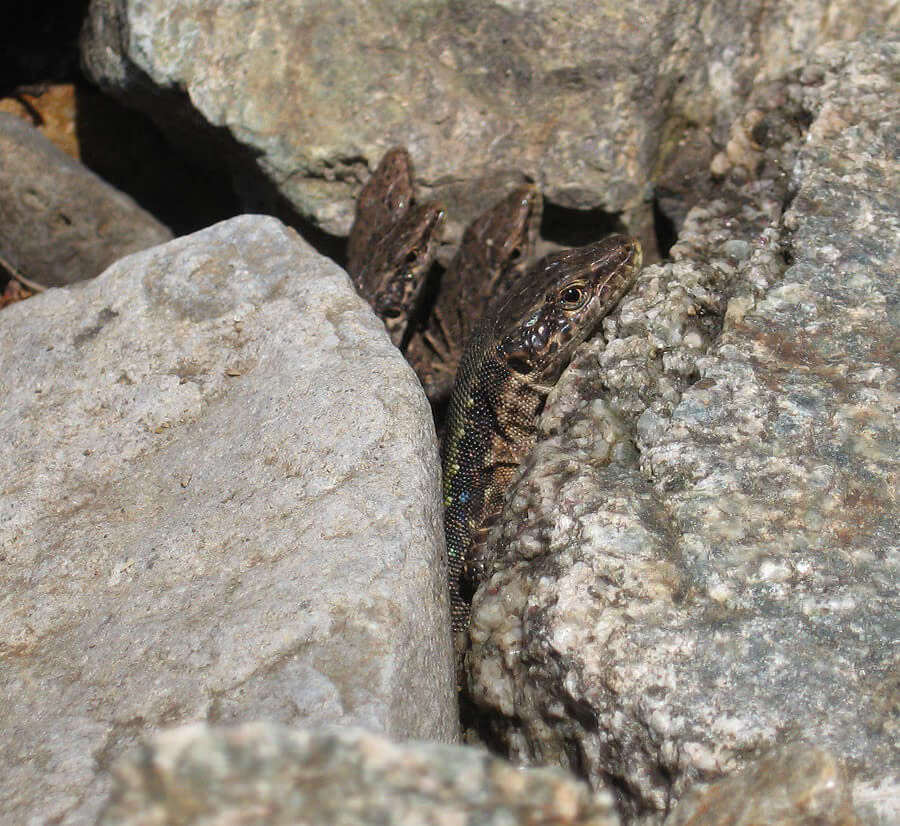
Paralaudakia caucasia is the only lizard from the agama family in Georgia. It is not venomous to humans. Its presence is confirmed in Kakheti, Shida Kartli, Kvemo Kartli, Tbilisi, Mtskheta-Mtianeti and Samtskhe-Javakheti. There are only isolated records from Imereti and Samegrelo-Zemo Svaneti; these regions are not considered part of its range. It has a flattened body and spines arranged in rings on its tail. It is active during the day.
Identification
How to identify Caucasian Agama
The jojo is a sturdy lizard with a flattened body, a triangular head and a spiny tail. The scales on its tail form distinct rings. In a photo taken from a distance, a small jojo and Tenuidactylus caspius may be confused with each other if the eye and tail scales are not clearly visible.
Often confused with

It has a flattened, triangular head. The ear opening is clearly visible.
The scales on the back are not all alike: they are relatively large along the spine and more spiny on the sides of the body.
The tail is about twice as long as the body and is covered in rings of spiny scales. This is one of the most noticeable features for identifying the animal.
The back is usually olive-colored or gray. The body may have yellowish spots or a dark, net-like pattern. During the breeding season, the male’s chest and the sides of its belly may darken.
A young jojo may have dark spots or crosswise stripes on its back; the Caspian gecko has a similar pattern. Up close, look at the gecko’s vertical pupil and the rings of spines on the jojo’s tail. Do not tell them apart only by whether you saw them by day or at night: the gecko is mostly active at night, but it has also been seen during the day.

Gallery
Caucasian Agama in photos
Jojo lives on dry, rocky slopes and steep cliffs. Its flattened body helps it slip into narrow crevices. It also shelters under rocks and in burrows. In Georgia, Jojo has been found in Fia and Tmogvi in Aspindza Municipality, and around Datviskhevi and Pantishara in Dedoplistskaro Municipality. It is also found on the Iori Plateau, in Kartli, Borjomi Municipality and Meskheti.
Distribution
Where Caucasian agama distribution is confirmed in Georgia
626 field records2007–20268 regions
Interactive map is loading.
- Field observation
- Several records in one spot
- Confirmed distribution region
The Caucasian agama map combines Reptiles.ge editorial photo records with public iNaturalist observations. Regions are taken from the records-by-region table, and only regions with confirmed status are treated as distribution.
Data: Reptiles.ge + iNaturalist · Methodology
Questions
Frequently asked questions
Short answers to the most important questions about Caucasian Agama.
Paralaudakia caucasia is the only lizard in the agama family found in Georgia.
It is confirmed to occur in Kakheti, Shida Kartli, Kvemo Kartli, Tbilisi, Mtskheta-Mtianeti and Samtskhe-Javakheti, including the municipalities of Aspindza and Dedoplistskaro. There are only isolated records from Imereti and Samegrelo-Zemo Svaneti, so these regions are not considered part of its range.
Jojo is not venomous. It may bite if picked up, so do not touch it. Leave it in the wild.
The Caucasian agama measures up to 15 cm from the tip of its snout to the base of its tail. Its tail is about twice as long as its body.
To identify the Caucasian agama, look at its firm, flattened body, triangular head, uneven, spiny scales, and the spines arranged in rings on its tail. To tell it apart from a gecko, check its pupil and tail scales. Its colour alone, or when you saw it, is not enough.
It eats insects, spiders and other small animals like them. It also eats plant-based food.
Jojo is often seen on rocks during the day, especially in warm weather.
References
Sources
References
Sources
- Tarkhnishvili et al. 2026 — Annotated checklist of Georgia's amphibians and reptiles
- Nikolskii 1913 — Georgian records cited in Tarkhnishvili et al. 2026
- Muskhelishvili 1970 — Georgian records cited in Tarkhnishvili et al. 2026
- Bannikov et al. 1977 — Georgian records cited in Tarkhnishvili et al. 2026
- Baig et al. 2012 — Morphology-based revision of Laudakia (Paralaudakia)
- The Reptile Database
- Aghasyan et al. 2017 — IUCN Red List account for Paralaudakia caucasia
- Georgian Government Resolution No. 190 of 2014 — Red List of Georgia
- Georgian National Encyclopedia — კავკასიური ჯოჯო (A. Bukhnikashvili)
- Panov and Zykova 2016 — Rock Agamas of Eurasia
- Karadeniz Technical University — Türkiye'nin Sürüngen Türleri
- Khisroon et al. 2013 — Caucasian rock agama morphology and juvenile pattern
- Besharati et al. 2021 — Caspian thin-toed gecko morphology and photographs
- Prondzynska 2025 — Caspian bent-toed gecko juveniles and field photographs in Georgia
Species profiles are compiled from peer-reviewed literature and established biodiversity databases, and are reviewed as new taxonomic and conservation data become available.
Related guides