


The Colchis slow worm (Anguis colchica) is a legless anguid lizard. Tarkhnishvili et al. 2026 treat it as a candidate species: it belongs to the widespread western Eurasian A. fragilis complex; Gvoždík et al. (2010) elevated the Caucasian form (A. f. colchica) to species rank. It is likely allopatric with A. graeca and A. fragilis; cytochrome b difference from those relatives is 6.5–8%. That does not confirm species rank in this atlas — it remains a candidate. It is often confused with the European glass lizard or with snakes. The checklist figure is from Nigoeti; barcodes are from Mtisdziri environs, Baniskhevi, and Lanchkhuti. It is harmless to people.
Identification
How to identify Colchis Slow Worm
A legless lizard with eyelids — not a snake. Smaller and smoother than the glass lizard, without a side fold.
Often confused with


A legless lizard with a snake-like body but movable eyelids — snakes have none. Secretive; it is not a snake.
Smaller and smoother than the glass lizard; no clear side fold or lateral groove.
The glass lizard (Pseudopus apodus) often has a yellow belly and hind-limb rudiments near the cloaca. The slow worm is not read by those marks.
Harmless to people; neither the slow worm nor the glass lizard is a snake.
Often confused with the glass lizard or with snakes. In this atlas it remains a candidate in the A. fragilis complex — species rank is not treated as settled here.

Gallery
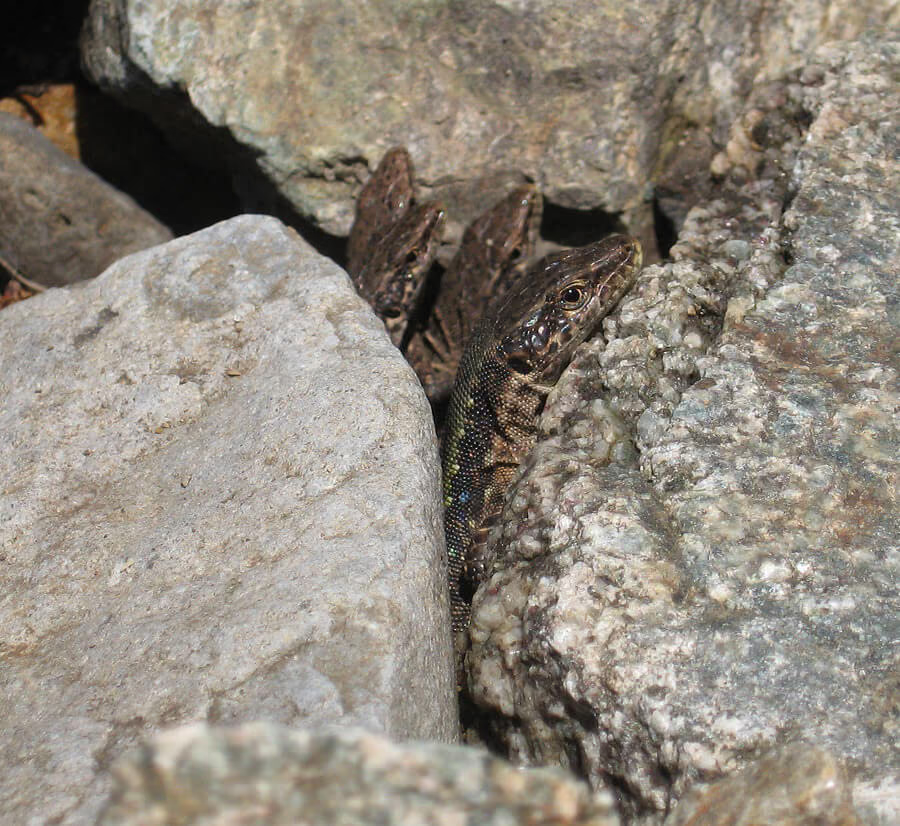
Colchis Slow Worm in photos
Questions
Frequently asked questions
Short answers to the most important questions about Colchis Slow Worm.
No — it is a legless lizard. Unlike a snake, it has movable eyelids.
The European glass lizard (Pseudopus apodus) is a large legless lizard with a clear side fold and often a yellow belly. The slow worm is smaller and smoother. Both are harmless.
Tarkhnishvili et al. 2026: it is in the A. fragilis complex; the Caucasian form was raised to species rank, but this atlas does not treat that rank as settled.
Harmless. It has no venom.
The checklist figure is from Nigoeti; barcodes are from Mtisdziri, Baniskhevi, and Lanchkhuti (Tarkhnishvili et al. 2026).
A legless lizard with eyelids — not a snake. Smaller and smoother than the glass lizard, without a side fold.
Small invertebrates; the checklist does not specify diet.
References
Sources
References
Sources
- Tarkhnishvili et al. 2026 — Annotated checklist of Georgia's amphibians and reptiles
- Gvoždík et al. 2010 — Anguis fragilis as a species complex
- Iankoshvili & Tarkhnishvili 2021 — Georgian herpetofauna records cited in Tarkhnishvili et al. 2026
- The Reptile Database
Species profiles are compiled from peer-reviewed literature and established biodiversity databases, and are reviewed as new taxonomic and conservation data become available.
Related guides
Continue with related pages

Darevskia adjarica
Ajarian Rock Lizard
Adjara (Shuakhevi) and Abastumani
Darevskia armeniaca
Armenian Rock Lizard
Southern Georgia — Ninotsminda (Saghamo), Akhalkalaki

Darevskia brauneri
Brauner's Rock Lizard
Western and central Greater Caucasus — Mestia (Manshura), Martvili, Ertso Lake

Darevskia caucasica
Caucasian Rock Lizard
Greater Caucasus