


The Colchic meadow lizard (Darevskia pontica) occurs in Georgia’s northwestern Black Sea region. It lives on the ground, has no venom and is not dangerous to people. It belongs to the family of true lizards (Lacertidae). A 2026 Georgian list treats it as a possible separate species: it distinguishes these lizards in northwestern Georgia’s Black Sea region from the meadow lizard (Darevskia praticola), although it has not yet been shown that the two groups are clearly separated genetically. The specimen used to describe the species is recorded as coming from Gagra, on the Black Sea coast of Abkhazia, rather than eastern Georgia. This atlas marks Abkhazia on its map because of that record; the mark does not mean the species occurs only in Gagra. IUCN has not assessed D. pontica separately; in 2009, the meadow lizard group was assessed as Near Threatened. This species is not on Georgia’s 2014 Red List.
Identification
How to identify Pontic Meadow Lizard
This small meadow lizard lives on the ground in the northwestern part of the Black Sea region. Color alone is not enough to tell it apart from other Darevskia lizards in the wild. We also need to look at its scales, how it lives, and where it is found.
Often confused with


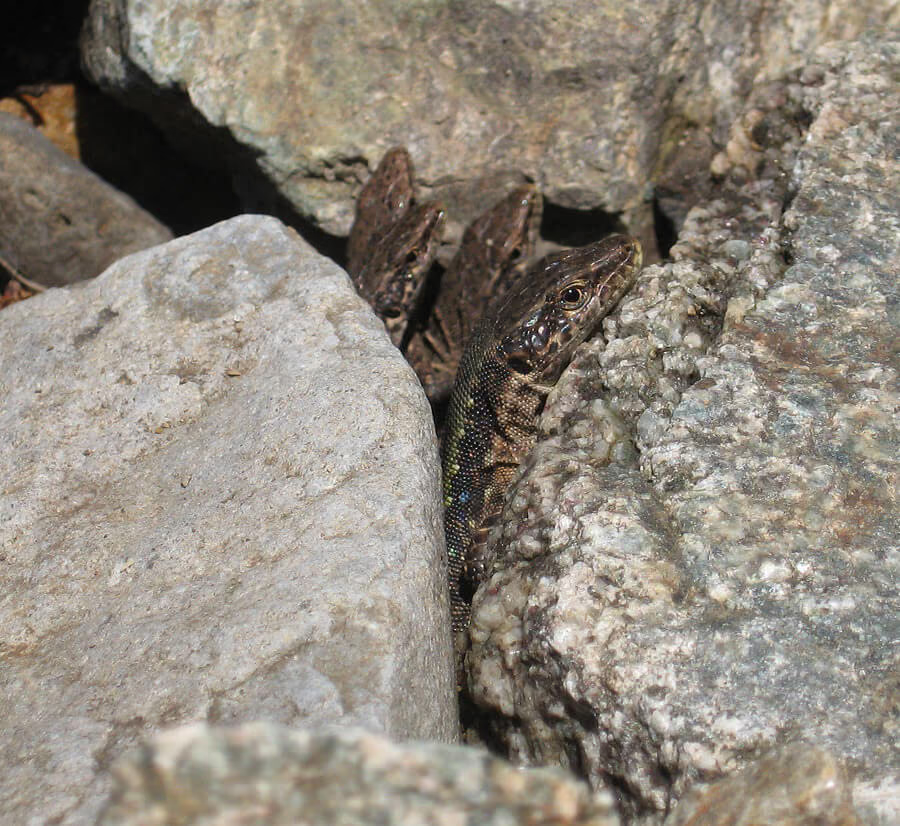
This is not a rock lizard (Darevskia): it has short limbs and lives on the ground in meadows and at forest edges. Its back is often brownish gray with dark spots. A broad dark stripe is also often visible along its back. This appearance is typical, but color alone is not enough to tell species apart.
In animals studied from the northwestern Caucasus, the head and body, measured from the snout to the cloaca (the base of the tail), are often about 4–6 cm long. This page does not provide a complete set of measurements for specimens from Georgia. Total length, including the tail, has not been measured here.
pontica often has six pairs of plates under its chin. Three of those pairs meet along the middle of the chin. praticola often has five pairs, two of which meet along the middle. Some animals in eastern Georgia, including on the Tsiv–Gombori Ridge, also have six pairs. This feature can help distinguish the species, but it is not enough on its own to identify an individual animal.
In this atlas, meadow lizard (D. praticola) refers to the group found in eastern and central Georgia (Sioni, Tushurebi), while pontica refers to the Pontic groups in the northwest. Color is not a reliable way to tell them apart: where they occur is a better guide than the shade of their backs. Sources differ on whether they are separate species or subspecies.
The Artvin lizard (D. derjugini) has also been confirmed in western Georgia. It lives on the ground in forests and is more often found deep in the forest or beside streams. Do not identify it by color alone: the meadow lizard (Lacerta agilis) is larger in the west and belongs to a different genus. It is not a small Darevskia.

It occurs in Georgia. However, its presence on the eastern lowlands or in the high mountains of Javakheti should not be assumed, nor should it be thought of as living only on sheer rock faces. It was described in 1918 under the name Lacerta praticola pontica. The location given in the original description is Gagra; in 2016, this was specified more precisely as the area around Gagra in Abkhazia. In 2011, an adult male (ZISP 22853), collected in June 1911, was chosen as the main reference specimen. The 2026 list gives neither a specific village nor a DNA barcode in its entry for pontica. Its entry for praticola assigns the Pontic groups in northwestern Georgia to pontica. The information on its distribution is of moderate reliability. For now, this atlas shows only Abkhazia on the map because Gagra is named in the original description. This does not mean that every meadow in Colchis has been surveyed. The original description also included unusual animals found at Ananuri in the Aragvi valley. In 2016, Doronin assigned them to praticola in its usual sense, not to pontica. It lives in meadows, along forest edges and in deciduous forests, on the ground among grass and leaves—not on sheer rock faces like Darevskia. Its full elevation range in Georgia has not been established for this page.
Biology
Diet, behavior, and conservation
Diet
This page does not include results from studies of the stomach contents of these lizards in Georgia. Lizards in the meadow lizard group probably eat small animals, such as insects, spiders and similar prey. This is not a confirmed list of what they eat in Georgia. They are not venomous; they catch prey with their jaws.
Behavior
It is active during the day. It lives on the ground, warming itself on rocks or by roadsides and hiding among grass, leaves and roots. This page does not say which hours of the day it is active in Georgia. In the northwestern Caucasus, in Krasnodar Krai (outside Georgia), it usually lays eggs in June. It often lays 1–6 eggs at a time and lays eggs once per season. There, the head and body are often about 4.2–6.2 cm long; females are usually larger than males. These measurements come from animals measured in Russia, not Georgia. If caught, its tail may come off, and it may bite. Watch it and leave it where it is. Do not pick it up.
Conservation
The 2026 list includes D. pontica as a possible separate species, but more evidence is needed that it is isolated from praticola. In 2009, the IUCN assessed Darevskia praticola as Near Threatened, without treating pontica as a separate species. D. pontica has no separate IUCN status. It is not on Georgia’s 2014 Red List, which includes other Darevskia species, such as clarkorum, dahli and mixta. Whether its numbers in Georgia are rising or falling has not been measured here. It is not listed under CITES. Do not catch wild lizards.
Questions
Frequently asked questions
Short answers to the most important questions about Pontic Meadow Lizard.
Yes. The 2026 list identifies it as a possible separate species. It gives Gagra, in Abkhazia, as the place where the specimen used to describe it came from. The entry for pontica in that list names no other village or barcode.
Gagra is the place named in the northwestern Pontic region. This atlas’s map shows Abkhazia. It is found in meadows, at forest edges and among leaves, as well as on rocks. This does not mean it is found throughout Georgia.
The meadow lizard is small and lives on the ground. Color alone is not enough to identify it. Compare it with the eastern D. praticola, the western D. derjugini, and the larger L. agilis. Where a lizard is found and the appearance of the scales on its chin are more reliable clues than the color of its back.
No. It has no venom. If you catch it, it may bite you. Its tail may also come off. Leave it where it is.
According to data from the northwestern Caucasus, head and body length is often about 4–6 cm. This page does not provide the full set of measurements from Georgia.
In this atlas, pontica refers to the northwestern Pontic populations and is considered a candidate for separate recognition; praticola refers to populations in eastern and central Georgia. Some databases still treat pontica as a subspecies. They cannot be distinguished by color.
There is no agreement on whether it is a species or a subspecies. Tuniyev (2011) considers it a species; Freitas (2016) groups the Caucasian pontica with praticola; Reptile Database retains it as a subspecies. This list does not consider its isolation proven.
During the day. This page does not give a complete account of when things happen throughout the year in Georgia. In the northwestern Caucasus, eggs have usually been seen in June. That timing applies only to that region.
References
Sources
References
Sources
- Tarkhnishvili et al. 2026 — Annotated checklist of Georgia's amphibians and reptiles
- Lantz & Cyrén 1918 — Note sur Lacerta praticola Eversm.
- Tuniyev et al. 2011 — Systematic and geographical variability of the meadow lizard
- Doronin 2016 — Type specimens of the Darevskia (praticola) complex
- Freitas et al. 2016 — Cryptic diversity in Darevskia praticola
- Speybroeck et al. 2020 — Species list of the European herpetofauna
- Kidov et al. 2016 — Age, growth and reproduction of Darevskia pontica in the Northwest Caucasus
- Kidov et al. 2017 — Reproduction of Darevskia pontica on the north-east of the range
- Agasyan et al. 2009 — IUCN Red List, Darevskia praticola
- საქართველოს მთავრობის დადგენილება №190 (2014) — წითელი ნუსხა
- The Reptile Database — Darevskia praticola
Species profiles are compiled from peer-reviewed literature and established biodiversity databases, and are reviewed as new taxonomic and conservation data become available.
Related guides
Continue with related pages

Darevskia adjarica
Ajarian Rock Lizard
Adjara (Shuakhevi) and Abastumani

Darevskia alpina
Alpine Rock Lizard
Western Greater Caucasus — literature; no named locality in the checklist
Darevskia armeniaca
Armenian Rock Lizard
Southern Georgia — Ninotsminda (Saghamo), Akhalkalaki

Darevskia brauneri
Brauner's Rock Lizard
Western and central Greater Caucasus — Mestia (Manshura), Martvili, Ertso Lake