


Mountain chiffchaff
Phylloscopus sindianus


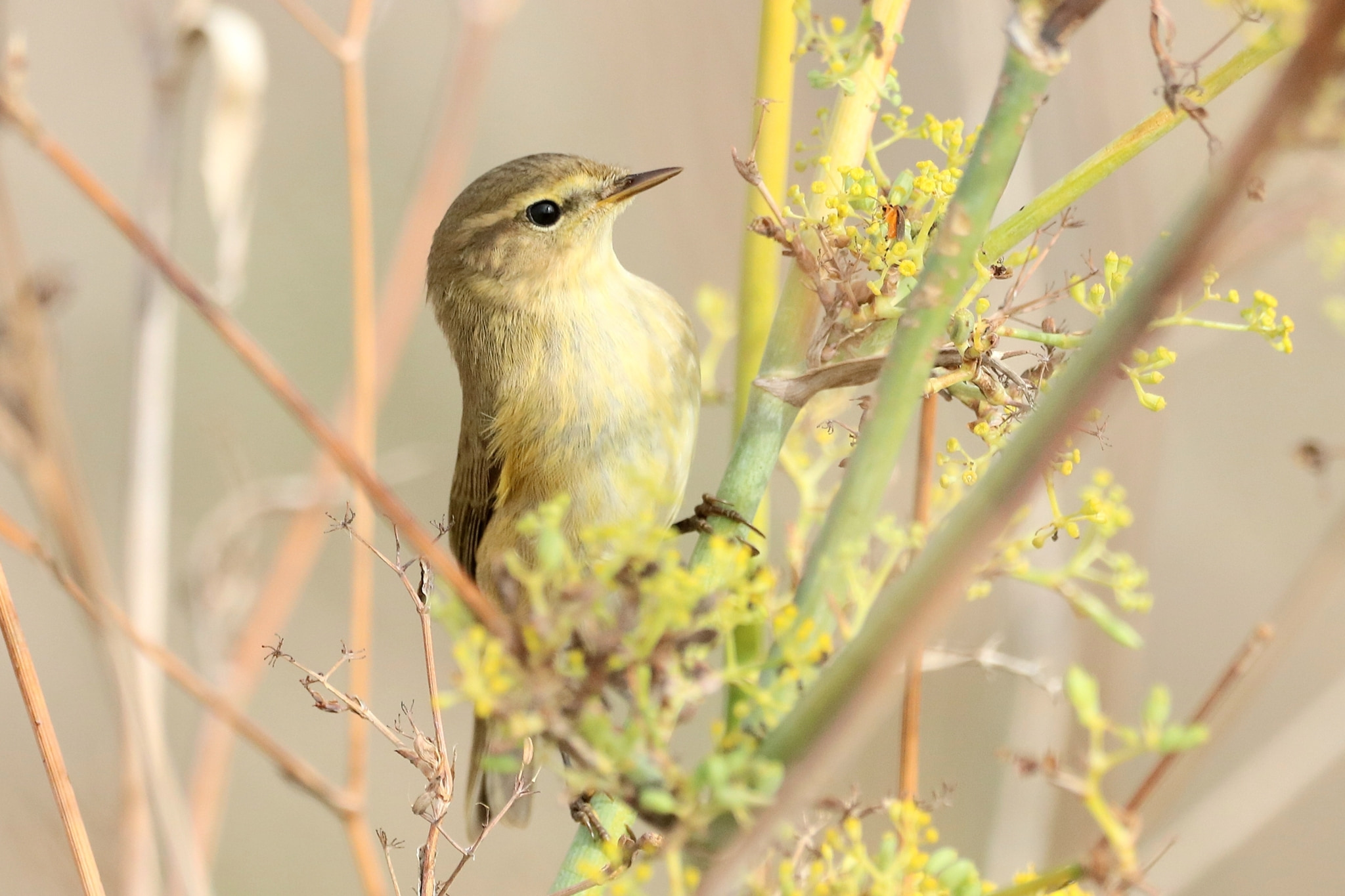
Mikael Bauer · Mtskheta-Mtianeti Georgia field photo
Key facts in one look
- Diet
- Small insects, especially flies; berries
- Status in Georgia
- Breeder, migrant
- Size
- 10–11.5 cm
- Habitat
- High mountain forest
- Family
- Phylloscopidae
- Conservation
- Global LC, 2019; Georgia LC, 2021
The Caucasian subspecies of the mountain chiffchaff lives in a small area of the world: the Caucasus, north-eastern Turkey and north-western Iran. In Georgia it is a breeder and a migrant, nesting mainly in high mountain forests. It looks very like the common chiffchaff, but is brownish above and creamy white below, with a black bill and legs. Some lists treat the Caucasian form as a separate species, Phylloscopus lorenzii. If you hear a fast song of short syllables high in the mountains in summer, record it: it may be a mountain chiffchaff.
Identification
Mountain chiffchaff: how to identify it
A small leaf warbler 10–11.5 cm long. It is brownish above and creamy white below, with a black bill and legs.

Length 10–11.5 cm, one of the smaller leaf warblers. It is brownish above and creamy white below. The bill and legs are black.
The Caucasian subspecies, P. s. lorenzii, is a warmer, darker brown than the Central Asian one. The Central Asian subspecies looks like a Siberian chiffchaff, but has a finer, darker bill, browner upperparts and buff flanks.
It looks very like the common and Siberian chiffchaffs and differs from them in voice, appearance and genes. If you see a brownish, black-legged chiffchaff in a high mountain forest in summer, record its voice: in this group the voice is the most reliable mark.
Colour
Swatches are illustrative. Do not identify a species by colour alone.
Often confused with
It breeds mainly in high mountain forests of the Caucasus and Transcaucasia. The range of the Caucasian subspecies covers the Caucasus, north-eastern Turkey and north-western Iran. In winter it moves down from the mountains. In Georgia it has been photographed in Kazbegi in May and in Tusheti National Park.
The mountain chiffchaff breeds in Georgia and is also seen on migration. The first records fall in the second half of March, there are many by April and most come from May. Records drop in summer, rise again in September, and the last ones fall in November. There are no records from December to February. By far most records come from Mtskheta-Mtianeti, followed by Samegrelo-Zemo Svaneti, Samtskhe-Javakheti and Kakheti. It has also been found in Kvemo Kartli, Adjara, Tbilisi, Imereti, Racha, Shida Kartli and Abkhazia. The oldest record is a museum specimen collected near Kobi in 1933.
Data: Reptiles.ge + iNaturalist · Methodology
- Field observation
- Several records in one spot
- Photo record
- Region with records
The song is fast and made of short syllables. In the Central Asian subspecies the song is almost identical to the common chiffchaff's, while the call is a weak "psew". The two subspecies, Caucasian and Central Asian, differ from each other in voice, so keep the subspecies in mind when identifying it by voice. In Georgia it is a breeding bird: after breeding it does not stay, and in spring and autumn it is also seen on migration. It is an altitudinal migrant and moves down from the mountains in winter. In a small area of the Western Caucasus it breeds alongside the common chiffchaff, but the two interbreed rarely, if ever. In the Greater Caucasus and Transcaucasia no trace of hybridisation shows up in their genes either.
Globally the mountain chiffchaff's risk of extinction is rated low (LC, 2019). This assessment covers the whole species, the Caucasian and Central Asian subspecies together. The Caucasian subspecies has unexpectedly low genetic diversity. This is probably the trace of a sharp drop in numbers in glacial refugia. In Georgia's national assessment (2021) its risk is also rated low (LC), and its numbers are stable. The list of the birds of Georgia gives it as a breeder and a migrant, one of the two species there with a limited global range.
Related guides
Continue with related pages
Yes. It breeds in Georgia, does not stay after breeding and is also seen on migration. The Caucasian subspecies, P. s. lorenzii, lives here. It has been photographed in Kazbegi on 22 May 2017 and in Tusheti National Park.
With difficulty. The mountain chiffchaff is brownish above and creamy white below, with a black bill and legs. The Caucasian subspecies is a warm, dark brown. It differs from the common chiffchaff in voice, appearance and genes, so a sound recording is the most reliable mark.
Mainly small insects, especially flies. Besides insects it also eats berries and fruit.
Mainly in high mountain forests of the Caucasus and Transcaucasia. In a small area of the Western Caucasus it breeds alongside the common chiffchaff. In Georgia it has been photographed in Kazbegi and Tusheti. In a mountain forest in summer you may hear its fast song too.
Yes. In Georgia it is a breeding bird and does not stay after breeding. It is an altitudinal migrant: in winter it moves down from the mountains. In spring and autumn it is also seen on migration.
No, it is harmless to people. Globally its risk of extinction is low (LC, 2019). In Georgia's national assessment (2021) its risk is also low (LC), and its numbers are stable. Do not catch wild birds.
References
What this profile is based on
Species profiles are compiled from peer-reviewed literature and established biodiversity databases, and are reviewed as new taxonomic and conservation data become available.
Prepared by the Reptiles.ge editorial team from the sources listed here.


