



Snakes
New study: how accurately do we know where Georgia's snakes occur?
A new Ecology and Evolution study shows how incomplete records can change estimates of the Area of Occupancy for snakes in Georgia.
Read the article
The Transcaucasian racer (Zamenis hohenackeri) is a nonvenomous, spotted snake. Its presence in Georgia has been confirmed. Its subspecies Z. h. hohenackeri is found here. It lives mostly in dry, rocky and grassy places. Adults are often less than a metre long. Its spots can make it easy to mistake for another snake, including a viper.
Identification
It is a relatively slender snake. It usually has two rows of dark spots on its back, with a pale line between them. The spots remain into adulthood.
Often confused with
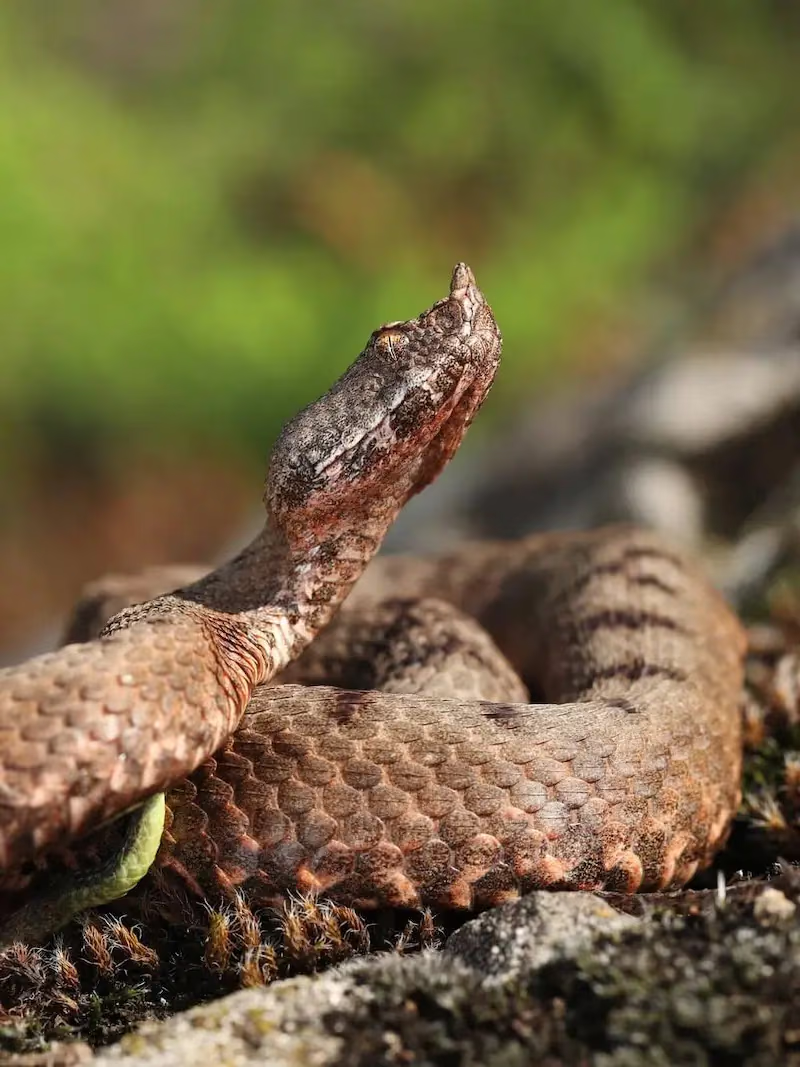
Its pupils are round. It has no horn on its nose, and the scales on its back are mostly smooth. Pupil shape alone is not enough to identify a snake.
The subspecies found in Georgia usually has two rows of brownish spots along its body, with a pale line between them. The spots sometimes join. A dark stripe is visible behind the eye. Color and pattern can vary from one animal to another.
The nose-horned viper has a horn on its nose and scales that are raised in the middle. It is venomous. You can compare these features in a photo, but do not approach a snake to inspect them.

Gallery
In Georgia, this species occurs in dry, rocky or grassy places. Published accounts report it from the villages of Gomaro and Boshuri in Adigeni Municipality and from western Georgia. Tbilisi is also mentioned in the material on which the species’ first description was based. On this page, one field record in a region is enough for “Distribution confirmed” status. This does not mean the species occurs throughout that region; the map does not show its full national range.
Distribution
32 field records2005–20265 regions
Interactive map is loading.
The Transcaucasian rat snake map combines Reptiles.ge field photos with public iNaturalist observations. One field record in a region is enough for confirmed distribution status. Some iNaturalist coordinates are obscured, so points near regional borders are approximate. Record counts reflect observation effort, not population density.
Data: Reptiles.ge + iNaturalist · Methodology
Biology
It mainly hunts rodents and birds. It also eats lizards. It catches prey with its body. These sources contain no separate study of what it eats in Georgia.
Questions
Short answers to the most important questions about Transcaucasian Ratsnake.
Yes. According to the 2026 list, biological data confirm its presence. The same list identifies its subspecies Z. h. hohenackeri for the country.
It is mostly found in dry, rocky and grassy places. Published accounts report it from Gomaro (Adigeni Municipality), Boshuri and western Georgia. On the map, one field record in a region is enough for confirmed distribution status.
No. This snake belongs to the colubrid family and is not venomous. Do not pick it up, as you might mistake it for another snake.
Its pupil is round. Two rows of dark spots run along its back, with a light-colored line between them. A dark stripe runs from its eye to the corner of its mouth. The spots remain in adulthood.
Adults are often less than one meter long. These sources do not provide a separate series of measurements for Georgia.
It mainly eats rodents and birds, and sometimes lizards. These sources do not include a separate study of what it eats in Georgia.
This species is not on Georgia’s 2014 Red List. It was placed in category LC in a 2009 global assessment. That assessment did not evaluate its population in Georgia separately.
References
Species profiles are compiled from peer-reviewed literature and established biodiversity databases, and are reviewed as new taxonomic and conservation data become available.
Related guides

Zamenis longissimus
Adjara, Abkhazia, Imereti, Racha — Lechkhumi — Kvemo Svaneti, Samtskhe — Javakheti, Shida Kartli

Dolichophis schmidti
Eastern Georgia

Eirenis collaris
Southeastern Georgia

Eirenis modestus
Eastern and central Georgia