




Snakes
New study: how accurately do we know where Georgia's snakes occur?
A new Ecology and Evolution study shows how incomplete records can change estimates of the Area of Occupancy for snakes in Georgia.
Read the article
The spotted whip snake (Hemorrhois ravergieri) is a harmless, blotched racer of dry rocky country in Georgia. It belongs to the family Colubridae. The 2026 Georgian checklist treats it as biologically confirmed. The named locality is Aspindza, Tmogvi, in Samtskhe — Javakheti; COI barcodes come from there too. The 2021 Georgian snake survey places it among dry-climate species of rocky or grassland habitats, mostly in eastern Georgia, and notes a substantial gain in knowledge for this species. Do not expect it throughout the country. The wider range runs from the Caucasus into Central Asia. Across the species, adults may reach about 1–1.3 m; a separate Georgian length series is not published here. It is not dangerous to people — it has no venom. IUCN lists it as Least Concern. Older books often used Coluber ravergieri or Zamenis ravergieri; the modern genus is Hemorrhois.
Identification
A slender, harmless racer with a round pupil and a blotched back. In Georgia the key points are dry rocky ground and the absence of a vertical pupil — this is not a viper and not a Levantine viper.
Often confused with
The body is slender and built for speed. The head is moderately distinct from the neck. The pupil is round. Dorsal scales are weakly keeled; there are often 21 rows at mid-body. Across the species, length may reach about 1.3 m. Do not pick the snake up to count scales.
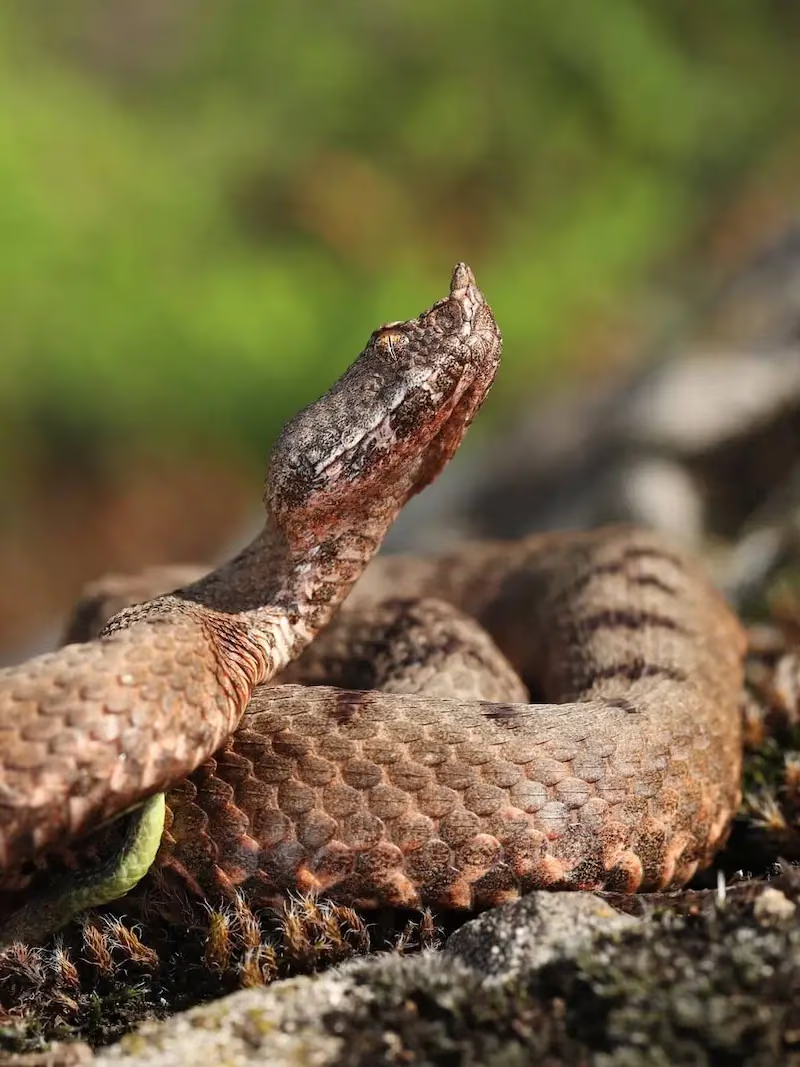
The ground colour is grey, brown, or sandy. The back has dark rhomboid or crossbar blotches and smaller spots on the sides. Toward the tail the blotches often join into lengthwise stripes. A dark diagonal streak sits below the eye; another runs from the eye toward the mouth corner. The belly is whitish, often with fine dark dots.
Dahl’s whip snake (Platyceps najadum) is thinner, with neck ocelli rather than rhombs along the whole back. The Urartian ratsnake (Elaphe urartica) is stouter, with a dark head and larger rounded blotches. The steppe ratsnake (Elaphe dione) has a finer pattern and often lengthwise stripes. Adult red-bellied racers (Dolichophis schmidti) are often plain coppery with a red belly. The smooth snake is smaller and has smooth scales.
A viper has a vertical pupil, a more triangular head, and strongly keeled scales; it is venomous. The Levantine viper (Macrovipera lebetina) is heavier, with a broad head and a vertical pupil — medically significant. If a blotched snake has a vertical pupil, it is a viper, not this species. There is no venom. A bite can still hurt. Do not pick it up.
The 2026 Georgian checklist treats it as biologically confirmed. The named locality is Aspindza, Tmogvi, in Samtskhe — Javakheti. The 2021 Georgian snake survey places it among dry-climate species of rocky or grassland habitats, mostly in eastern Georgia. Do not expect it throughout the country.

Gallery
The 2021 Georgian snake survey treats this species as dependent on a fairly dry climate: rocky or grassland settings, mostly in eastern Georgia. The 2026 checklist does not name a habitat type. The figured specimen is from Aspindza, Tmogvi, in the rocky Mtkvari canyon. This atlas maps only Samtskhe — Javakheti, because no other named Georgian locality is given on this page. The 2021 survey notes that some eastern colubrids have also been recorded in suitable western habitats and that knowledge of this species improved; named western or Colchic points are still not listed here. Across the range it uses dry and semi-arid slopes, canyons, and steppe; a separate Georgian elevation band has not been published. Outside Georgia the range includes the Caucasus, Anatolia, Iran, and Central Asia. The type locality is usually given as Baku, not Georgia.
Biology
There is no separate Georgian diet study. Elsewhere in the range it takes lizards, small mammals, birds, and other snakes. It has no venom — it catches prey by speed. The Georgian diet has not been measured directly.
Across the range it is mainly active by day; it often basks and moves quickly. Hourly activity in Georgia has not been described separately. When threatened it usually tries to flee. Do not pick it up — it has no venom, but a large snake can bite. It lays eggs; outside Georgia the literature often cites 4–10 eggs. Mating season and clutch size for Georgian animals have not been published here. In the same dry south you may also meet Dahl’s whip snake (Platyceps najadum), the Urartian ratsnake (Elaphe urartica), and, more rarely, the Levantine viper (Macrovipera lebetina) — pattern, head shape, and pupil differ. Confusion with a viper is dangerous: vipers have a vertical pupil.
The 2017 IUCN Red List assessment is Least Concern — the range is wide. It is not on Georgia’s 2014 Red List. The 2026 checklist treats it as biologically confirmed; distribution confidence is medium. The Georgian distribution picture is still uneven: the named recent point is Tmogvi, and the 2021 survey notes a gain in knowledge but does not provide a full map. Local threats include habitat conversion, road mortality, and killing after confusion with venomous snakes. Do not handle it.
Questions
Short answers to the most important questions about Spotted Whip Snake.
Yes. The 2026 checklist treats it as biologically confirmed. The named locality is Aspindza, Tmogvi. It does not occur throughout the country.
The named recent point is in Samtskhe — Javakheti, around Tmogvi. The 2021 survey links it to dry rocky or grassland habitats, mostly in the east, and notes a gain in knowledge. This atlas maps only Samtskhe — Javakheti. Named western or Colchic points are not listed here.
No. It has no venom. When threatened it usually flees. A large snake can bite — do not pick it up. A vertical pupil points to a viper or Levantine viper.
Slender build, round pupil, grey or brown ground with rhomboid blotches that often become stripes on the tail, and a dark streak by the eye. Dahl’s whip snake has neck ocelli, not rhombs along the back. Vipers and the Levantine viper have a vertical pupil.
Across the species, adults are about 1–1.3 m. A separate measured length for Georgian animals is not given on this page.
It lays eggs; outside Georgia the literature often cites 4–10 eggs. Diet has not been studied separately in Georgia; elsewhere it takes lizards, small mammals, birds, and other snakes.
Across the range it is mainly diurnal. A separate hourly and seasonal calendar for Georgia has not been published; expect the warm season in dry rocky country.
The spotted whip snake is more slender and fast; the blotches are often rhomboid and turn into stripes on the tail. The Urartian ratsnake is stouter, with a dark head and larger rounded blotches. Both are harmless.
References
Species profiles are compiled from peer-reviewed literature and established biodiversity databases, and are reviewed as new taxonomic and conservation data become available.
Related guides