


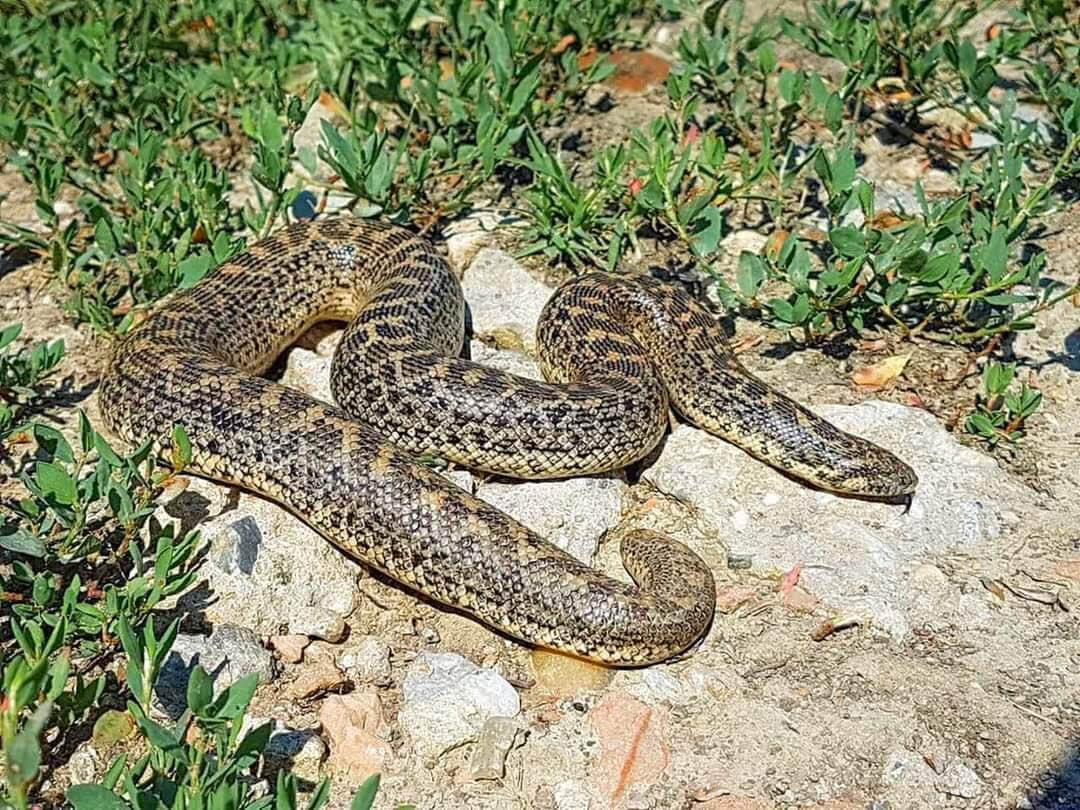
The javelin sand boa (Eryx jaculus) is a non-venomous burrowing boa found in Georgia only in the semi-arid south-east. The 2026 checklist treats it as biologically confirmed and lists the subspecies E. j. turcicus. The 2021 Georgian snake survey places it in the same landscape as the Levantine viper and Urartian ratsnake — not across the whole country. A named barcode and a checklist figure are from Tbilisi. Photos on this atlas are from Lake Kumisi, June 2020 (Giorgi Iankoshvili) and Lisi Lake, 2 July 2023 (Ioane Rostiashvili). In Georgia it is usually under 50 cm; it has no venom and kills prey by constriction. Its burrowing look is easy to confuse with the European blind snake, but the build is different.
Identification
How to identify Javelin Sand Boa
A short, stout harmless boa with small eyes and a blunt tail. Size and visible eyes separate it from the blind snake. The first photo is from Lake Kumisi (June 2020), then Lisi Lake (2 July 2023). Later frames show the species from other parts of the range.
Often confused with


The body is short and stout, almost cylindrical. The head is weakly set off from the neck and covered in small scales — not the large plates of most colubrids. The tail is short with a blunt tip; it can look like a second head. The 2021 Georgian review places it among small snakes to about 70 cm, usually under 50 cm.
The eyes are small but visible. The pupil is a vertical slit. A large rostral scale helps it push into soil. Dorsal scales are smooth in front and weakly keeled toward the tail. The belly scales are narrow.
The ground colour is grey, sand, brownish, or reddish. The back has darker irregular blotches or bars. A dark streak often runs from the eye to the mouth corner. The belly is pale. Pattern varies — do not rely on colour alone.
The European blind snake (Xerotyphlops vermicularis) is worm-like, with eyes reduced under the scales, and is usually much smaller. This species has small but obvious eyes and a boa’s stout body.
The cat snake (Telescopus fallax) is also nocturnal and has a vertical pupil, but the eyes are large and the body is slender, with a more distinct head. The steppe viper has a broad triangular head and keeled scales — it is venomous. The collared dwarf snake occurs in the same dry zone but is a thin colubrid with a round pupil.

Gallery
Javelin Sand Boa in photos
Look in dry open country with loose soil — sandy or loamy flats, semi-desert, sparse shrub, and stony slopes. It spends most of the day underground, in a burrow, or under a stone; it usually appears at dusk or at night. The 2021 survey restricts it to south-eastern semi-arid landscape. This atlas maps Kakheti, Kvemo Kartli, and Tbilisi; that does not mean it is even across every corner of those regions. Named modern points are Tbilisi (CaBOL 1027415; also the checklist figure) and photographs from Lake Kumisi (June 2020) and Lisi Lake (2 July 2023). There is no confirmed range in western Georgia, Colchic forest, or the high mountains. A separate elevation band for Georgia is not published here.
Biology
Diet, behavior, and conservation
Diet
No separate Georgian diet study is available. It kills by constriction — wrapping the body around prey, not with venom. Elsewhere in the range (Sicily) adults mainly eat small mammals; they also take lizard eggs and, less often, lizards. Juveniles forage more on lizard eggs. The Georgian menu has not been measured; the same prey groups — small lizards and rodents — are likely, but that is an inference, not a local count.
Behavior
The 2021 Georgian review lists it as nocturnal, together with the cat snake. It is rarely seen by day; encounters are more likely on a road, on freshly turned soil, or when a stone is lifted. It is live-bearing: eggs develop inside the female and young are born alive. Litter size and the exact season in Georgia are not published here. If you meet one, watch and leave it — do not pick it up. It is on the national Red List; removing it from the wild is restricted by law.
Conservation
IUCN lists it globally as Least Concern — the range is wide. Georgia’s 2014 Red List (Resolution No. 190) treats it as Vulnerable (VU), criterion B2a — a small fragmented range. The list cites Duméril & Bibron 1844 as authors; the accepted name is Eryx jaculus (Linnaeus, 1758). The 2026 checklist places it in Boidae. Local threats are conversion of dry habitat, roadkill, and killing after confusion with vipers. Do not collect it or kill it.
Questions
Frequently asked questions
Short answers to the most important questions about Javelin Sand Boa.
Yes. It is biologically confirmed on the 2026 checklist. It occurs only in the semi-arid south-east — not throughout the country.
In dry open country with loose soil in the south-east. The map marks Kakheti, Kvemo Kartli, and Tbilisi. Named points are Tbilisi (CaBOL), Lake Kumisi (photograph, June 2020), and Lisi Lake (photograph, 2 July 2023). Do not look for it in the west or the high mountains. It is rarely seen by day.
No. It is a non-venomous boa; it kills prey by constriction. It poses no medical venom risk. Still do not pick it up: it is Red Listed and can be mistaken for a viper.
A short stout snake with small eyes, a blunt tail, and a head covered in small scales. The blind snake is worm-like with almost no visible eyes. The cat snake has large eyes and a slender body.
In Georgia it is usually under 50 cm; the 2021 review places it among small snakes up to about 70 cm.
The Georgian diet has not been measured. Elsewhere in the range, small mammals dominate; lizard eggs are also taken. It kills by constriction.
Mainly at night and at dusk. It spends most of the day underground. An exact Georgian seasonal calendar is not published here.
Yes. The 2014 Red List lists it as Vulnerable (VU, B2a) — a small fragmented range. Globally IUCN lists it as Least Concern.
References
Sources
References
Sources
- Tarkhnishvili et al. 2026 — Annotated checklist of Georgia's amphibians and reptiles
- Iankoshvili & Tarkhnishvili 2021 — Distribution of snakes in Georgia
- IUCN Red List — Eryx jaculus
- საქართველოს მთავრობის დადგენილება №190 (2014) — წითელი ნუსხა
- The Reptile Database
- Faraone et al. 2021 — Food habits of Eryx jaculus in Sicily
Species profiles are compiled from peer-reviewed literature and established biodiversity databases, and are reviewed as new taxonomic and conservation data become available.
Related guides


