


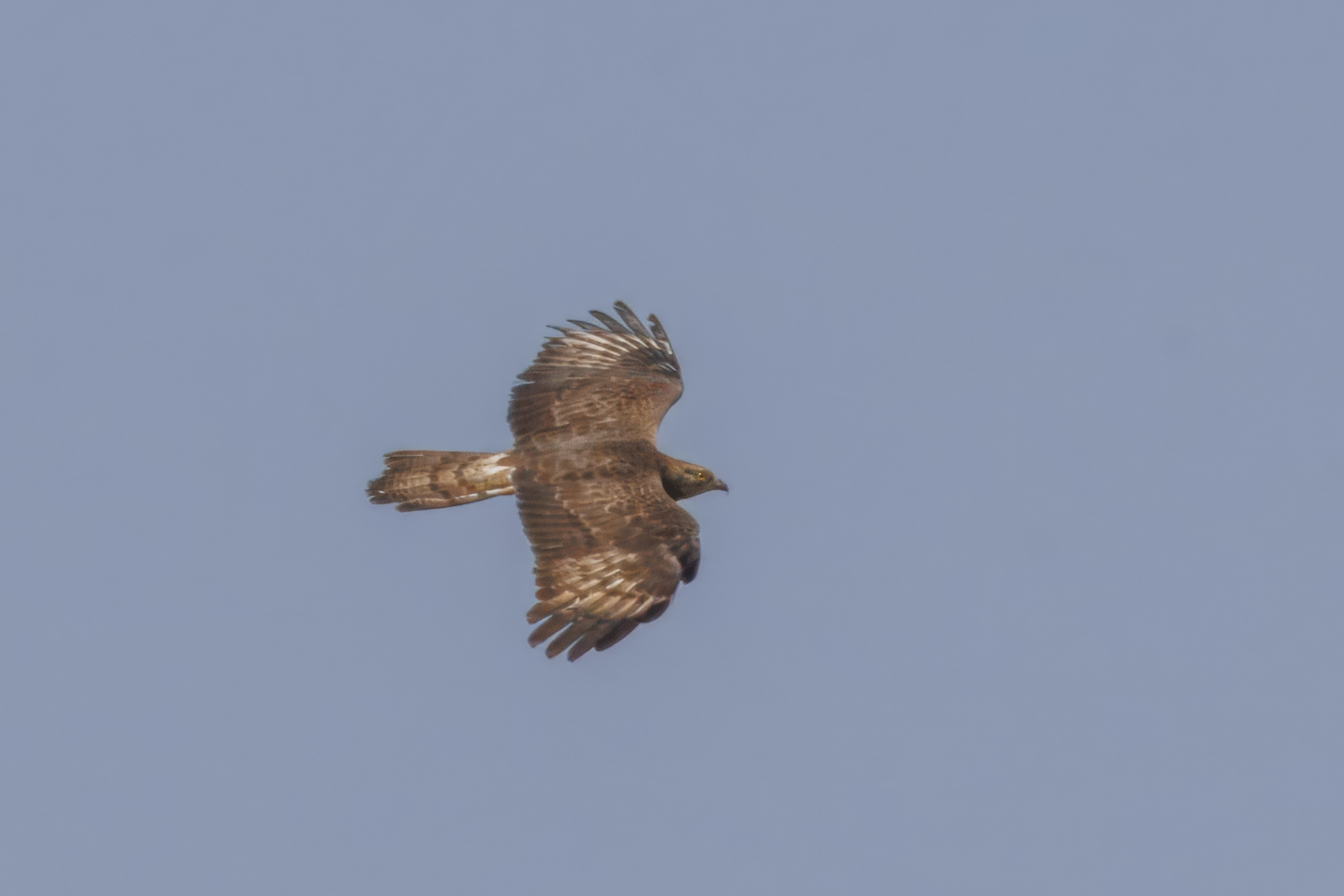
1970s material from western Georgian floodplains (Rioni, Enguri, Khobi) and Gardabani Reserve (Mtkvari floodplain) shows a broad diet: hunting and scavenging. Prey remains (about 170) and pellets (n = 232) from 19 nests, plus about 60 observed attacks: mammals and birds at least three-quarters of prey frequency and more than 95% of prey biomass; amphibians and reptiles are frequent in the breeding season but a small share of biomass. Among reptiles, grass snake (Natrix natrix) and dice snake (Natrix tessellata) were the usual species. Also large insects, fish, frogs, small and medium birds, and rodents; remains of domestic fowl were found under nests several times. In winter it often feeds at dumps and on carrion. At species level it is an opportunistic hunter-scavenger.


Black kite
Milvus migrans
Charles J. Sharp · Huelva, Spain
A medium-sized bird of prey with a forked tail, not an eagle. Confirmed in Georgia on the 2024 national bird checklist as a year-round resident, a passage migrant, and a winter visitor. It passes the Batumi bottleneck in large numbers in autumn.
Key facts in one look
- Size
- 48–58 cm
- Diet
- Carrion and live prey
- Status in Georgia
- Resident, migrant, winter visitor
- Habitat
- Floodplain and wetland
- Family
- Accipitridae
- Conservation
- Least Concern
The black kite (Milvus migrans) is confirmed in Georgia as a year-round resident, passage migrant, and winter visitor; autumn passage at Batumi is massive. It belongs to the family Accipitridae. The 2024 annotated checklist of the birds of Georgia codes it YR-R; M; WV: a breeding resident, a bird of passage, and a winter visitor. Seasonality is classed as high-quality (code A). Occurrence quality is high (H), with photographs. A 2013 Georgian monograph uses the Georgian name ძერა; this atlas uses შავი ძერა as the page title. The European form is about 48–58 cm long, with a wingspan of about 130–155 cm. It is not a threat to people. IUCN lists the species as Least Concern. The 2024 checklist assigns the same category nationally.
Identification
Black kite: how to identify it
A medium-sized raptor with a forked tail and dark brown plumage. In Georgia it is a resident, migrant, and winter visitor on the 2024 checklist. It is not an eagle. Usual confusion is with common buzzard, European honey-buzzard, and red kite.

The European form is about 48–58 cm long, wingspan about 130–155 cm, mass often 560–940 g; females are generally larger than males. A separate measured series from Georgia is not given on this page. The head is relatively pale, the bill black with a yellow cere, the legs yellow. Back and wings are dark brown; the underwing often shows a pale “window” at the base of the primaries. The tail is forked in flight and barred. Sexes are alike in the field. Juveniles have a shallower fork.
The subspecies expected in Georgia is M. m. migrans. A 2013 monograph names this form as the only one in the country. Yellow-billed kite (Milvus aegyptius) is often split in current world bird lists and is not on the Georgian list. Black-eared lineatus is an eastern Palearctic form; field identification on this page is to species.
Common buzzard (Buteo buteo) has a page in this atlas: broader wings, a short rounded tail, often a dark carpal patch, no fork. European honey-buzzard (Pernis apivorus) also passes Batumi in large numbers: a small pigeon-like head, a long barred tail that is not constantly forked; this atlas has a page for that species. Red kite (Milvus milvus) is rare on the 2024 checklist (ND); It is treated as an occasional visitor and can be confused with pale immature black kites. Red kite has a deeper fork, a rufous body, and a white wing patch. Golden eagle (Aquila chrysaetos) is much larger, with a more protruding head; this atlas has a page for that species. Griffon vulture (Gyps fulvus) is a large scavenger with an almost bare head; this atlas has a page for that species too.
It is not a threat to people. Leave it alone. A medium dark raptor with a forked tail over Batumi in autumn is more likely this species than an eagle or a buzzard.
Often confused with
This page does not colour a municipality-by-municipality map. The 2024 checklist confirms country-level resident, migrant, and winter-visitor status but does not publish a regional gazetteer. Do not assume it occurs evenly across Georgia, including treeless high plateaus or alpine meadows. Breeding habitat is deciduous floodplain forest on large rivers: in the west, Rioni, Enguri, Khobi, Bzipi, and Kelasuri; in the east, Mtkvari, Alazani, and Iori. Nesting elevation is up to about 800 m in the Lesser Caucasus and about 1,000 m in the Greater Caucasus. Named nests (historical): Armazi near Mtskheta (1974, cliff), Vere gorge west of Tbilisi (1976, cliff), Okumi floodplain in Abkhazia (1983), a grey-heron colony in Kobuleti district, Adjara (1981 and 1988; not found there in 1991–2012), and Rioni floodplain below Vani, Imereti (1978–1980). In winter it is the most numerous wintering raptor, mainly in the western Kolkheti Lowland and Black Sea coast, including the Paliastomi basin and the lower Rioni; it is scarcer in the east. Autumn raptor passage at Batumi has been counted since 2008 from watchpoints at Sakhalvasho and Shuamta, north of Batumi in Adjara. Those figures describe passage, not a breeding-distribution map. Photographs on this page were not taken in Georgia.
It is active by day. In flight the tail is forked — the main field mark. The wings are long and angled; compared with a buzzard it is more agile and often flaps, not only glides. The call is a sharp whistle, often with a rapid whinny. The nest is of sticks, often lined with rubbish (rags, wire, plastic); 44 of 47 studied nests were in old trees, mostly 10–20 m up. Eggs are laid in the second and third decades of April, mostly 15–25 April; of 27 complete clutches, 21 had two eggs, five had three, one had four. The female incubates about 32 (±3) days. Hatching was recorded from 11 May to 2 June; young fledge after about 45 (±3) days, sometimes up to 55. First fledging in western Georgia was on the Rioni floodplain between 4 and 12 July, about a week later in the east. The 2024 checklist treats the species as a breeding resident in Georgia. In autumn the Batumi bottleneck is a mass-passage site.
Milvus migrans is assessed as Least Concern on the IUCN Red List (2021). The 2024 Georgian bird checklist assigns global and national Red List category LC. The species is not on Georgia’s 2014 Red List (Government Resolution No. 190); long-legged buzzard (Buteo rufinus rufinus) is listed there as VU, not this kite. A European assessment gives Georgia 240–2,500 breeding pairs (2013–2017, partial method) and a very wide short-term interval; that is uncertainty, not a precise census. A 2013 estimate gave 400–500 breeding pairs at the time, down from 900–1,100 in the mid-1970s; a 2005 estimate gave 100–300 pairs. A complete 2020s national breeding census is not on this page. Passage at Batumi increased through 2008–2019 at about 10% per year; that is a passage trend, not a breeding count. A 2013 account inferred a decline in passage relative to the early count years; later counts do not support that. Documented pressures include illegal shooting in the Batumi bottleneck, as well as hunting, electrocution, and loss of floodplain forest. Accipitridae is on CITES Appendix II. Do not catch or keep wild birds.
Related guides
Continue with related pages
Yes. The 2024 annotated checklist of the birds of Georgia lists it as a year-round resident, migrant, and winter visitor (YR-R; M; WV), with photographs.
In floodplain forest and near wetlands where it is resident. The most concentrated autumn passage is documented in the Batumi bottleneck from the Sakhalvasho and Shuamta watchpoints. In winter it is mainly in the western Georgian lowland. This page does not map every region.
Medium size, dark brown plumage, a forked tail in flight, long angled wings, often a pale patch on the underwing. A buzzard’s tail is rounded. Eagles are larger.
The European form is about 48–58 cm long, wingspan about 130–155 cm. Mass is often 560–940 g. A separate measured series from Georgia is not given on this page.
Live prey and carrion: rodents, birds, reptiles, amphibians, fish, insects, and refuse. The Georgian sample is from the 1970s.
All year, according to the 2024 checklist. The spring peak is in the first week of April and autumn peaks in the second decade of September and late September to the first week of October. At Batumi the autumn mass is often mid-September. Exact arrival dates for the whole country are not tabulated on this page.
Neither. This is the black kite (Milvus migrans). Eagles belong to other genera. Red kite (Milvus milvus) is a separate, scarce species in Georgia.
It is harmless if left alone. It is globally Least Concern and is coded LC nationally on the 2024 checklist. It is not on Georgia’s 2014 Red List. Do not catch wild birds.
References
What this profile is based on
Species profiles are compiled from peer-reviewed literature and established biodiversity databases, and are reviewed as new taxonomic and conservation data become available.
Prepared by the Reptiles.ge editorial team from the sources listed here.


News
Related news

Birds
239,735 raptors in one day at Batumi: new Black Kite and eagle records
After a week of cold rain, the Batumi bottleneck had its second-biggest day on record. Black Kites and large eagles set new records.
Read the article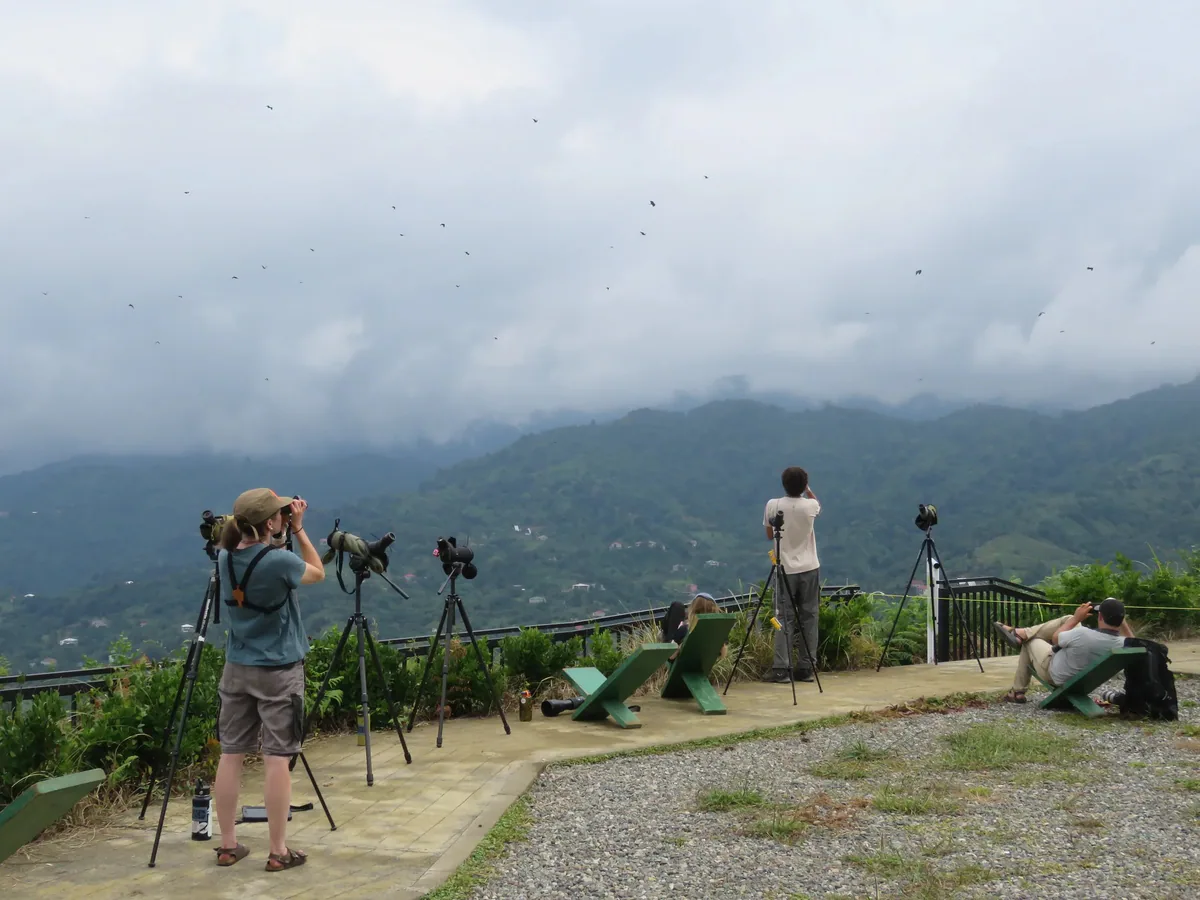
Birds
Nearly 19,300 raptors counted in one day at Batumi
After rain and fog, the Batumi bottleneck recorded the season’s first 10,000-plus day. Nearly 19,300 birds were counted in total.
Read the article

