


A tabulated Georgian diet study is not given on this page. A 2011 Georgian study collected prey remains and pellets at nests, but that prey list is not reproduced here. At species level it takes medium-sized birds (pigeons, corvids, thrushes, gamebirds) and mammals (squirrels, rabbits). It hunts by surprise in woodland or at the forest edge. In western Georgia it was traditionally flown by bazieri falconers at common quail; that is cultural use, not a diet sample for this page. It is not food for people.


Eurasian goshawk
Accipiter gentilis
Listen to the voice
Holger.Ellgaard · Marieberg, Stockholm
A large woodland hawk with short broad wings, a rounded tail and a white eyebrow. Confirmed in Georgia as a year-round resident, a passage migrant and a winter visitor on the 2024 national bird checklist.
Key facts in one look
- Size
- 49–64 cm
- Diet
- Birds and mammals
- Status in Georgia
- Resident, migrant, winter visitor
- Habitat
- Dense forest
- Family
- Accipitridae
- Conservation
- Least Concern
The Eurasian goshawk (Accipiter gentilis) is a large woodland raptor of the family Accipitridae. The usual Georgian name is ქორი; დიდი ქორი is sometimes used to separate it from the sparrowhawk. The 2024 annotated checklist of the birds of Georgia codes it YR-R; M; WV: a breeder present throughout the year, and also a bird of passage and a winter visitor. The English checklist name is Eurasian Northern Goshawk. Seasonality is classed as high-quality (code A). Occurrence quality is high (H), with photographic evidence. Adults are about 49–64 cm long at species level; females are clearly larger than males. It is not a threat to people. IUCN lists the species as Least Concern. The 2024 checklist assigns the same category nationally.
Identification
Eurasian goshawk: how to identify it
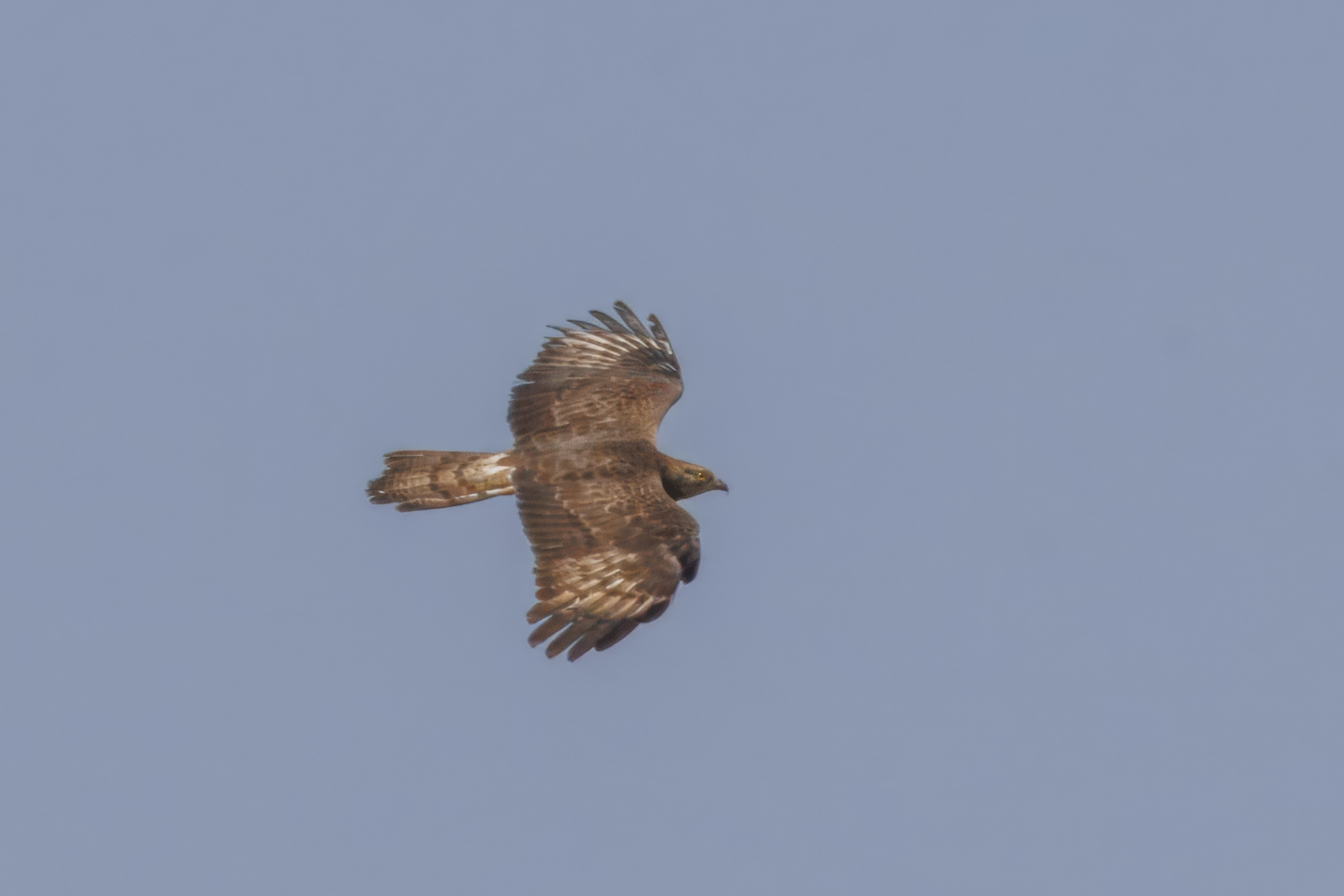
A large woodland hawk with short broad wings, a rounded tail, a dark cap and a white eyebrow. Adults are slate-grey above with fine barring below; juveniles are brown with lengthwise spots. In Georgia the usual confusion is with Eurasian sparrowhawk.

The silhouette is bulkier than a sparrowhawk: deep chest, broad wing bases, a comparatively short tail with a rounded tip. Flight is flap-flap-glide, not the pointed wings of a falcon. Adults have an orange to reddish eye and yellow legs. At species level length is about 49–64 cm and wingspan often about 90–125 cm. Females are clearly larger than males. A separate measured series from Georgia is not given on this page.
Adults have a dark cap and ear-coverts with a bold white supercilium. The back is slate-grey; the breast and belly are pale with fine dark cross-barring. Juveniles are brown above and cream below with lengthwise teardrop spots — not the adult’s fine bars. The eye is yellower in juveniles.
Eurasian sparrowhawk (Accipiter nisus) is much smaller, with thinner legs, a longer almost square-tipped tail and a weak eyebrow; this atlas has a separate page for it. Levant sparrowhawk (Accipiter brevipes; in current world bird lists Tachyspiza brevipes) is smaller still, with more pointed wings and a dark eye; on the 2024 checklist BB; M and VU on the national Red List. Common buzzard (Buteo buteo) is a broad-winged soaring raptor, not a woodland hawk. Peregrine is a pointed-winged falcon. Shikra (Accipiter badius) is casual (Cas) on the checklist. This atlas does not yet have a separate page for Levant sparrowhawk.
It is not a threat to people. Leave it alone. A small hawk in a Georgian garden is more likely a sparrowhawk; a bulky silhouette and white eyebrow in deep forest point to this species.
This page does not colour a municipality-by-municipality map. The 2024 checklist confirms country-level resident, migrant and winter-visitor status but does not publish a regional gazetteer. Do not assume it occurs evenly across Georgia, including treeless high plateaus. A 2011 summary treats it in Georgia as an uncommon or locally rare year-round resident with local vertical movements. For breeding it prefers mature or middle-aged dense forest — deciduous, coniferous, or mixed. Passage is described as more frequent in the lowlands of western Georgia and in the valleys of large rivers in the east; winter visitors are called widespread, but that is not a municipality list. A checklist of Special Protection Areas (SPA) gives YR-R, M; the 2024 national checklist adds WV. In autumn the eastern Black Sea bottleneck near Batumi (Sakhalvasho, Shuamta) is a watchpoint, but the species is scarce there, passes low and solitarily, and complete counts are difficult. A separate national elevation band for Georgia is not published here.
It is active by day. In woodland it is fast and agile: short broad wings and a relatively long tail with a rounded tip. Flight is often flap-flap-glide, but the silhouette is bulkier than a sparrowhawk — deeper chest, broader wing bases, a comparatively shorter tail. The call is a loud, resonant kek-kek-kek or similar series, slower and deeper than the sparrowhawk, mostly near the nest. The recording on this page is xeno-canto XC396773 (Alvaro Ortiz Troncoso): an adult female alarm call at an urban cemetery in Germany, not a Georgian recording. Do not handle it; birds may be aggressive at the nest. The nest is a stick platform in a tree. At species level clutches are often two to four eggs and incubation about five weeks; a local account gives 2–4 eggs in April and notes that incubation length for the Caucasian form is not established. That is not a Georgian nest sample on this page. The 2024 checklist treats the species as a breeding resident in Georgia. Northern populations migrate; local birds stay more often, sometimes shifting altitude. Georgia has all three components: local breeders, passage birds, and winter visitors.
Accipiter gentilis is Least Concern on the IUCN Red List. The 2024 Georgian checklist assigns LC globally and nationally. A 2011 summary speaks of about 240–250 breeding pairs, after a decline in the 1950s–1970s and a moderate increase in the 1980s–1990s; that is a then-current estimate, not a 2024 national census. A Kartli-area paper in the same 2011 volume gives 20–25 pairs locally — a regional figure, not a national one. The 2014 Georgian Red List (Decree No. 190) includes Levant sparrowhawk (Accipiter brevipes, VU), not this species. Accipitridae are on CITES Appendix II. Local pressure is documented in the Batumi bottleneck: illegal shooting and traditional trapping for falconry in Adjara. Do not take wild birds without a permit. Species-level historical pressures include persecution, felling of mature forest, and pesticides; a measured recent Georgian population trend is not given on this page.
Jevgenijs Slihto · Kronvalda Park, Riga
Related guides
Continue with related pages
Questions
Frequently asked questions
Short answers to the most important questions about Eurasian goshawk.
Yes. The 2024 annotated checklist of the birds of Georgia confirms it as a year-round resident, a passage migrant and a winter visitor (YR-R; M; WV).
In mature or middle-aged dense forest. Passage is described as more frequent in western Georgian lowlands and large river valleys in the east, in a 2011 summary. It is scarce in the Batumi bottleneck in autumn. This page does not map every region.
A bulky woodland hawk with a white eyebrow, dark cap, short broad wings and a rounded tail. Adults are grey with fine-barred underparts; juveniles are brown with lengthwise spots. Sparrowhawk is much smaller.
About 49–64 cm long at species level, with a wingspan often about 90–125 cm. Females are clearly larger than males. A separate measured series from Georgia is not given on this page.
Mainly medium-sized birds and mammals. Diet in Georgia is not tabulated on this page.
All year as a resident, and also as a passage migrant and winter visitor. The 2024 checklist lists all three statuses.
Yes. YR-R on the 2024 checklist means a breeding resident. Named nest sites in Georgia are not listed on this page.
It is harmless. Globally and nationally LC on the 2024 checklist. It is not on the 2014 Georgian Red List (Levant sparrowhawk is VU there). Do not take wild birds.
References
What this profile is based on
Species profiles are compiled from peer-reviewed literature and established biodiversity databases, and are reviewed as new taxonomic and conservation data become available.
Prepared by the Reptiles.ge editorial team from the sources listed here.


