
Middle spotted woodpecker
Leiopicus medius
Andrey Deev · Shchekino District
Key facts in one look
- Size
- 20–22 cm
- Diet
- Insects and larvae; acorns and hazelnuts in winter
- Status in Georgia
- Year-round resident, breeds
- Habitat
- Old broadleaf forest, especially oak woods
- Family
- Picidae
- Protection
- Globally LC, 2018; in Georgia LC, 2021
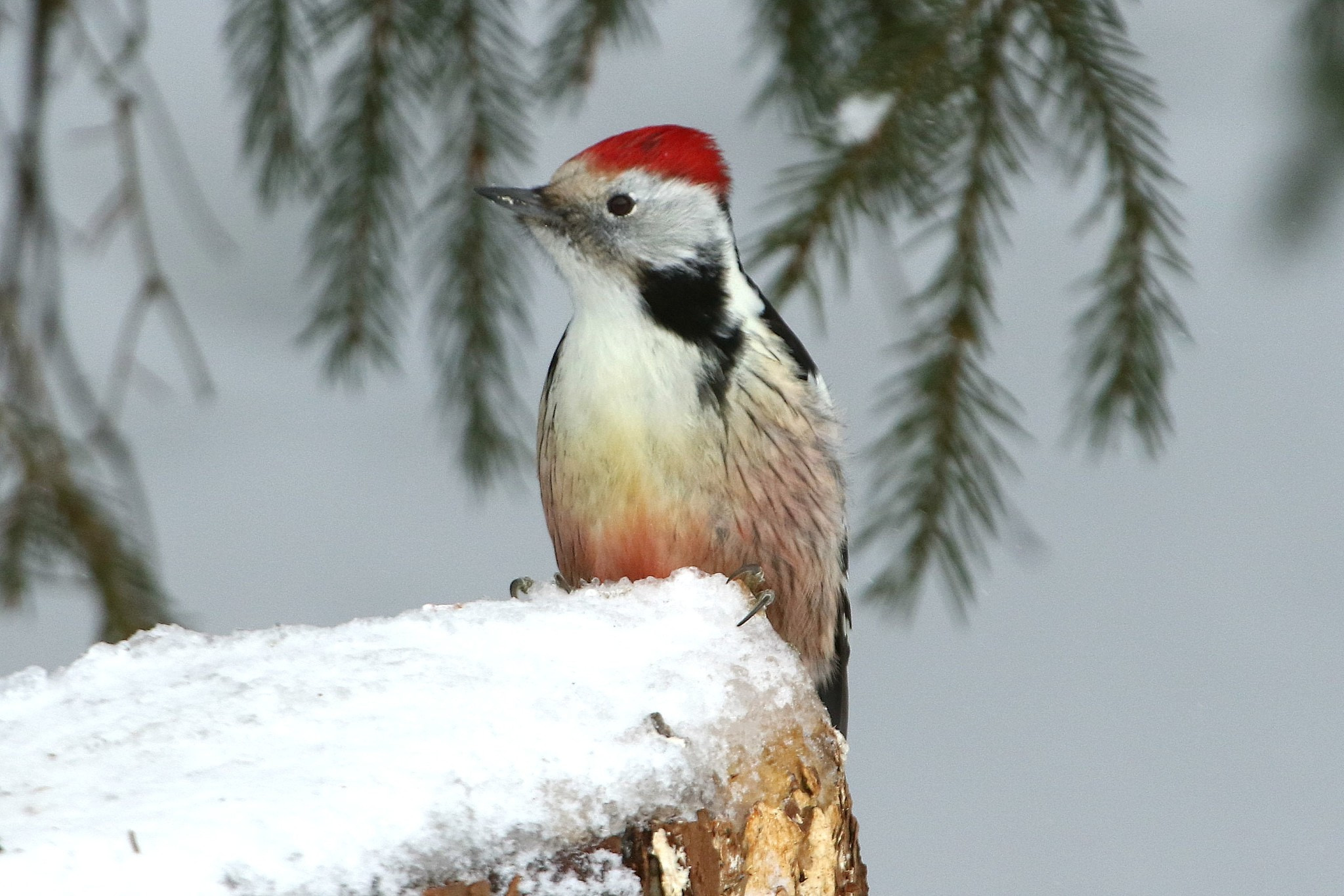
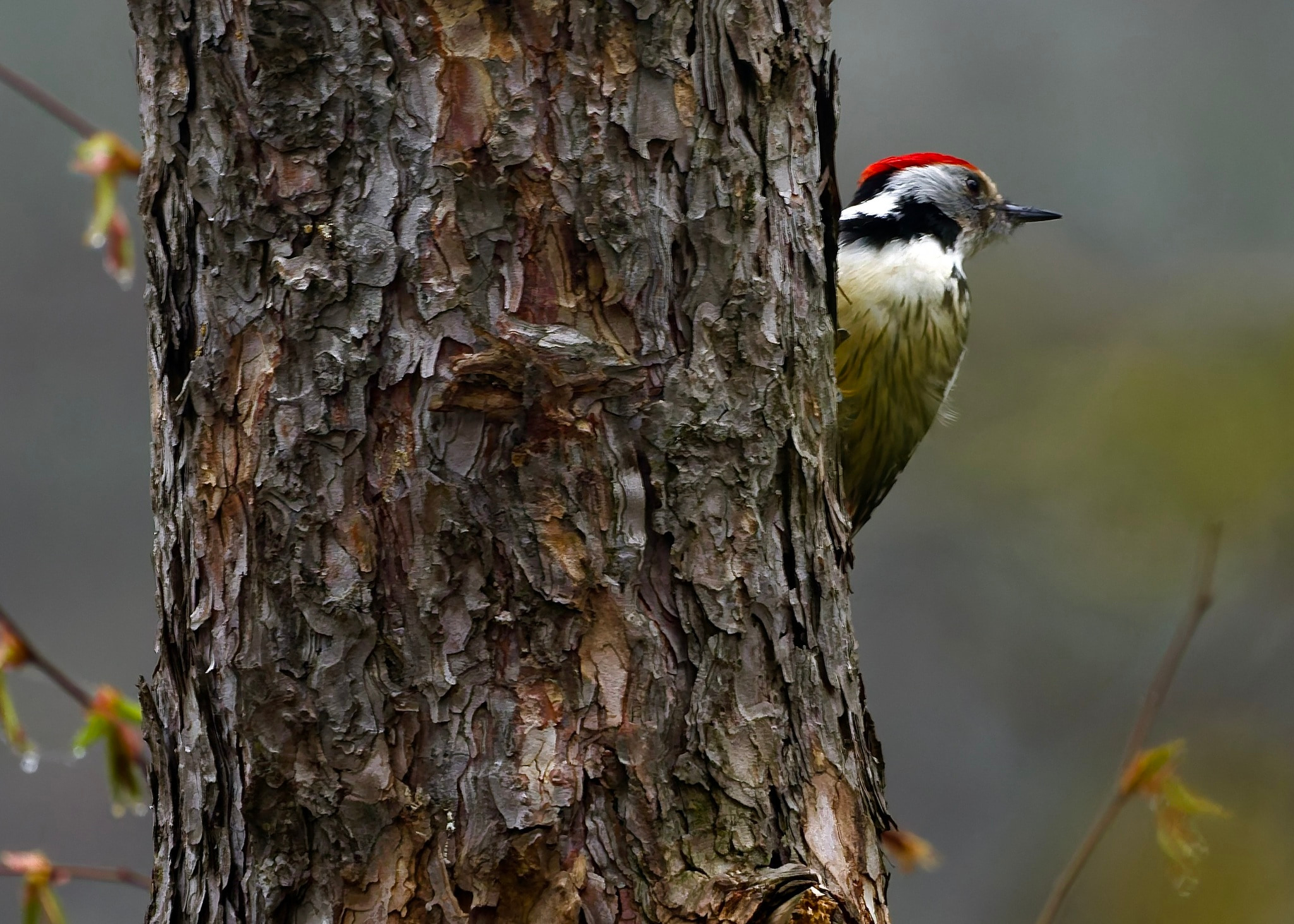
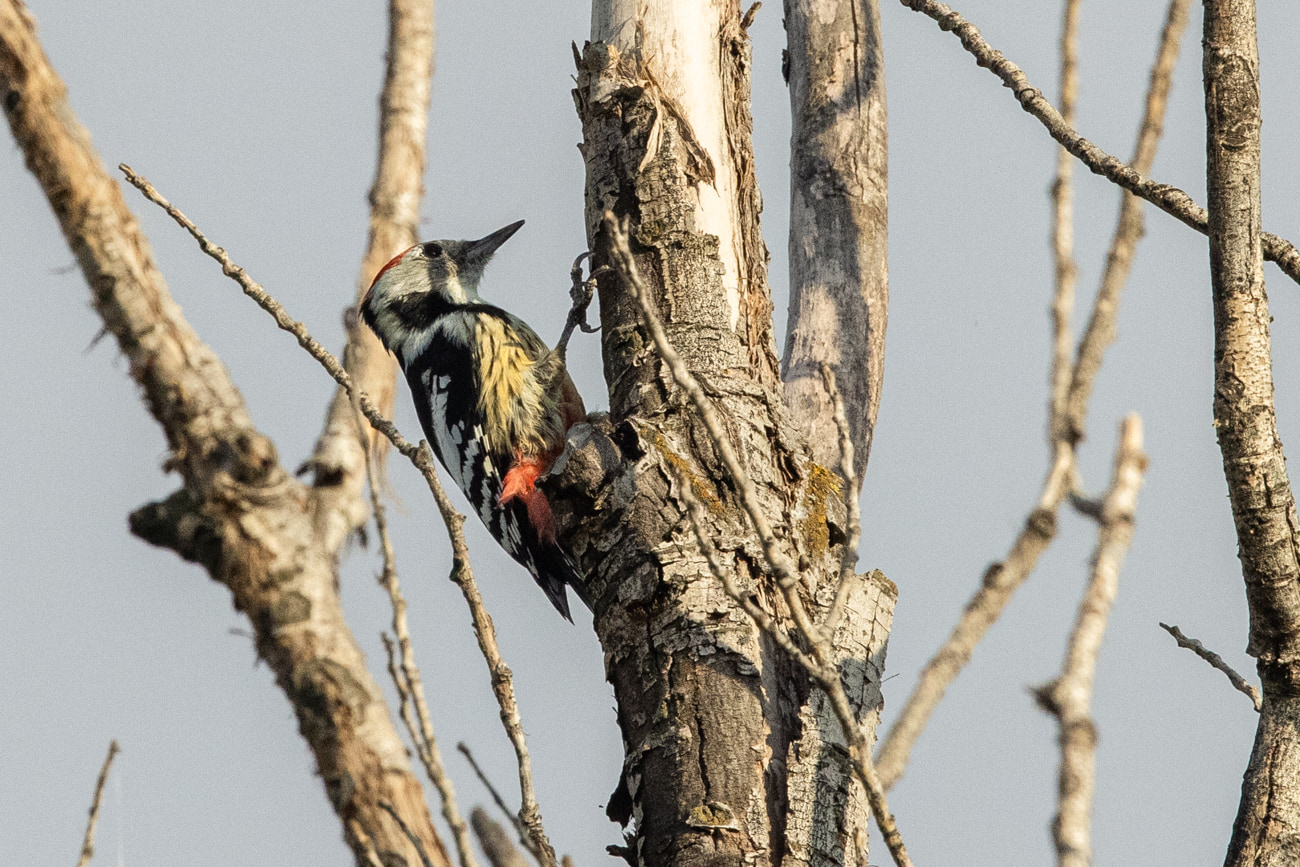
The middle spotted woodpecker looks like the great spotted woodpecker, but both sexes have a red cap and there is no black moustache on the face. The bill is short and slender, the head round and pale, so it looks smaller than it is. In Georgia it lives and breeds all year round, and in the Caucasus it is a fairly common species. It picks old broadleaf forest with plenty of oak and dead trees. It drums less than other woodpeckers: it spends its time in the treetops, picking insects from twigs and leaves.
Identification
Middle spotted woodpecker: how to identify it
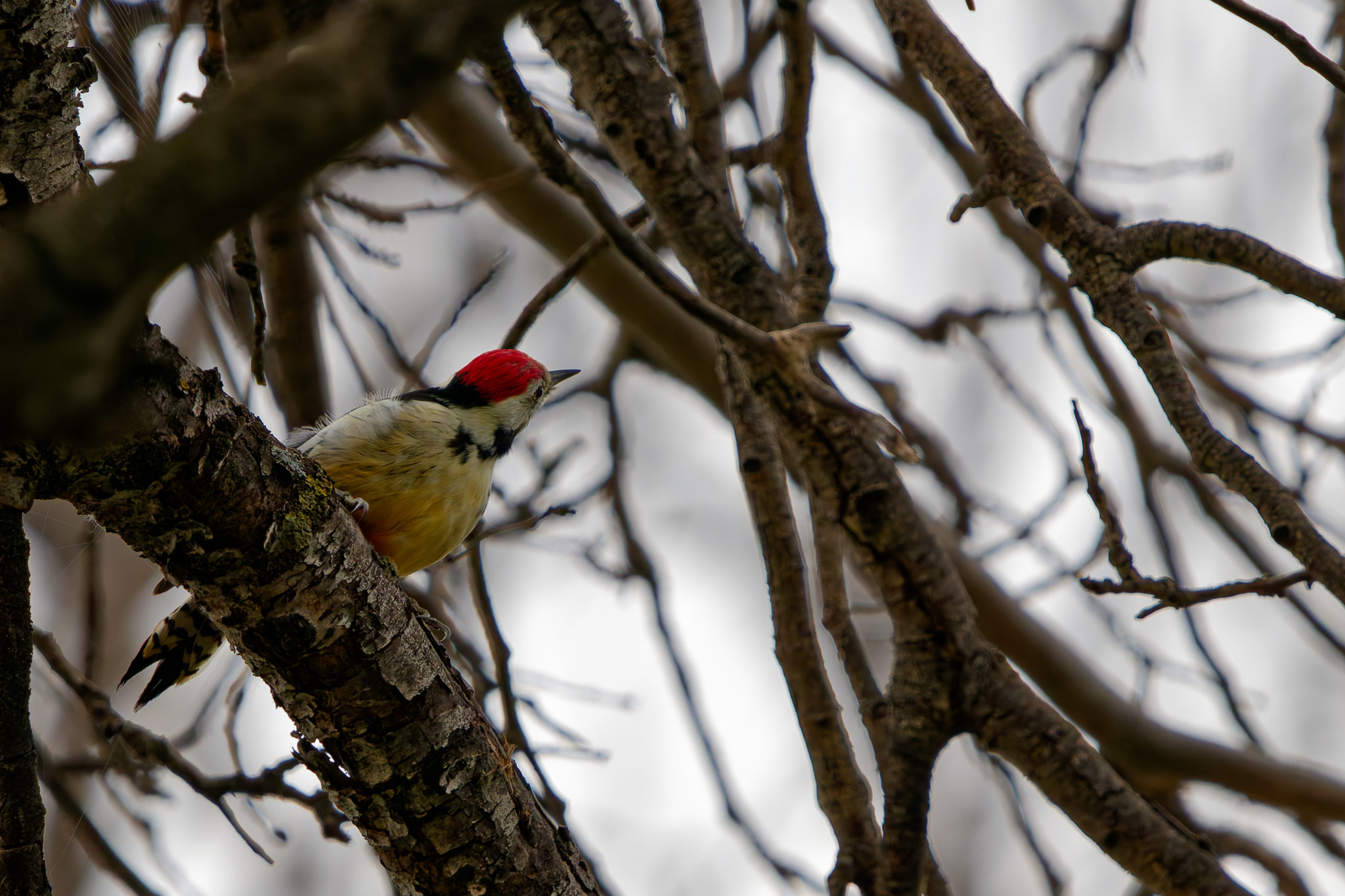
A black-and-white woodpecker, 20–22 cm long and 50–85 g. It has an all-red cap, no black moustache on the face, a pink vent and dark streaks on the flanks.
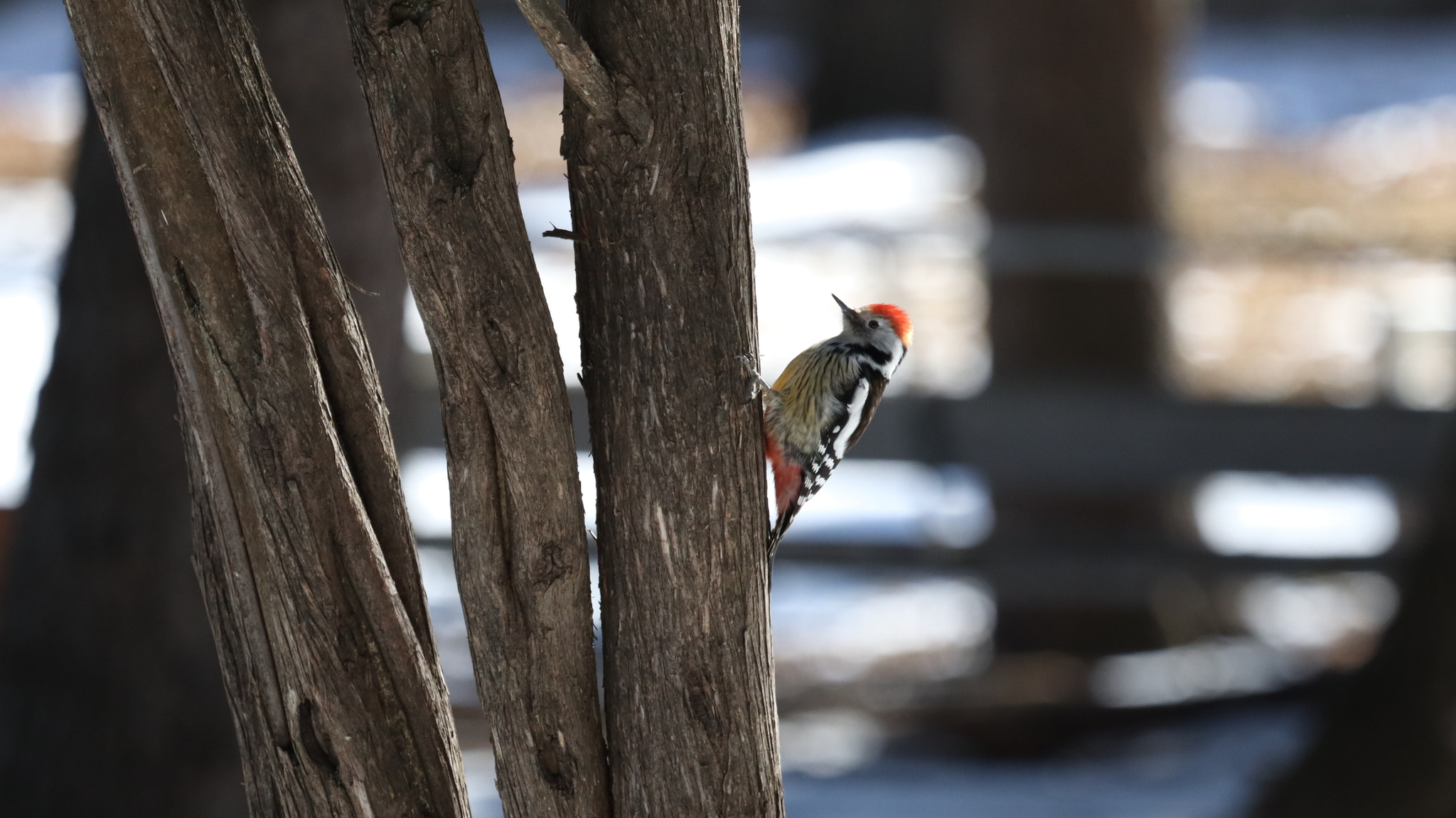
Length 20–22 cm, weight 50–85 g. It is only slightly smaller than a great spotted woodpecker but looks smaller. The reason is its short, slender, dark grey bill and its round, pale head.
The upperparts are mainly black, with large white oval patches and white bars on the wings. The underparts are whitish to yellowish, with dark streaks on the flanks, and the lower belly and vent are pale pink. Both sexes have a red cap, the female's with a yellowish or brownish tinge. Young birds are duller.
The great spotted woodpecker has a black moustache on the face. It also resembles the Syrian woodpecker, especially young ones: the middle spotted woodpecker has a smaller bill, its red cap has no black edges, and the black neck stripe does not reach the bill. If the cap is all red and the face clean white, it is a middle spotted woodpecker.
Colour
Swatches are illustrative. Do not identify a species by colour alone.

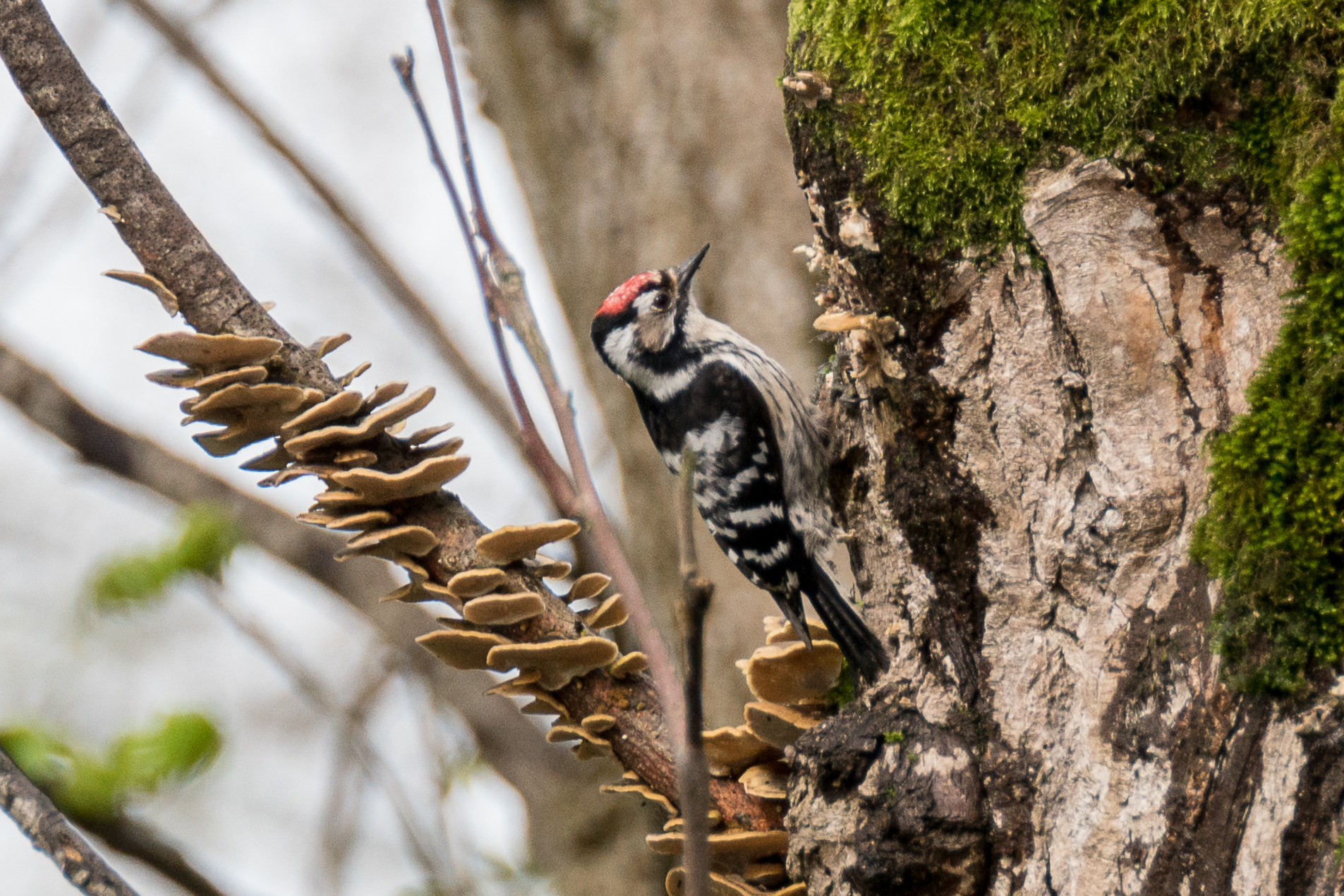
It is a bird of mature broadleaf and mixed forest in lowlands, river valleys and foothills. Across most of Europe it is tied to oak woods, often mixed with hornbeam, elm, alder, beech or ash. It needs plenty of diseased and dead trees, because its bill is poorly suited to hacking. It rarely goes high into the mountains: in Transcaucasia it occurs up to 900 m above sea level. In some countries it also settles in old orchards and parks at the forest edge.
The middle spotted woodpecker lives in Georgia all year round and breeds here. Records cover every month, with the most in September, then May and October. Most come from Adjara and Kvemo Kartli, with fewer from Mtskheta-Mtianeti, Kakheti, Tbilisi and Imereti. It has also been found in Abkhazia, Samtskhe-Javakheti, Racha-Lechkhumi and Kvemo Svaneti, Shida Kartli and Samegrelo-Zemo Svaneti. The oldest record is a museum specimen collected near Kvareli in August 1910.
Data: Reptiles.ge + iNaturalist · Methodology
- Field observation
- Several records in one spot
- Photo record
- Region with records
It eats almost only animal food: insects and their larvae. It rarely hacks at bark and instead picks openly crawling insects from twigs and leaves. It moves even along thin twigs and sometimes hangs from their tips like a tit. It eats many caterpillars, including hairy ones that other birds avoid, as well as beetles, ants, aphids and true bugs. In autumn and winter it also takes a little plant food: acorns, hazelnuts, beechnuts and walnuts. It drinks tree sap too.
It is a resident bird, but outside the breeding season it wanders through the forest, and in the mountains it moves up and down with the seasons. In winter it often joins flocks of tits or other woodpeckers. Unlike other woodpeckers, it rarely drums and never drums to hold a territory. It sings instead: a slow, nasal, hoarse "gvayk-gvayk-gvayk". The call is a fast "kik-kekekekek". Both parents cut the nest hole, in the trunk or a thick branch of a decaying broadleaf tree, often near a clearing or the forest edge. The hole is usually low, 1.5–3 m above the ground, with an entrance about 5 cm wide. The female lays 4–7 eggs, and both parents incubate for 11–14 days. The young fledge at 20–26 days but stay with their parents for another 8–11 days.
Globally the middle spotted woodpecker's risk of extinction is rated low (LC, 2018). It is mainly a bird of Europe and western Asia, from Spain to Iran. It bred in Denmark until 1959 and died out in Sweden in the 1980s. In eastern Europe, by contrast, its range has been spreading east since the mid-1980s. In Georgia's national assessment (2021) its risk is also rated low (LC), and its numbers are stable. The list of the birds of Georgia gives it as a year-round resident and breeder.
Related guides
Continue with related pages
Yes. It lives and breeds in Georgia all year round, and in the Caucasus it is a fairly common species. It picks old broadleaf forest, especially oak woods. It rarely goes high into the mountains: in Transcaucasia it occurs up to 900 m above sea level.
The middle spotted woodpecker has a red cap, no black moustache on the face, a pink vent and dark streaks on the flanks. The bill is short and slender, the head round and pale. The great spotted woodpecker has a black moustache on the face. If the cap is all red and the face clean white, it is a middle spotted woodpecker.
Almost only insects and their larvae. It rarely hacks at bark and picks insects from twigs and leaves. It eats many caterpillars, hairy ones too. In autumn and winter it also eats acorns, hazelnuts and walnuts.
In the trunk or a thick branch of a decaying broadleaf tree, often near a clearing or the forest edge. The hole is usually low, 1.5–3 m above the ground. Both parents cut it. The female lays 4–7 eggs.
No, it is a resident bird. Outside the breeding season it wanders through the forest, and in the mountains it moves up and down with the seasons. In winter it often joins flocks of tits or other woodpeckers. At that time it also eats plant food.
No, it is harmless to people. Globally its risk of extinction is low (LC, 2018). In Georgia's national assessment (2021) its risk is also low (LC), and its numbers are stable. Do not fell dead trees in old oak woods.
References
What this profile is based on
Species profiles are compiled from peer-reviewed literature and established biodiversity databases, and are reviewed as new taxonomic and conservation data become available.
Prepared by the Reptiles.ge editorial team from the sources listed here.