
Black woodpecker
Dryocopus martius
jamesbot · Eastern Administrative District
Key facts in one look
- Size
- 45–55 cm
- Diet
- Tree-dwelling ants, wood-boring beetle grubs
- Status in Georgia
- Year-round resident, breeds
- Habitat
- Mature conifer and mixed forest with large and dead trees
- Family
- Picidae
- Protection
- Globally LC, 2016; in Georgia LC, 2021
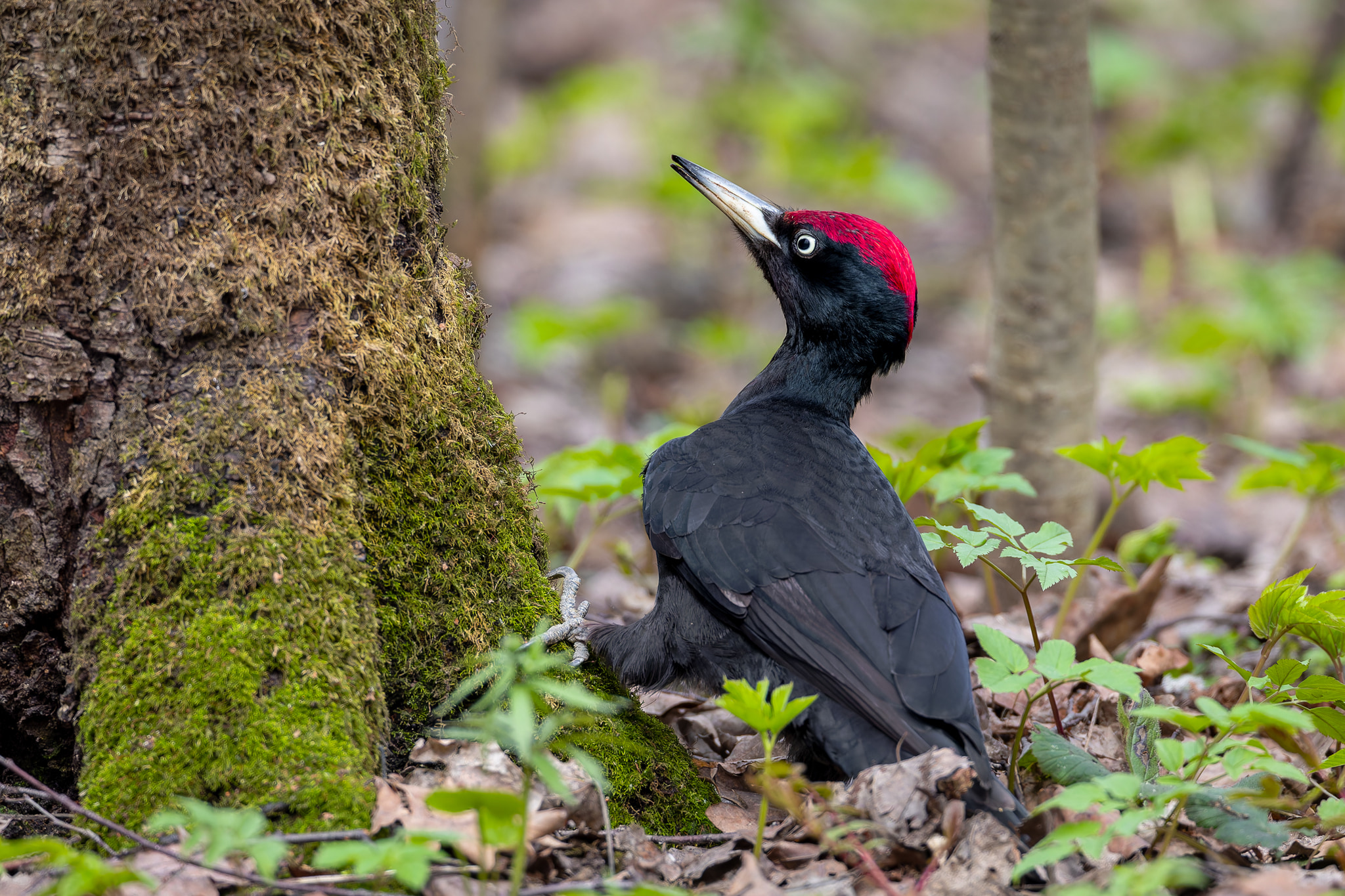
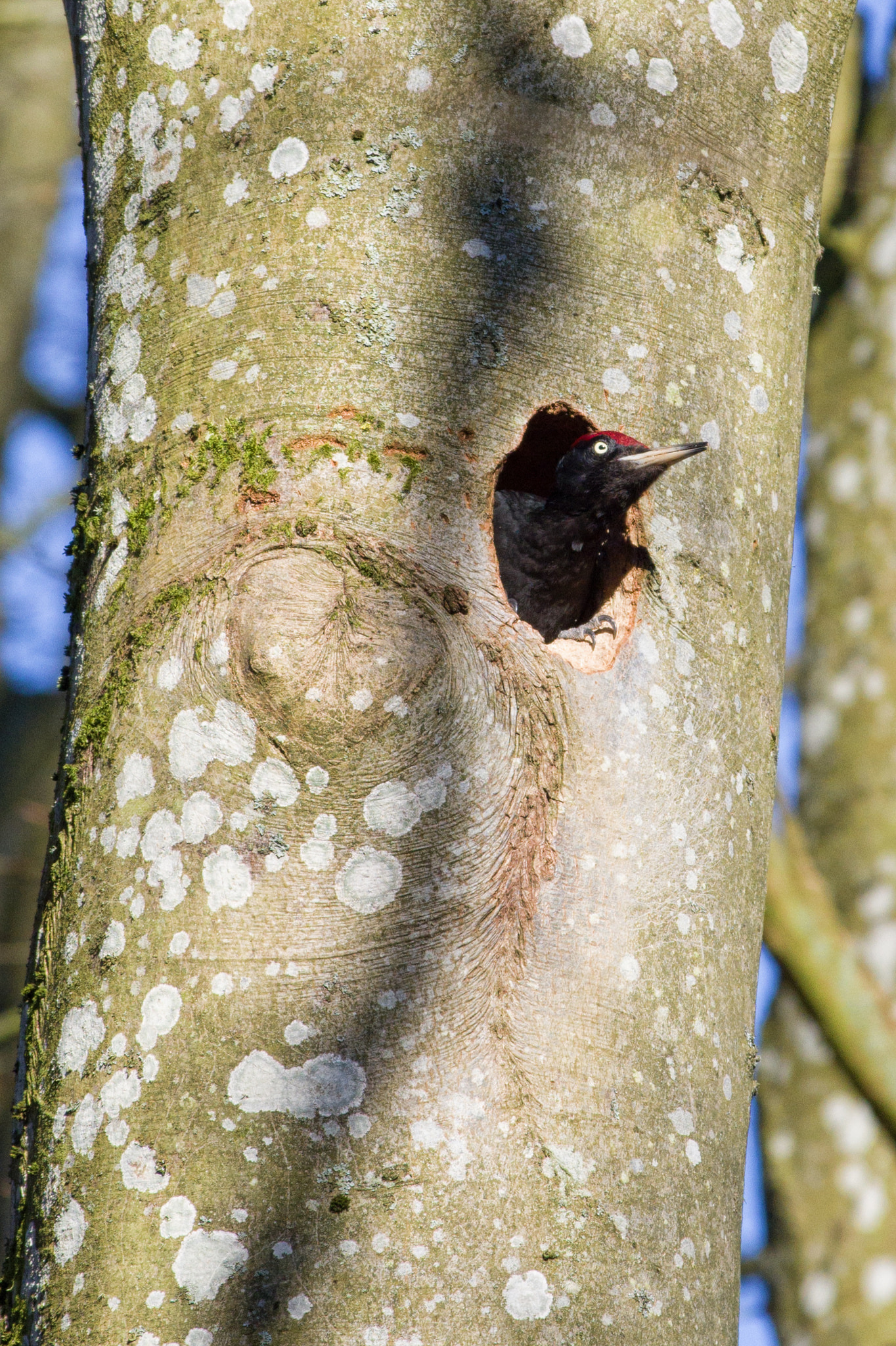
The black woodpecker is by far the largest woodpecker in Europe and the part of Asia where it lives, and one of the largest in the world. It is the size of a crow, entirely black, with a red cap and pale yellow eyes. In Georgia it lives and breeds all year round in mature, tall forests. It cuts its own nest holes, and its old holes are later used by other birds and mammals. It calls loudly all year, and its drumming carries for several kilometres: in the forest you will often hear it from far away.
Identification
Black woodpecker: how to identify it
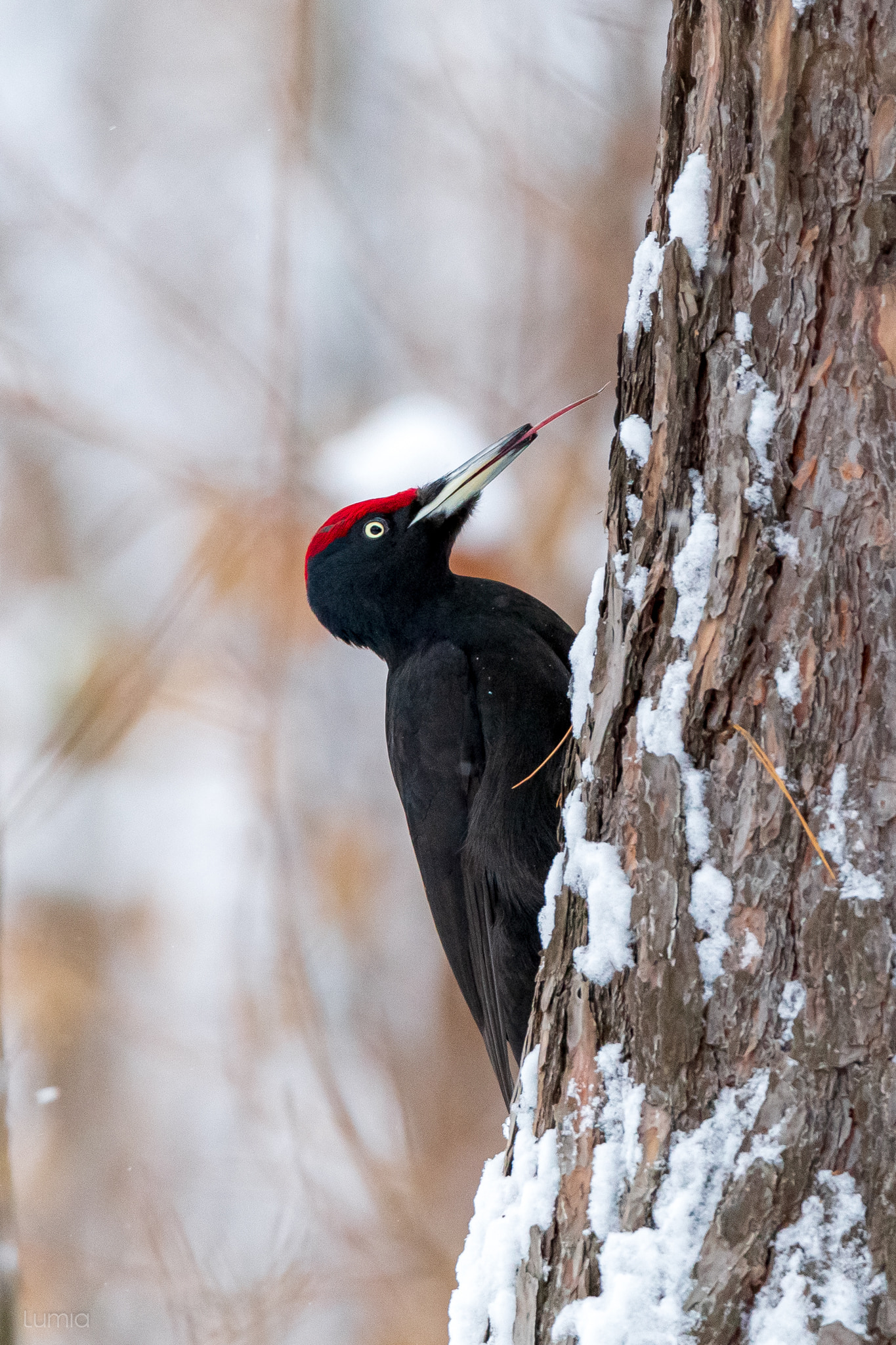
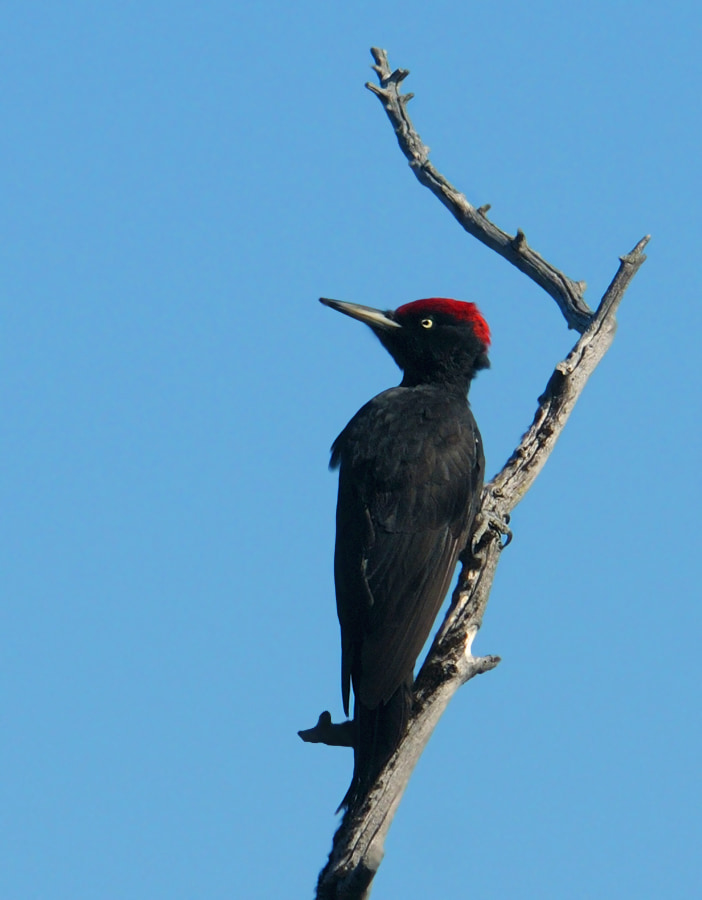
A crow-sized woodpecker, 45–55 cm long and 250–400 g. It is entirely black, with a red cap, pale yellow eyes and a long, powerful, pale bill.
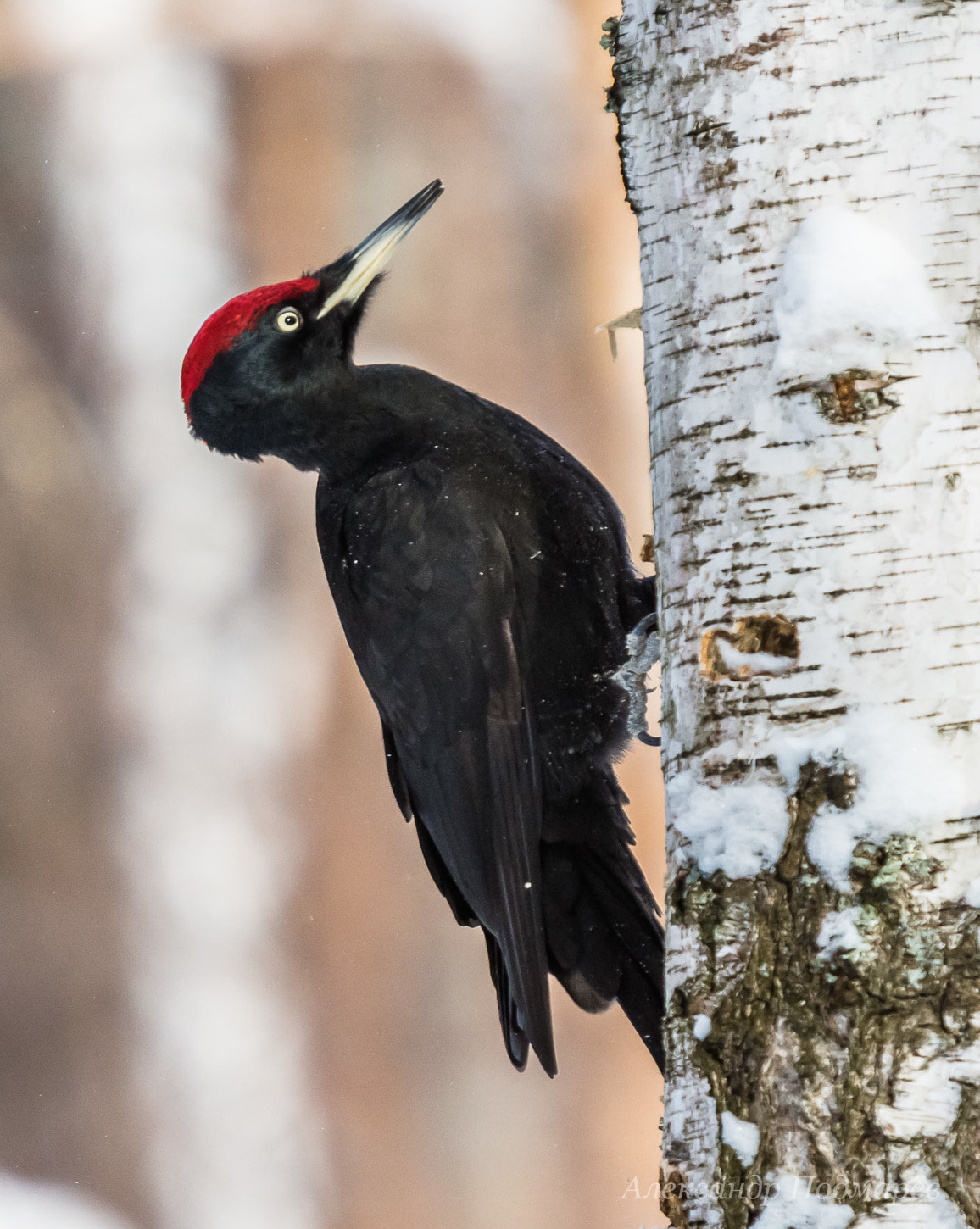
Length 45–55 cm, wingspan 64–84 cm, weight 250–400 g. It is the size of a crow but slimmer, with a long thin neck and a long tail. The bill is long, straight and as strong as a chisel.
The plumage is entirely glossy black. The male has a red cap from the base of the bill to the nape; the female has red only on the back of the head, and her plumage is duller, with a brownish tinge. The eyes are whitish to pale yellow, the bill greyish, yellowish towards the base of the lower half.
Young birds are duller: the plumage is less glossy, the red cap faint, the throat greyish. In flight it does not bound like other woodpeckers: it flaps slowly and seemingly unsteadily, with its head raised. This flight is a good mark even at a distance.
Colour
Swatches are illustrative. Do not identify a species by colour alone.
It is a bird of mature, tall forest, mostly conifer and mixed, sometimes broadleaf too. It needs large trees and plenty of dead or diseased ones to cut its holes in. In the mountain forests of Europe it picks beech woods or mixed beech and fir. It is widespread in mountain and lowland forests, at 100–2,400 m above sea level. A pair holds on average 300–400 hectares of forest.
The black woodpecker lives in Georgia all year round and breeds here. Records cover every month, with the most in October, then September and May. Most come from Kvemo Kartli, Kakheti and Samtskhe-Javakheti, followed by Mtskheta-Mtianeti, Adjara, Samegrelo-Zemo Svaneti and Tbilisi. It has also been found in Abkhazia, Imereti, Shida Kartli and Racha-Lechkhumi and Kvemo Svaneti. The oldest record is a museum specimen collected near Mtskheta in December 1909.
Data: Reptiles.ge + iNaturalist · Methodology
- Field observation
- Several records in one spot
- Region with records
It eats wood-dwelling insects, above all large ants that live in trees and the grubs of wood-boring beetles. With its powerful bill it hacks into rotting stumps and dead trees, strips bark and breaks off finger-thick chips. It digs tunnels up to half a metre deep into ant nests and eats the pupae along with the adult ants. Plant food makes up very little of its diet: fruit, berries and conifer seeds.
It is a resident bird and in winter moves only short distances. It calls loudly all year: a melodious "kree-kree-kree" series often ends in a long, wailing "klee-ah". Courtship lasts from February to April. Then both sexes call and drum: a drum roll lasts 1.75–3 seconds and can be heard 2–4 km away. It cuts its nest hole in a damaged, branchless part of a living tree, 8–20 m above the ground, most often in an old aspen. Cutting a new hole takes 10–17 days, and the male does most of the work. The female usually lays 3–6 eggs, and both parents incubate for 12–14 days. The young leave the nest after 24–28 days.
Globally the black woodpecker's risk of extinction is rated low (LC, 2016). It is widespread in the forests of Eurasia, from Spain to Japan. When much of Europe and Asia was cleared of forest, its numbers fell. Where forests have been restored, it has increased again in parts of Europe. A viable population needs mature trees and plenty of dead wood. In Georgia's national assessment (2021) its risk is also rated low (LC), and its numbers are stable. The list of the birds of Georgia gives it as a year-round resident and breeder.
Related guides
Continue with related pages
Yes. It lives and breeds in Georgia all year round. It picks mature, tall forests with plenty of large and dead trees. In the national assessment (2021) its numbers are rated stable.
It is a crow-sized, entirely black woodpecker with a red cap. The male has red over the whole crown, the female only on the back of the head. In flight it does not bound like other woodpeckers but flaps slowly. If you see a crow-sized black bird with a red cap on a tree trunk, it is a black woodpecker.
Mainly large ants that live in trees and the grubs of wood-boring beetles. It hacks into rotting stumps and dead trees and also digs into ant nests. It eats very little plant food. It digs tunnels up to half a metre deep into ant nests.
In a damaged, branchless part of a living tree, 8–20 m above the ground, most often in an old aspen. It cuts the hole itself, in 10–17 days, and a thick layer of chips piles up at the foot of the tree. It often uses the same hole for years. Other birds and mammals later move into its old holes.
No, it is a resident bird. In winter it moves only short distances. Outside the breeding season it turns up more often in woods close to settlements. It calls all year round.
No, it is harmless to people. Globally its risk of extinction is low (LC, 2016). In Georgia's national assessment (2021) its risk is also low (LC), and its numbers are stable. Do not fell old trees with holes.
References
What this profile is based on
Species profiles are compiled from peer-reviewed literature and established biodiversity databases, and are reviewed as new taxonomic and conservation data become available.
Prepared by the Reptiles.ge editorial team from the sources listed here.