


This page does not include a separate study that measured its diet by weight in Georgia. General accounts of the species say it catches almost only birds in flight, including pigeons, shorebirds, ducks, sparrow-like birds and others. It dives quickly on them from above and catches them with its beak. Small mammals and insects are rarely mentioned in descriptions of its diet. It is not food for people.


Peregrine falcon
Falco peregrinus
Listen to the voice
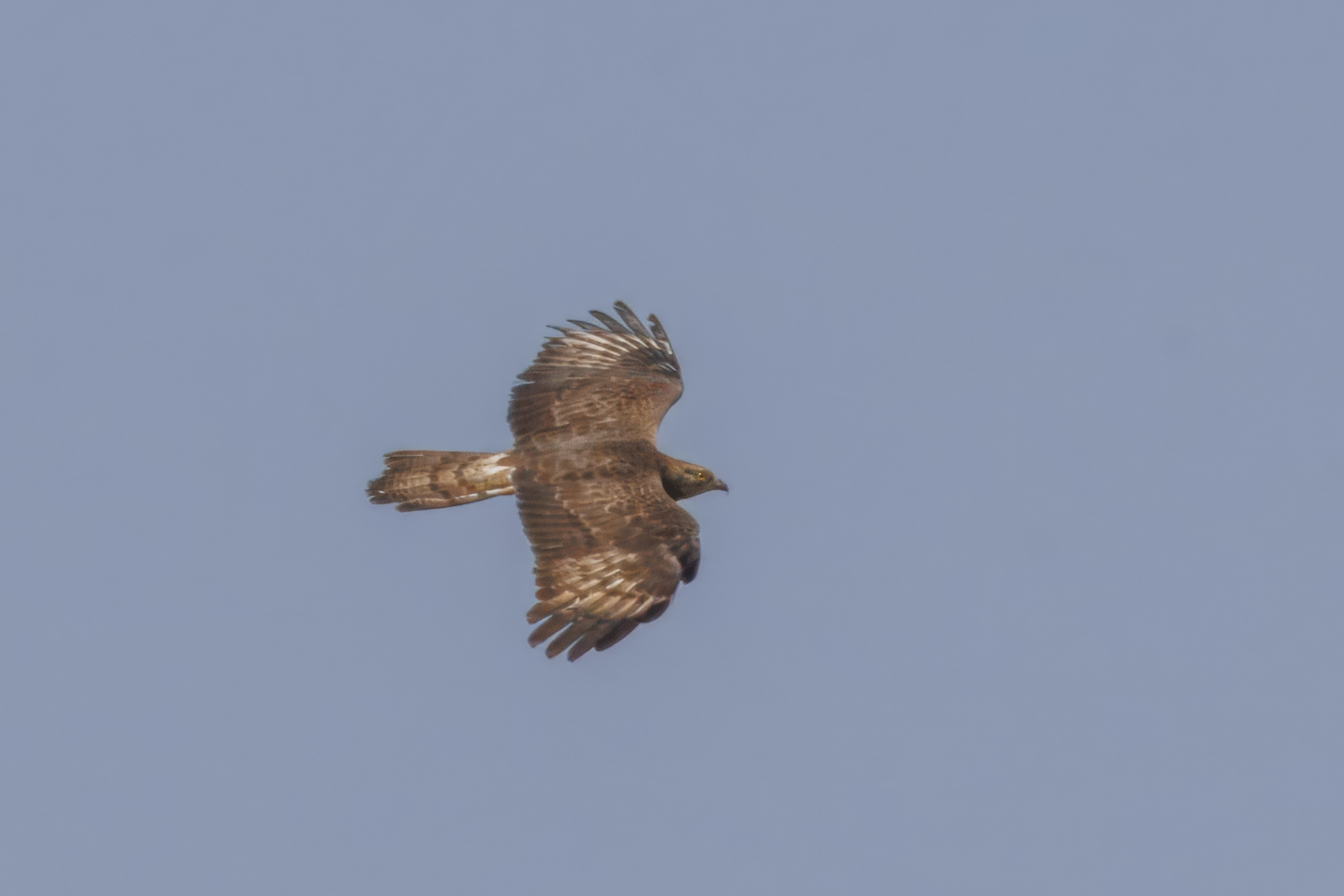
Pavel Shukov · KakhetiGeorgia field photo
A powerful pointed-winged falcon with a dark hood and moustache. Confirmed in Georgia as a year-round resident and passage migrant on the 2024 national bird checklist.
Key facts in one look
- Size
- 34–58 cm
- Diet
- Birds in flight
- Status in Georgia
- Resident and migrant
- Habitat
- Cliffs, open hunting ground
- Family
- Falconidae
- Conservation
- Least Concern
The peregrine falcon (Falco peregrinus) is a medium-sized falcon that is active during the day. It belongs to the falcon family (Falconidae). Its Georgian names are shavardeni and chveulebrivi shavardeni. It breeds in Georgia and can be found there year-round. It is also seen passing through in spring and autumn. Its presence in Georgia is confirmed by photographs and records from rings attached to birds. Birds of this species are about 34–58 cm long, with a wingspan of about 74–120 cm. Females are noticeably larger than males. An ordinary encounter poses no direct danger to people. Globally, it is considered of least concern. A 2024 assessment gives it the same status in Georgia. It is not on Georgia’s 2014 Red List.
Identification
Peregrine falcon: how to identify it
This is a sturdy falcon with pointed wings. The top of its head is dark, and a prominent dark stripe resembling a moustache crosses its pale face. Adults are blue-grey above and striped below. Young birds are browner, with stripes or spots. In Georgia, it is most often confused with other large falcons and, during migration, with smaller falcons that have pointed wings.

Shape: The wings are long and pointed, and the tail is relatively short. A sparrowhawk has short, broad wings and a long, square-ended tail. This species is about 34–58 cm long, with a wingspan of about 74–120 cm. A female may be up to 30% larger than a male. An adult has a dark crown and throat. A thick, dark stripe resembling a moustache crosses its pale cheek. Its back is blue-gray, and its underside has fine stripes. The skin at the base of the beak and the feet are yellow; the eye is dark. This page does not provide separate measurements from birds measured in Georgia.
Young birds are browner above. Below, they have more noticeable stripes or spots rather than fine stripes, and the cap marking on the head is less even. In the wild, males and females are distinguished mainly by size. The Mediterranean subspecies F. p. brookei, which according to Abuladze lives in Georgia year round, is often described as slightly smaller and darker than the northern subspecies. Quickly telling this subspecies apart from others in the wild in Georgia requires specialist knowledge and is not necessary to identify the species itself.
The Eurasian hobby (Falco subbuteo) is listed in the 2024 checklist as a migratory bird that breeds here. It is smaller and slimmer, and adults have rust-colored feathers on their upper legs. The common kestrel (Falco tinnunculus) is also smaller. Males have reddish backs, and the bird often circles in the air. The lanner falcon (Falco biarmicus) and saker falcon (Falco cherrug) are large falcons that can be confused with it. Both are rarer and have a different status from the hobby in the 2024 checklist. In Georgia, the saker falcon is considered endangered (EN). The lanner and saker often have a less complete dark “cap” on the head and different markings under the wings. A good view is needed to tell them apart reliably. Sparrowhawks and buzzards are not falcons; they belong to another family, Accipitridae. This atlas has pages on sparrowhawks and buzzards, but does not yet have separate pages on the hobby, kestrel, lanner or saker.
It poses no direct danger to people on an ordinary hike. Do not pick it up. If you see a pointed-winged falcon with a dark, moustache-like mark diving toward a bird on a cliff or in an open area, it is more likely to be this species than a buzzard or a sparrowhawk.
The regional map below uses public iNaturalist photo observations. Only regions marked confirmed in its table count as distribution; an individual observation does not establish breeding. The 2024 checklist confirms country-level resident and migrant status but does not publish a regional gazetteer. Do not assume it nests evenly across Georgia, including treeless plateaus without cliffs. Abuladze (2017) treats the Mediterranean subspecies F. p. brookei as the year-round resident in Georgia, with local seasonal movements, and nominate F. p. peregrinus as a passage and winter visitor. Breeding pairs use little-visited sites and nest on inaccessible cliffs. He places the upper limit of breeding distribution at about 2,000 m, with most nests usually up to about 1,500 m. Outside the nest season the species may hunt over open country, coasts, wetlands, and towns where prey birds are available. A separate national elevation band for every Georgian region is not published here. The eastern Black Sea raptor bottleneck near Batumi is a documented corridor for migrating falcons generally; this page does not give a separate published peregrine count series for that site.
Distribution confirmedfield records
Recorded only · 5
The peregrine falcon map uses public iNaturalist photo observations in Georgia. Regions come from the records-by-region table: only confirmed status counts as distribution; other regions remain recorded only. These observations do not establish breeding, and record counts reflect observation effort rather than population density.
Data: Reptiles.ge + iNaturalist · Methodology
Interactive map is loading.
- Field observation
- Several records in one spot
- Photo record
- Confirmed distribution region
It is active during the day. Its long, pointed wings and relatively short tail, which narrows toward the tip, give it the typical shape of a falcon. It flies powerfully and directly, and dives from above when hunting. Reports about the species from different parts of its range give diving speeds of more than 300 km/h. This speed was not measured in Georgia. Its call is a harsh, rapidly repeated “kak-kak-kak” or a similar sound, heard more often near the nest. The alarm-call recording used here was made in Yaxley, United Kingdom, not Georgia. Do not pick up the bird or approach its nest. It nests on a rock ledge or in a hollow in a cliff. It also uses buildings in other parts of its range; accounts of nesting in Georgia place particular emphasis on hard-to-reach cliffs. It usually lays three or four eggs. This figure also comes from different parts of the species’ range, rather than from Georgian nests described on this page. According to a 2024 list, it nests in Georgia and is found there year-round; it is also seen during migration.
BirdLife International lists Falco peregrinus as Least Concern (LC) on the IUCN Red List. Georgia’s 2024 list also assigns it LC status both globally and in Georgia. The species is absent from Decree No. 190 of 2014. Other falcons on that list are the saker falcon (Falco cherrug, CR), red-footed falcon (Falco vespertinus, EN) and lanner falcon (Falco biarmicus, VU). Older Georgian sources describe the peregrine falcon as being on the verge of extinction in the Red Book. Those sources predate the 2014 decree and the 2024 list, so that description should not be treated as its current legal status. In a 2017 estimate, Abuladze put the number of nesting pairs in Georgia at about 60–80. At the time, their numbers were growing slowly but steadily after a sharp decline in the mid-20th century linked to shooting, disturbance and pesticides. According to the same source, about 300–500 birds passed through in autumn in those years, compared with about 100 in the 1980s. In some winters, about 50–70 birds spent the winter there. These are estimates from that period, not the results of a full count across Georgia in the 2020s. Reported threats include illegal shooting, capture during migration for falconry, taking chicks, damage to the places where the birds live, and disturbance in some areas. Do not catch a wild bird without a permit. International trade in the species is restricted under CITES Appendix I.
Giorgi Natsvlishvili · Nadarbazevi Lake
Pavel Shukov · Kakheti
Giorgi Natsvlishvili · Likani
Juan Lacruz · La Cañada, Ávila
Giorgi Natsvlishvili · Pavel Shukov · Juan Lacruz · leekelai · Ermell · Nilfanion
Related guides
Continue with related pages
Questions
Frequently asked questions
Short answers to the most important questions about Peregrine falcon.
Yes. According to 2024 data, it has been confirmed that this bird lives in Georgia year-round and is also migratory.
It nests on hard-to-reach cliffs, mostly at elevations up to about 1,500–2,000 m. Outside the nesting season, it may hunt in open areas, along coasts, in wetlands and in settlements. The map on this page does not show every municipality.
This falcon has pointed wings. The top of its head is dark, with thick, dark moustache-like markings below its eyes. Adults have a bluish-grey back and a striped belly. Young birds are browner and also have stripes. The Eurasian hobby and common kestrel are smaller. Telling this falcon apart from the saker falcon and lanner falcon takes a closer look.
This bird is about 34–58 cm long, with a wingspan of about 74–120 cm. Females are noticeably larger than males. This page does not provide separate measurements for Georgia.
It feeds mainly on birds, catching them in flight by diving down from above. What it eats in Georgia is not discussed separately on this page.
According to the 2024 list, this bird is found here year-round, with migrating birds also appearing in spring and autumn. According to Abuladze, migrants of another subspecies and birds arriving for the winter join the local brookei.
Yes. The 2024 list says this species nests here and is present throughout the year. A 2017 estimate put the number of pairs on cliffs at about 60–80.
It poses no danger in an ordinary encounter, but do not approach its nest. Globally, it is classified as Least Concern (LC). It has the same status on Georgia’s 2024 list. It is not included on the 2014 Red List. Do not catch a wild bird; international trade in this species is restricted.
References
What this profile is based on
Species profiles are compiled from peer-reviewed literature and established biodiversity databases, and are reviewed as new taxonomic and conservation data become available.
Prepared by the Reptiles.ge editorial team from the sources listed here.


