
Confused flour beetle
Tribolium confusum
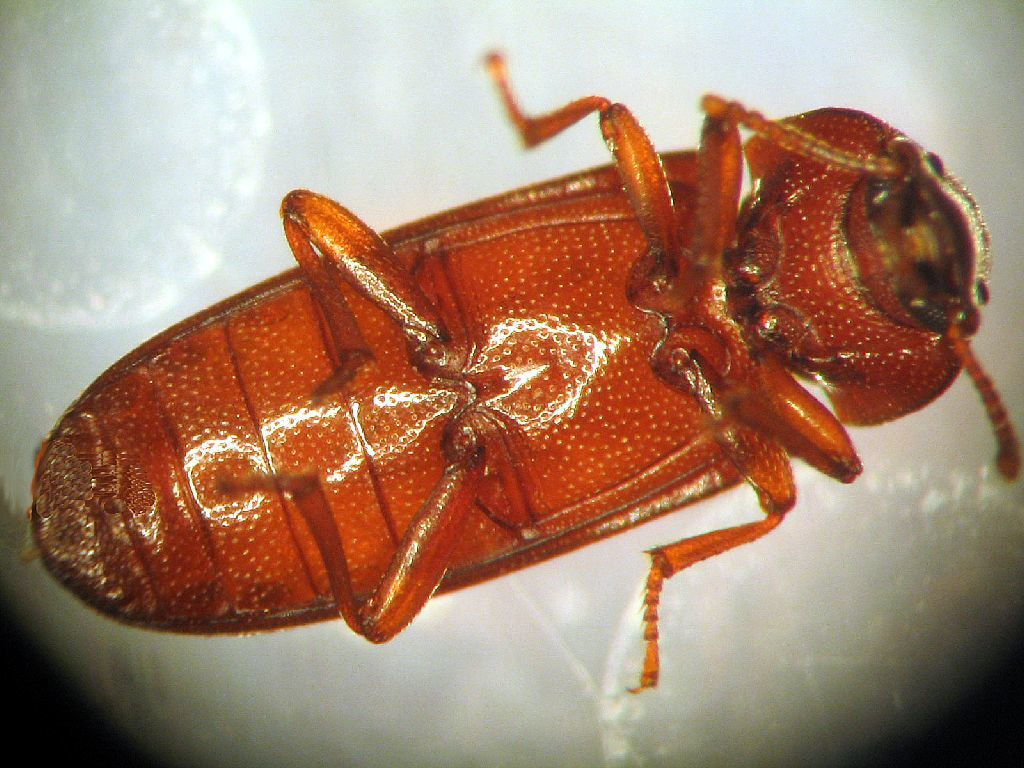
Tomioka Masafumi · Kumagaya, Kumagaya City, Saitama Prefecture 360-0016, Japan
Key facts in one look
- Group
- Insect
- Family
- Tenebrionidae
- Size
- 3.1–3.6 mm
- Status in Georgia
- Listed for the country's fauna
- Activity
- All year in mills
- Conservation
- NE
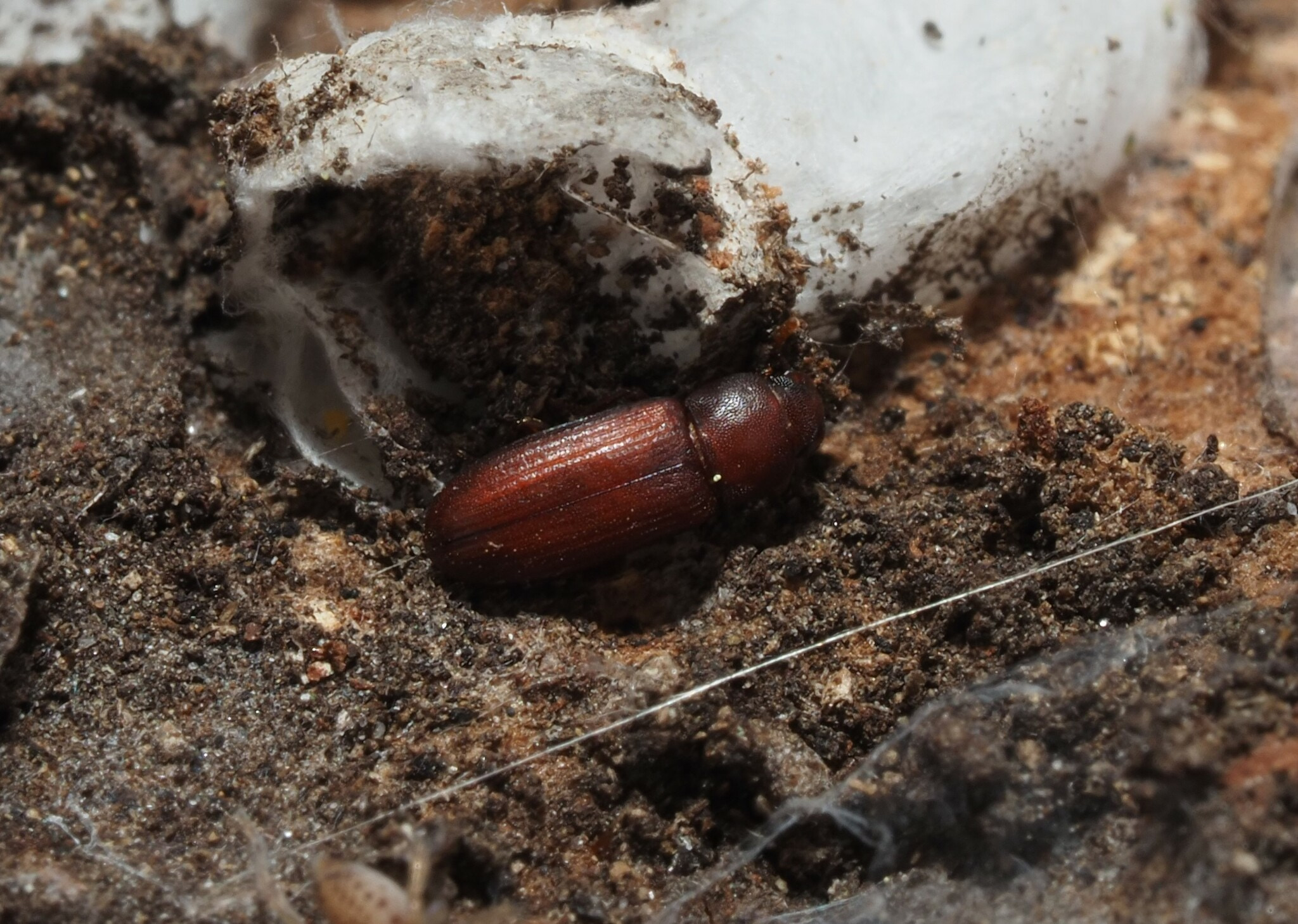
The confused flour beetle (Tribolium confusum) is one of the most common and most destructive pests of stored food in the world. It spoils flour, bran, semolina, broken grain and dried fruit, but it cannot eat whole, undamaged grain. It is a small reddish-brown beetle, 3.1–3.6 mm long. Its wings are developed, but it does not fly. Infested flour turns lumpy, smells unpleasant and grows mould. If you find small brown beetles or yellow larvae in your flour, you are probably dealing with this beetle or a close relative.
Identification
Confused flour beetle: how to identify it
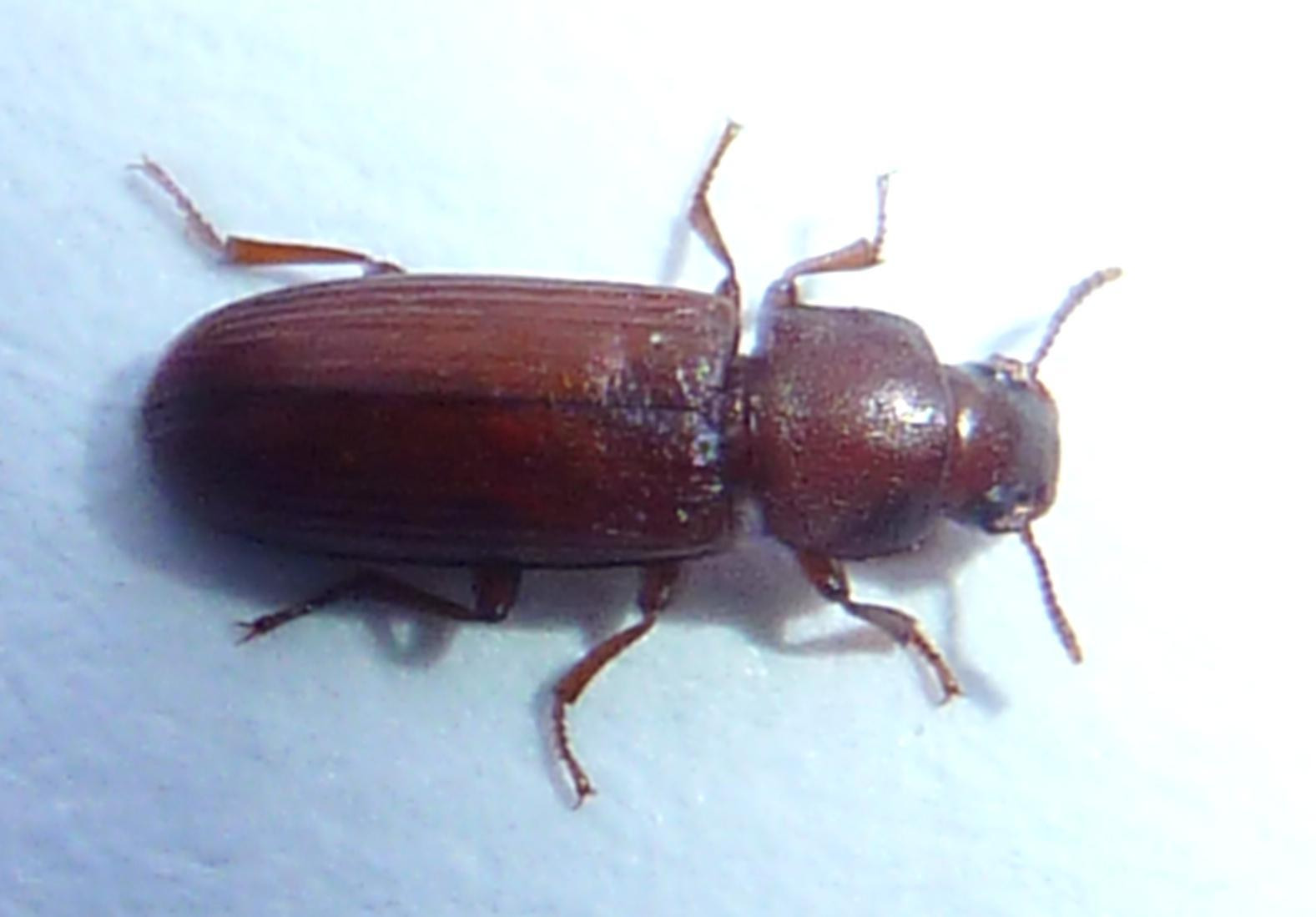
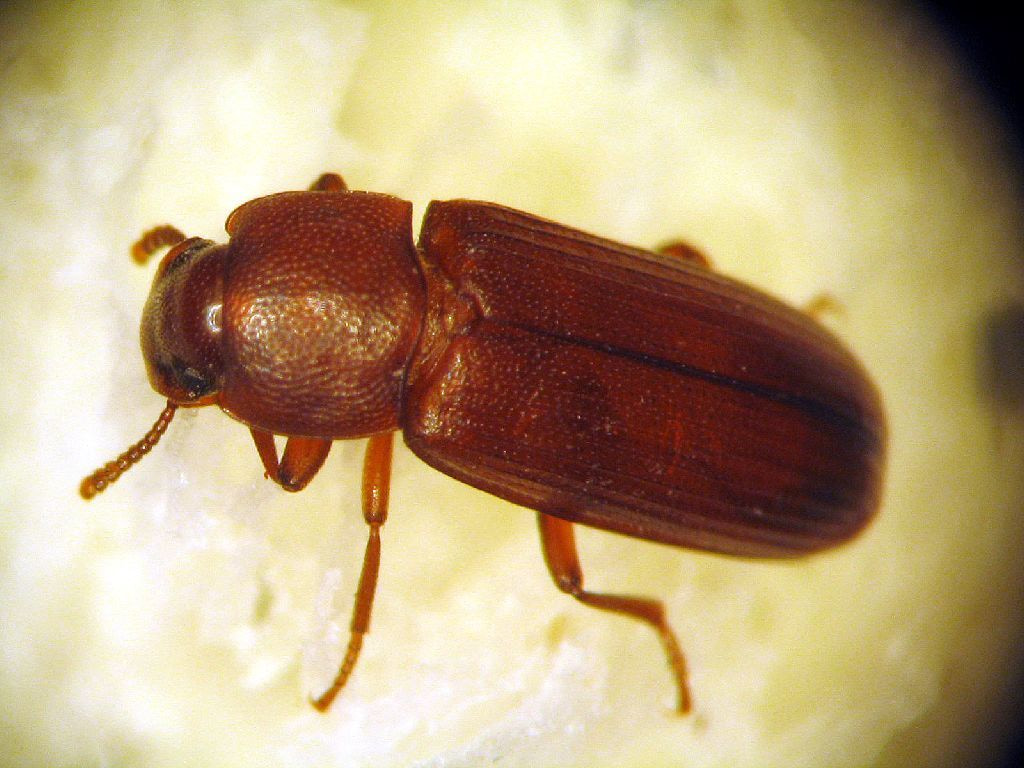
A small, flat, reddish-brown beetle, 3.1–3.6 mm long. It looks very like the red flour beetle (Tribolium castaneum), and that is where its name comes from: the two species are easily confused. The main difference is in the antennae. A reliable identification needs a hand lens or a close photo.
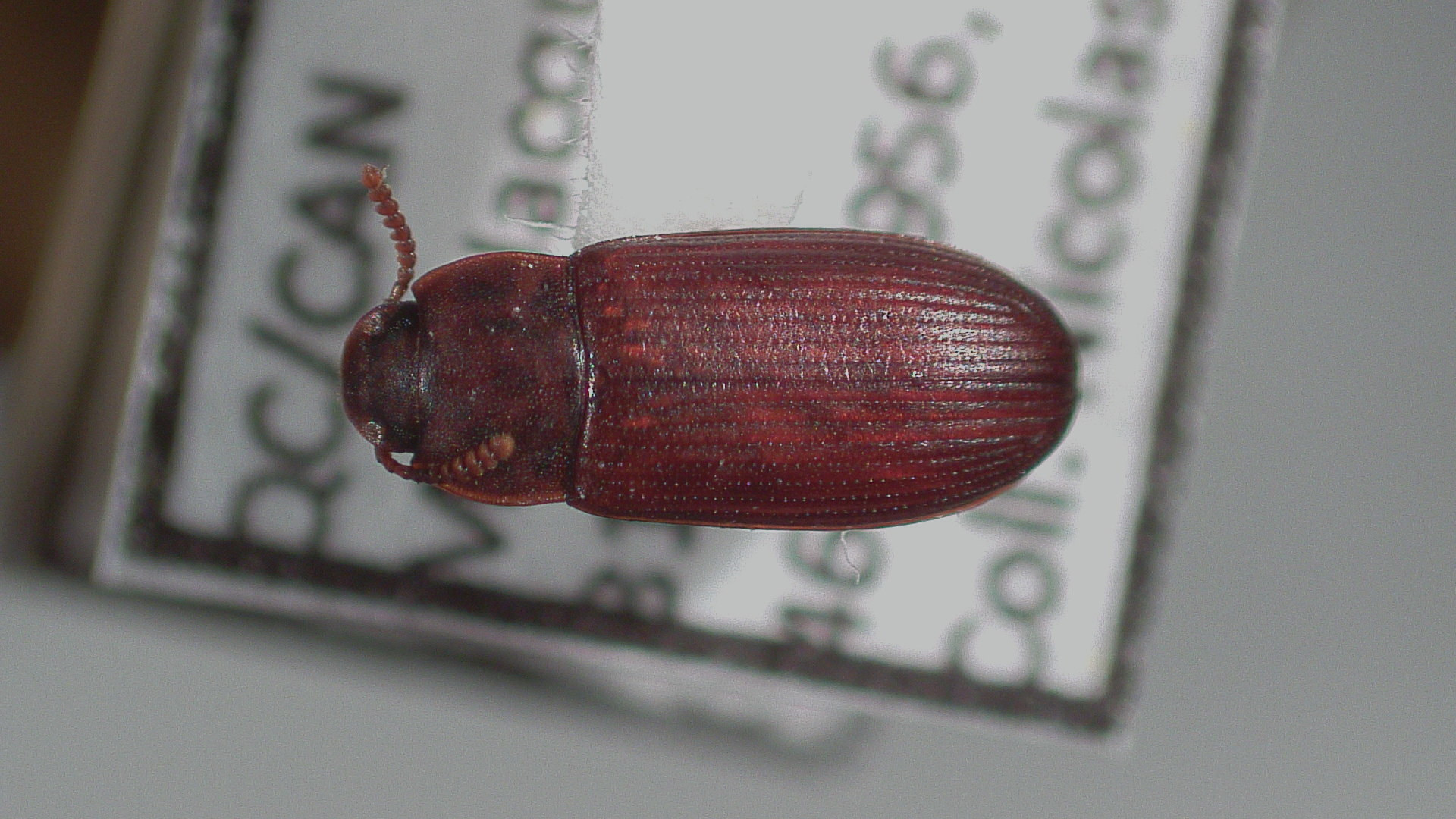
The antennae thicken gradually towards the tip and end in four enlarged segments. In the red flour beetle the last three segments widen abruptly. You will only see this with a hand lens.
The cheek projection in front of the eye extends beyond the edge of the eye. In the red flour beetle it does not. The pronotum is almost square, with weakly rounded sides.
Its wings are well developed, but it does not fly. The red flour beetle does fly short distances. If a beetle flies to a window or a light, it is probably not the confused flour beetle.
Colour
The adult is reddish brown or dark red and shiny. The larva is light yellow to yellowish brown. The egg is white. Colour will not separate it from its relative, the red flour beetle.
Swatches are illustrative. Do not identify a species by colour alone.
The confused flour beetle is a beetle of food that people store. It lives in mills, bakeries, grain stores and shops, and in homes in the crevices of kitchen cupboards and shelves. In mills it settles inside the machinery, where cleaning is hard, and it tolerates vibration easily. It originally comes from Africa and is now found all over the world. It prefers cooler climates than its relative, the red flour beetle.
The confused flour beetle is listed for the fauna of Georgia and lives with food that people store. In the country it is known from two places: Tsnori in Kakheti, and Tbilisi. Neither record has a date.
Data: Reptiles.ge + iNaturalist · Methodology
- Field observation
- Several records in one spot
- Region with records
Both the beetle and its larva feed on processed grain and grain products. It eats flour, especially coarse flour, bran, semolina, broken grain and grain dust, as well as rice, dried fruit, nuts and beans. It cannot eat whole, undamaged grain. So the damage is where grain is already broken or milled. When food is short it turns to cannibalism: adults and larvae eat eggs, and adults also eat pupae and larvae.
The female lays her eggs straight into the food. The eggs are sticky and hide in the flour. She lays 300–400 eggs in her lifetime. The larva moults five times and then pupates. Under normal conditions it takes 46–60 days from egg to adult, and there are 3–4 generations a year. An adult lives about one year on average, some for 3–4 years. It copes badly with cold: below 10 °C development stops, and below −7 °C it dies quickly. In unheated buildings the adults overwinter; in heated ones both adults and larvae do.
It has not been assessed on the global IUCN Red List (NE). It is not on Georgia's Red List. It needs no protection: it is a pest of stored food and is found all over the world. In mills and warehouses it is controlled with fumigation, heat and insecticides. The use of different insecticides has increased the genetic variability of its populations, which makes it hard to kill.
Related guides
Continue with related pages
Yes, it is listed in the checklist of Georgia's darkling beetles. In the country it is known from Tsnori in Kakheti and from Tbilisi. It lives with food that people store: in mills, warehouses and homes. It spreads easily with flour and grain.
By the antennae and by flight. In the confused flour beetle the antennae thicken gradually towards the tip, while in the red flour beetle the last three segments widen abruptly. The confused flour beetle does not fly; the red flour beetle flies short distances. Both are reddish brown and similar in size, so check the antennae with a hand lens.
No, it is not dangerous to people. But its foul-smelling secretion builds up in infested flour and irritates the skin and airways. Its presence in food also encourages mould. Do not use infested flour.
Throw away infested flour and grain products. Keep fresh food in tightly closed containers. Put small amounts of grain in the freezer for 4–5 days: the beetle cannot survive that cold for longer. When you buy, check that the packaging is intact.
References
What this profile is based on
Species profiles are compiled from peer-reviewed literature and established biodiversity databases, and are reviewed as new taxonomic and conservation data become available.
Prepared by the Reptiles.ge editorial team from the sources listed here.