


Eurasian wren
Troglodytes troglodytes


Qiuhan Zhang · Schwebsange
Key facts in one look
- Size
- 9–10 cm
- Diet
- Insects and their larvae; spiders
- Status in Georgia
- Year-round resident, breeds
- Habitat
- Scrub, woodland, gardens and hedgerows
- Family
- Troglodytidae
- Protection
- Globally LC, 2018; in Georgia LC, 2021
The wren is only 9–10 cm long and weighs about 10 grams, yet its voice is enormous for its size. It often holds its short tail cocked up, which sets it apart at once from other small brown birds. In Georgia it lives and breeds all year round. It picks scrub, gardens, hedgerows and forest, and stays close to the ground. If you cannot see the bird, listen for its loud, rapid, trilling song coming from a bush.
Identification
Eurasian wren: how to identify it
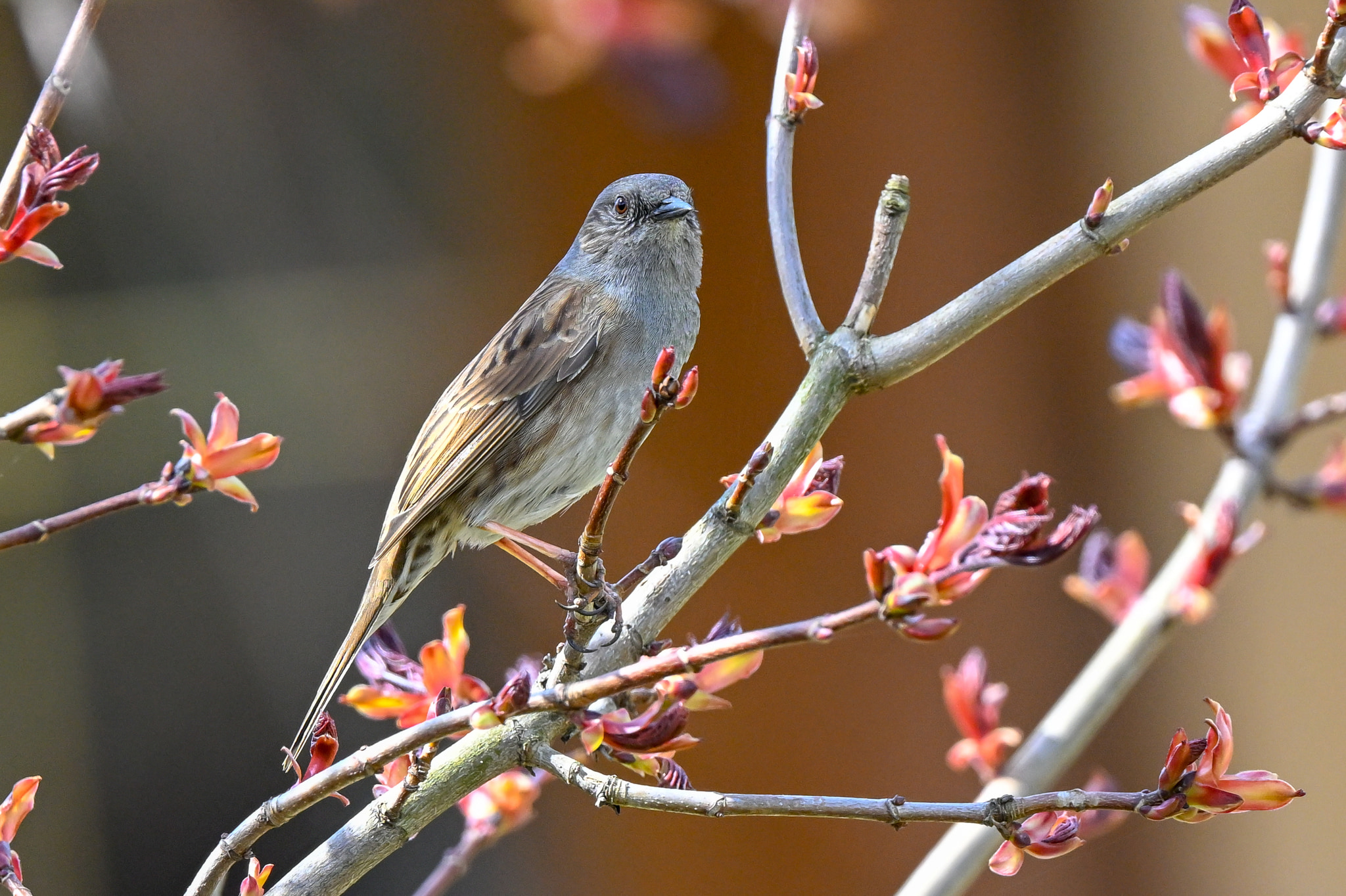
A round, brown bird, 9–10 cm long, with a short tail that is often cocked up, a short neck and a fairly long, thin bill. A pale buff stripe runs over the eye.

Length 9–10 cm, wingspan 13–17 cm, weight about 10 g. The wings are rounded, and the tail is very short and often cocked up.
It is rufous brown above and greyer below, finely barred darker all over, even on the wings and tail. The bill is dark brown and the legs pale brown. The sexes look alike.
Young birds are less clearly barred and mottled below. The song may be confused with the dunnock's, but the wren's is longer and stronger and contains repeated trills.
Colour
Swatches are illustrative. Do not identify a species by colour alone.
Often confused with
It is a bird of scrub and low, dense cover. It lives in woodland, gardens, hedgerows, thickets, plantations and reedbeds, and also on boulder-strewn slopes and rocky coasts. It mostly stays near the ground and rarely climbs into the treetops.
The Eurasian wren lives and breeds in Georgia all year round. It has been recorded in every region of the country. Most records come from Mtskheta-Mtianeti, especially around Kazbegi, followed by Samtskhe-Javakheti, Kakheti, Adjara and Samegrelo-Zemo Svaneti. It has also been found in Kvemo Kartli, Tbilisi, Imereti, Abkhazia, Shida Kartli, Racha-Lechkhumi and Kvemo Svaneti, and Guria. Records come from every month of the year, with the most from April to June and in September and October. The oldest record is a museum specimen collected near Mtskheta in 1909.
Data: Reptiles.ge + iNaturalist · Methodology
- Field observation
- Several records in one spot
- Region with records
It eats mainly insects, above all the larvae of butterflies and moths, and also beetle and fly larvae and aphids. It also takes spiders and some seeds. It searches crevices, old stone walls and fallen logs, moving in quick, jerky hops. Because it finds insects on bark and logs even in winter, it can survive in cold and snowy places. It feeds its young mostly on moth caterpillars.
It is always on the move, creeping like a mouse among bushes and roots. Its most common call is a sharp, repeated "tic-tic-tic", which turns into a churr when the bird is excited. The male's song is long and complex, with a whole series of trills. Weight for weight, it sings ten times louder than a cockerel. The song can be heard at any time of year, most of all in spring. On winter nights it roosts in holes and old nests, and in harsh weather several birds roost together. The male builds several nests on his territory, and the female picks one and lines it with feathers. The nest is domed, with a side entrance, and made of grass, moss, lichen and dead leaves. It is built in a crack in a wall, tree or rock, in a bush, or in another bird's old nest. From April on it lays 5–6 eggs, rarely 3–11. Only the female incubates, for 14–15 days, and the young leave the nest at about 16 days. There are usually two broods a year. A male may have several females nesting on his territory at the same time.
Globally the Eurasian wren's risk of extinction is rated low (LC, 2018). It is extremely widespread, and its numbers are growing. Europe holds 32.7–56.5 million breeding pairs. In Georgia's national assessment (2021) its risk is also rated low (LC), and its numbers are stable. The list of the birds of Georgia gives it as a year-round resident and breeder.
Related guides
Continue with related pages
Yes. It lives and breeds in Georgia all year round. It picks scrub, gardens, hedgerows and forest, and is easiest to notice by its loud song.
It is a tiny, round, brown bird, 9–10 cm, with a short tail often cocked up. It is finely barred all over and has a pale stripe over the eye. It is easiest to recognise by its loud, trilling song.
The male announces his territory with his song. Weight for weight, he sings ten times louder than a cockerel. The song can be heard at any time of year, most of all in spring.
Mainly insects, especially the larvae of butterflies and moths, and also beetle and fly larvae, aphids and spiders. It also takes some seeds. It searches for food in crevices and among fallen logs.
The male builds several domed nests of grass, moss and leaves, each with a side entrance. The female picks one and lines it with feathers. It lays 5–6 eggs, usually twice a year.
No, it is harmless to people. Globally its risk of extinction is low (LC, 2018). In Georgia's national assessment (2021) its risk is also low (LC), and its numbers are stable. Do not touch its nest, and do not catch wild birds.
References
What this profile is based on
Species profiles are compiled from peer-reviewed literature and established biodiversity databases, and are reviewed as new taxonomic and conservation data become available.
Prepared by the Reptiles.ge editorial team from the sources listed here.


