
Wallcreeper
Tichodroma muraria
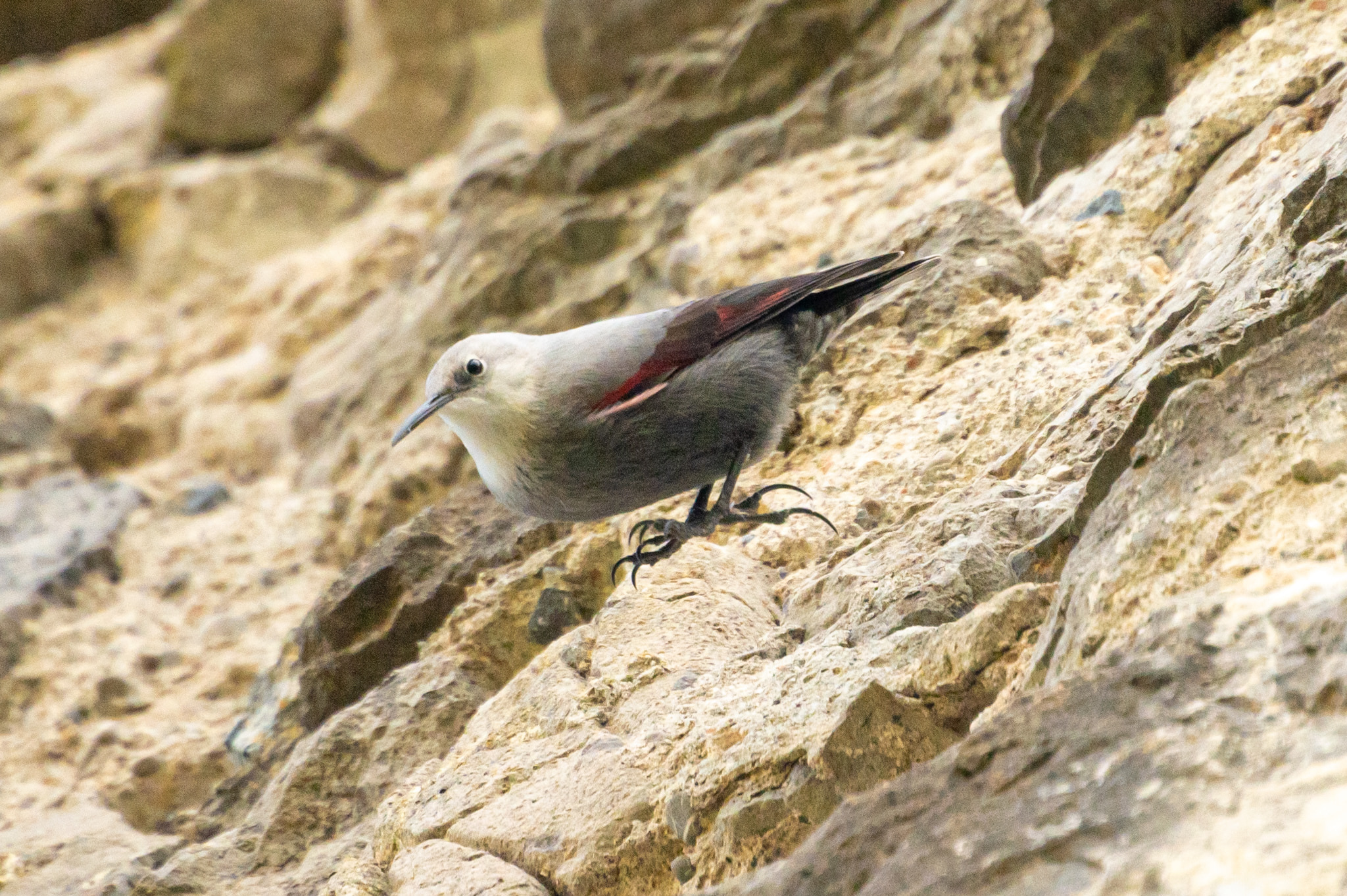
Paolo Zucca · Brescia
Key facts in one look
- Size
- 15.5–17 cm
- Diet
- Insects and spiders
- Status in Georgia
- Year-round resident, breeds
- Habitat
- Sheer cliffs and gorges of high mountains
- Family
- Tichodromidae
- Protection
- Globally LC, 2019; in Georgia LC, 2021
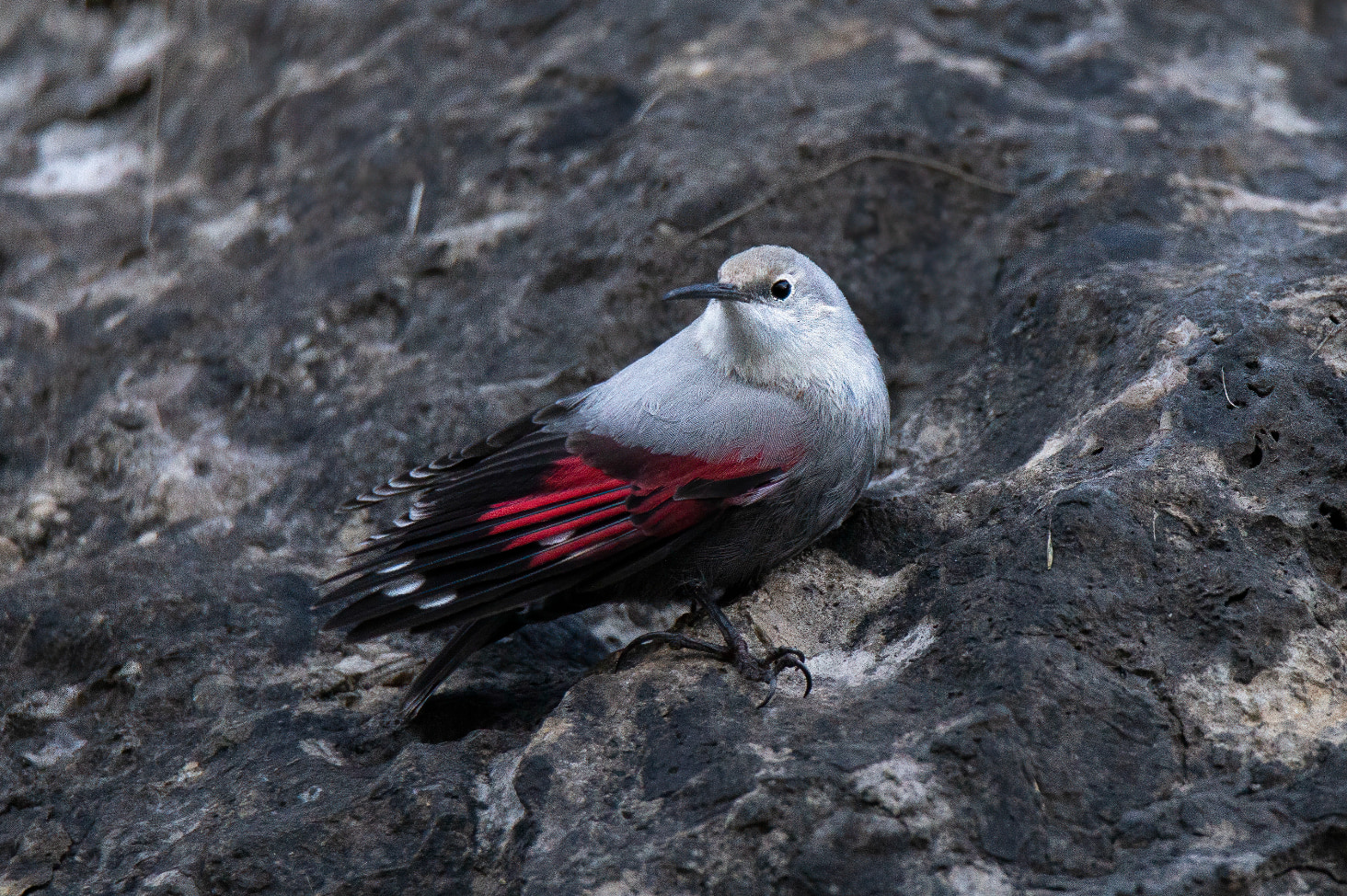
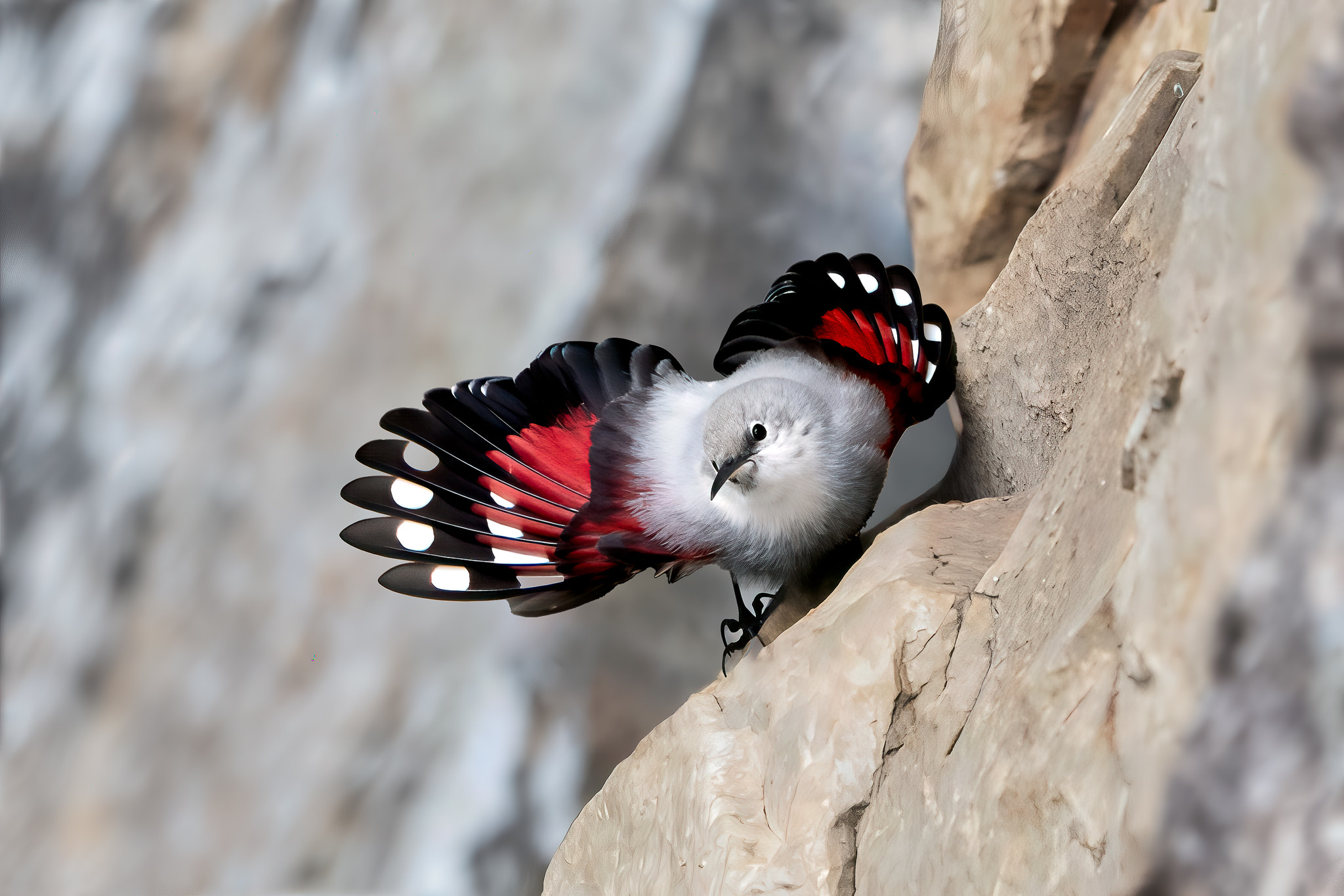
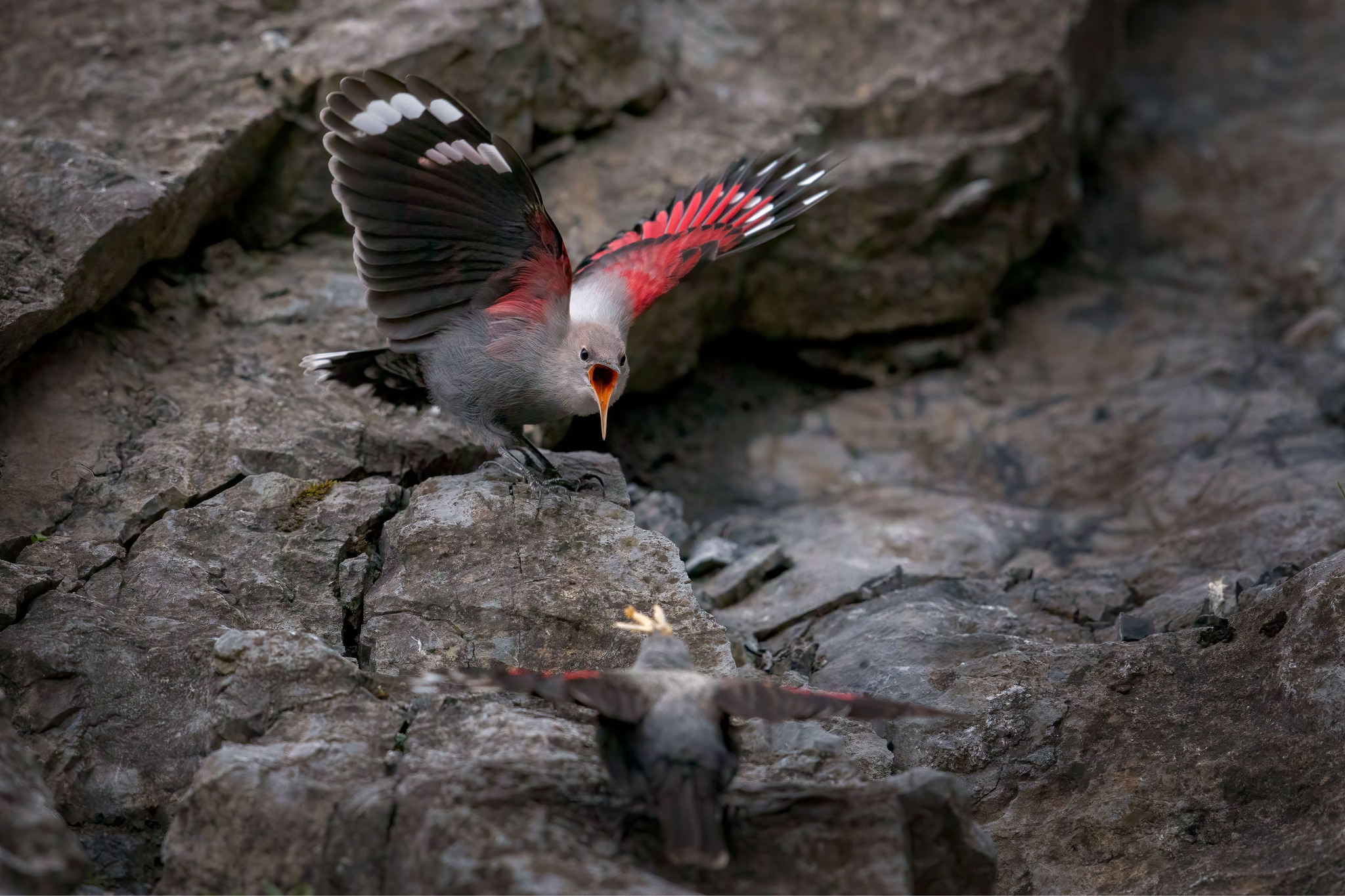
The wallcreeper is the only living species of its genus and family. It is a grey bird, but when it opens its wings it shows a crimson patch and white spots, and in flight it looks like a large, bright butterfly. It lives on sheer cliffs in high mountains and moves over rock walls in short flights and hops, with its wings half open. In Georgia it lives and breeds all year round and comes down lower in winter. It is hard to spot on a cliff, so watch for a flash of red when it opens its wings.
Identification
Wallcreeper: how to identify it
A grey bird, 15.5–17 cm long and 17–19 g, with a long, thin, down-curved bill. The wing has a crimson patch and white spots that barely show on the folded wing. The tail is short and black.
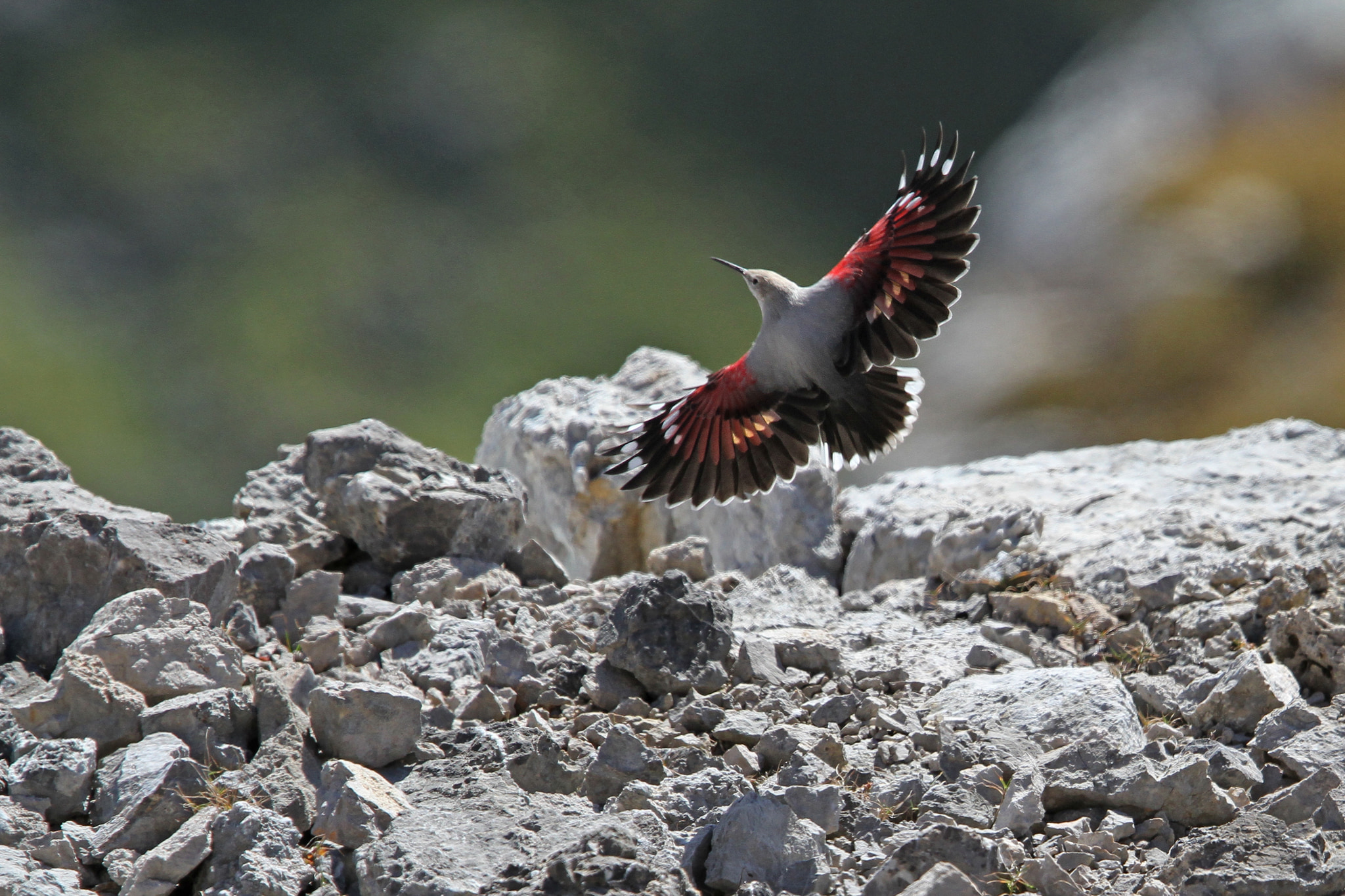
Length 15.5–17 cm, weight 17–19 g. The bill is long, thin and down-curved. The tail is short and black with a narrow white fringe.
The body is blue-grey, the flight and tail feathers darker. Most of the wing coverts and the base of the flight feathers are crimson, with white spots. On the folded wing this colour is almost hidden, and in flight the bird looks like a large, bright butterfly.
In summer the male has a black throat that grades into the grey body. The female has a white throat or a small dark throat patch. In autumn and winter both sexes have a white throat, and young birds look like winter adults. In winter a white-throated bird is a wallcreeper too, if red shows on the wing.
Colour
Swatches are illustrative. Do not identify a species by colour alone.
It is a bird of high mountains that picks the steepest and wildest cliffs, and it nests mostly in gorges above mountain streams. In Europe it breeds at 1000–3000 m. In winter it moves lower and then also turns up on buildings and in quarries. In Georgia it has been seen in Kazbegi District and near Tbilisi, at the village of Digomi.
The wallcreeper lives and breeds in Georgia all year round. Most records come from Mtskheta-Mtianeti, mainly the Kazbegi area, in April and May. It has also been found in Kakheti, Samegrelo-Zemo Svaneti, Tbilisi, Samtskhe-Javakheti, Kvemo Kartli, Imereti, Shida Kartli, Abkhazia and Racha-Lechkhumi and Kvemo Svaneti. There are records from every month, and in Tbilisi it is seen mostly from November to March. The oldest record is a museum specimen collected near Mtskheta in 1909.
Data: Reptiles.ge + iNaturalist · Methodology
- Field observation
- Several records in one spot
- Region with records
It eats insects and spiders, which it picks off rock faces. It moves over the rock in short flights and quick hops, often with its wings half open. It does not use its tail as a prop when climbing. Sometimes it makes a short sally from the rock wall and catches a flying insect in the air.
It is largely resident but comes down from the mountains in winter. In winter it lives alone: males and females each defend a separate feeding territory, and some birds return to the same winter site in later years. It is mostly silent. The song is a high, drawn-out whistle whose notes rise and fall in turn. The male sings while perched or climbing in the breeding season, the female mainly in winter while defending her feeding territory. The female builds the nest deep in a rock crevice, a hole or a cave. It is a cup of grass and moss lined with soft material, often feathers or wool, and usually has two entrances. She lays 4–5 white eggs, sometimes only three. The female incubates for 19–20 days and is fed by her mate during that time. Both parents feed the young for 28–30 days, and the pair raises only one brood a year.
Globally the wallcreeper's risk of extinction is rated low (LC, 2019). It is a bird of the high mountains of Eurasia, from southern Europe to central China. In Georgia's national assessment (2021) its risk is also rated low (LC), and its numbers are stable. The list of the birds of Georgia gives it as a year-round resident and breeder.
Related guides
Continue with related pages
Yes. It lives and breeds in Georgia all year round. It lives on sheer cliffs in high mountains and comes down lower in winter. It has been seen in Kazbegi District and near Tbilisi, at the village of Digomi.
It is a grey bird with a long, thin, curved bill and crimson wings. On the folded wing the red barely shows, but when it opens its wings a crimson patch and white spots appear. In flight it looks like a large, bright butterfly. It climbs rock walls with its wings half open: that is its main mark.
Insects and spiders, which it picks off rock faces. It moves over the rock in short flights and hops. Sometimes it flies out from the wall and catches a flying insect in the air.
Deep in a rock crevice, a hole or a cave. The female builds the nest of grass and moss and lines it with feathers or wool, and it usually has two entrances. She lays 4–5 eggs and incubates them for 19–20 days. The young leave the nest after 28–30 days.
Mostly not; it is a resident bird. In winter it comes down from the mountains and also turns up on buildings and in quarries. At that time it lives alone and defends its own feeding territory. Some birds return to the same winter site in later years.
No, it is harmless to people. Globally its risk of extinction is low (LC, 2019). In Georgia's national assessment (2021) its risk is also low (LC), and its numbers are stable. Do not catch wild birds.
References
What this profile is based on
Species profiles are compiled from peer-reviewed literature and established biodiversity databases, and are reviewed as new taxonomic and conservation data become available.
Prepared by the Reptiles.ge editorial team from the sources listed here.