



Stripe-winged grasshopper
Stenobothrus lineatus
Simon Piqué Caillou · Saint-Martin-de-l'Arçon
Key facts in one look
- Size
- ♂ 15–19 mm, ♀ 21–26 mm
- Group
- Insect
- Family
- Acrididae
- Status in Georgia
- Listed for the country's fauna
- Activity
- Mid-June to end of October
- Conservation
- NE
The stripe-winged grasshopper (Stenobothrus lineatus) is the slowest singer in Europe: one wheezy phrase of the male lasts 10–25 seconds. It is the largest Stenobothrus of Central Europe, with males 15–19 mm and females 21–26 mm long. It has an oblique white mark on the forewing. It lives on short-grass, dry, nutrient-poor grasslands. If in summer you hear a slow sound from the grass like wheezy breathing, it may well be this one.
Identification
Stripe-winged grasshopper: how to identify it
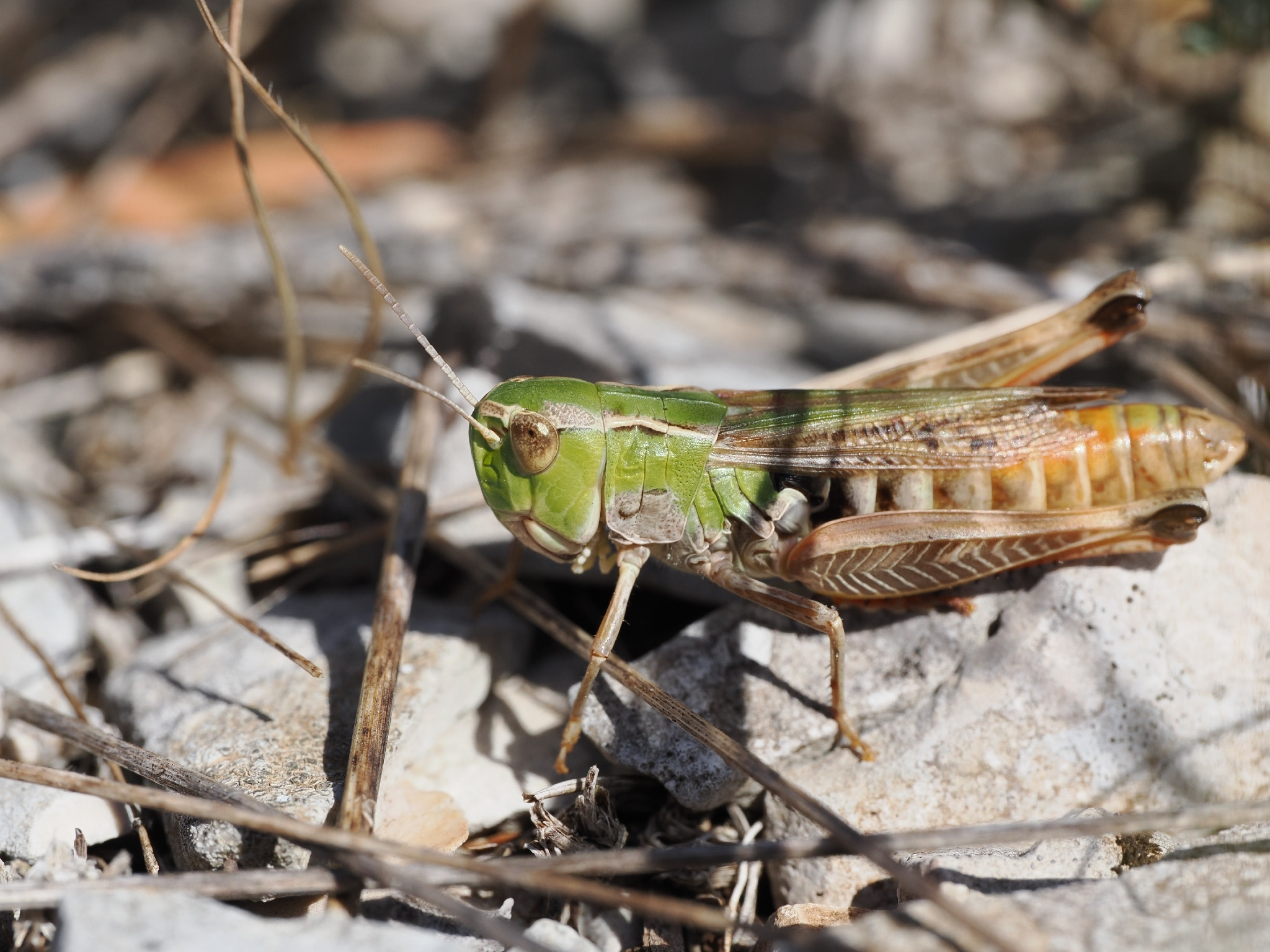
A fairly large grasshopper: the male is 15–19 mm and the female 21–26 mm. It has an oblique white mark just behind the middle of the forewing. The side keels of the pronotum curve strongly inwards. Its song is still the easiest way to tell it: no other grasshopper in Europe has such a slow, wheezy song.
The forewings are broad, with an oblique white mark just behind the middle. The middle field of the wing is broad but does not reach beyond half the wing's length. This separates it from S. nigromaculatus.
The male's cerci are simply conical. In the similar S. fischeri and S. nigromaculatus they are flattened from the sides towards the tip. The hind wings of the stripe-winged grasshopper are also darker and more smoky.
The side keels of the pronotum curve strongly inwards. Other Stenobothrus have similar keels, so this alone does not identify the species. Record the song along with your photo.
Colour
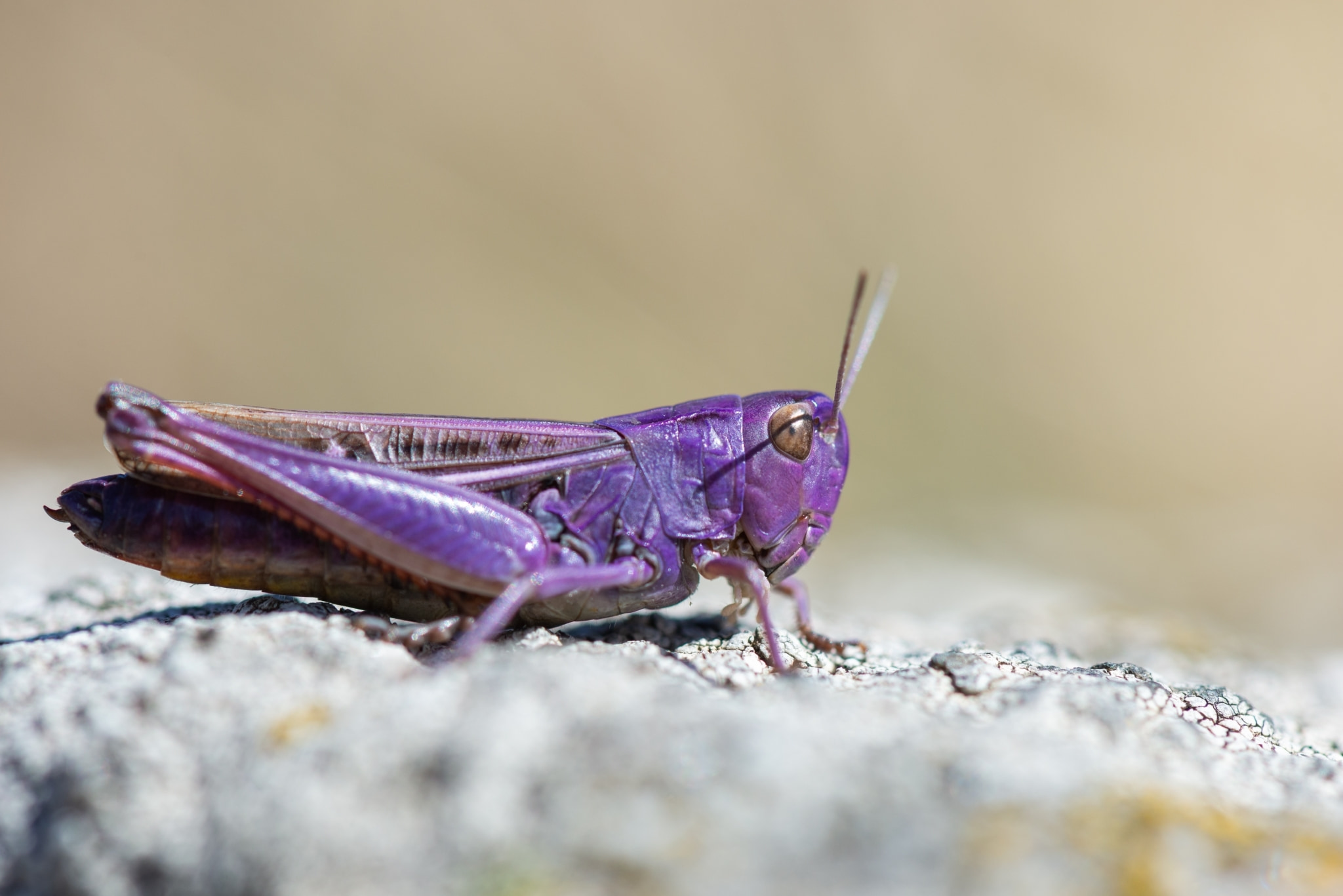
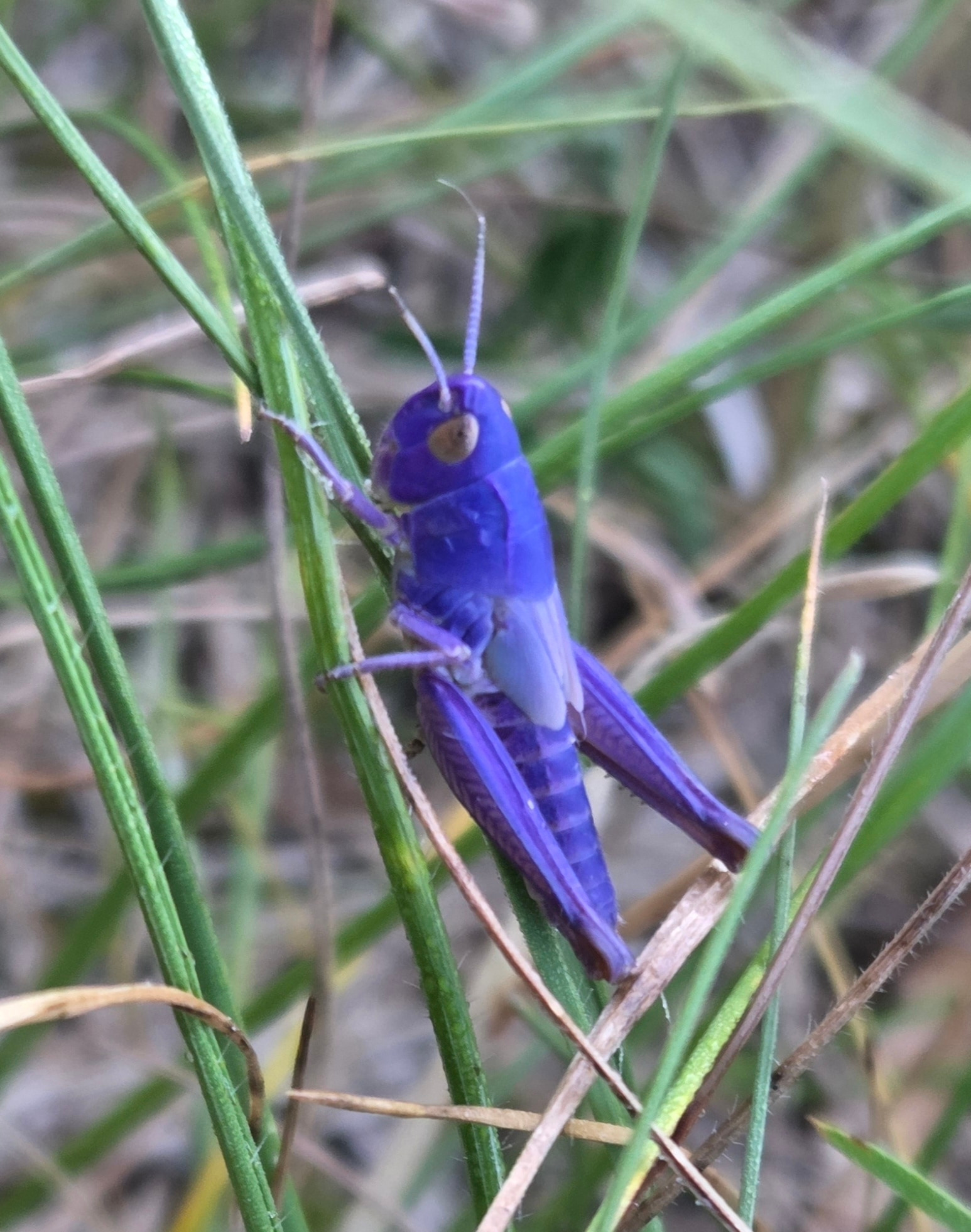
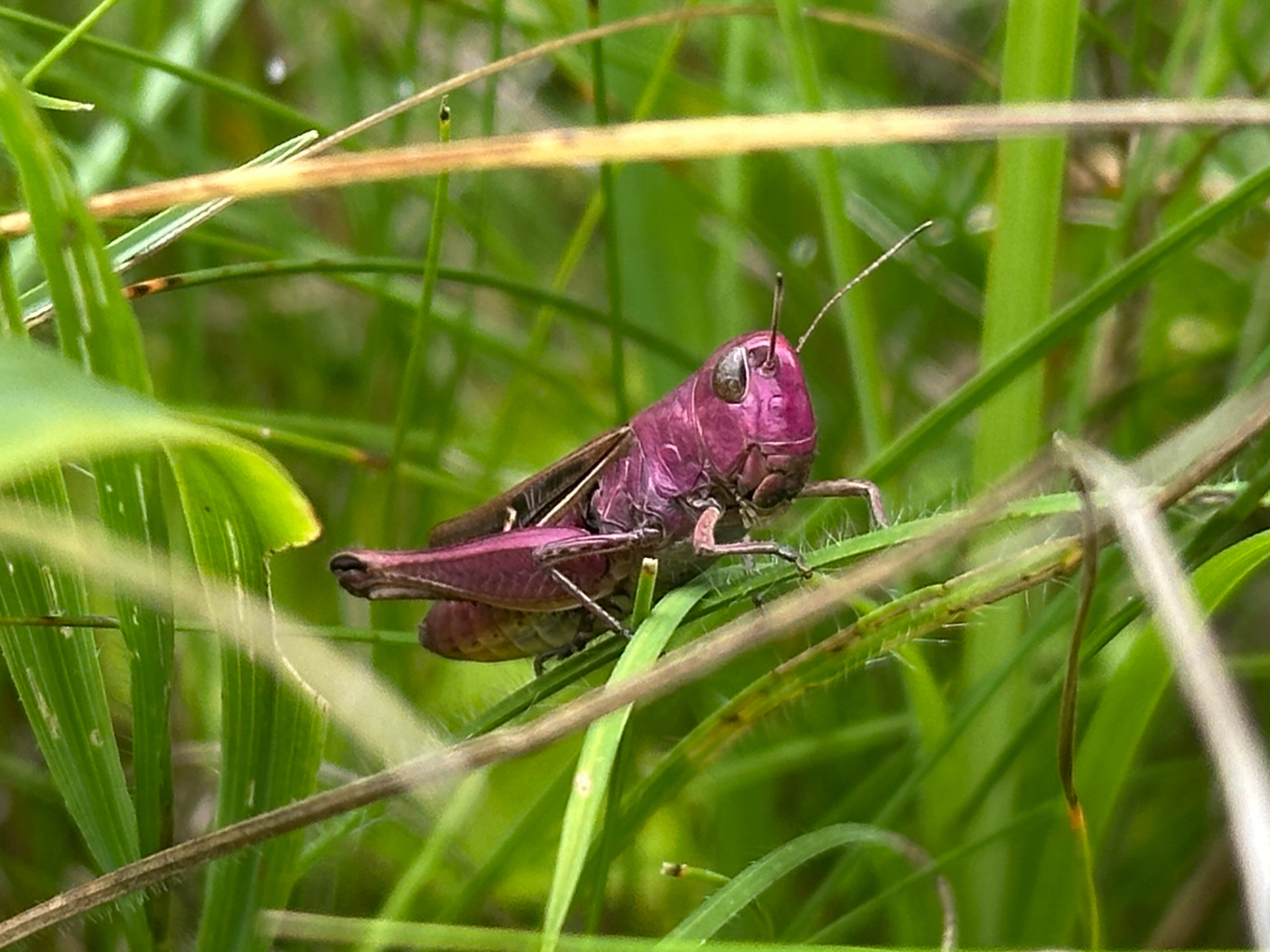
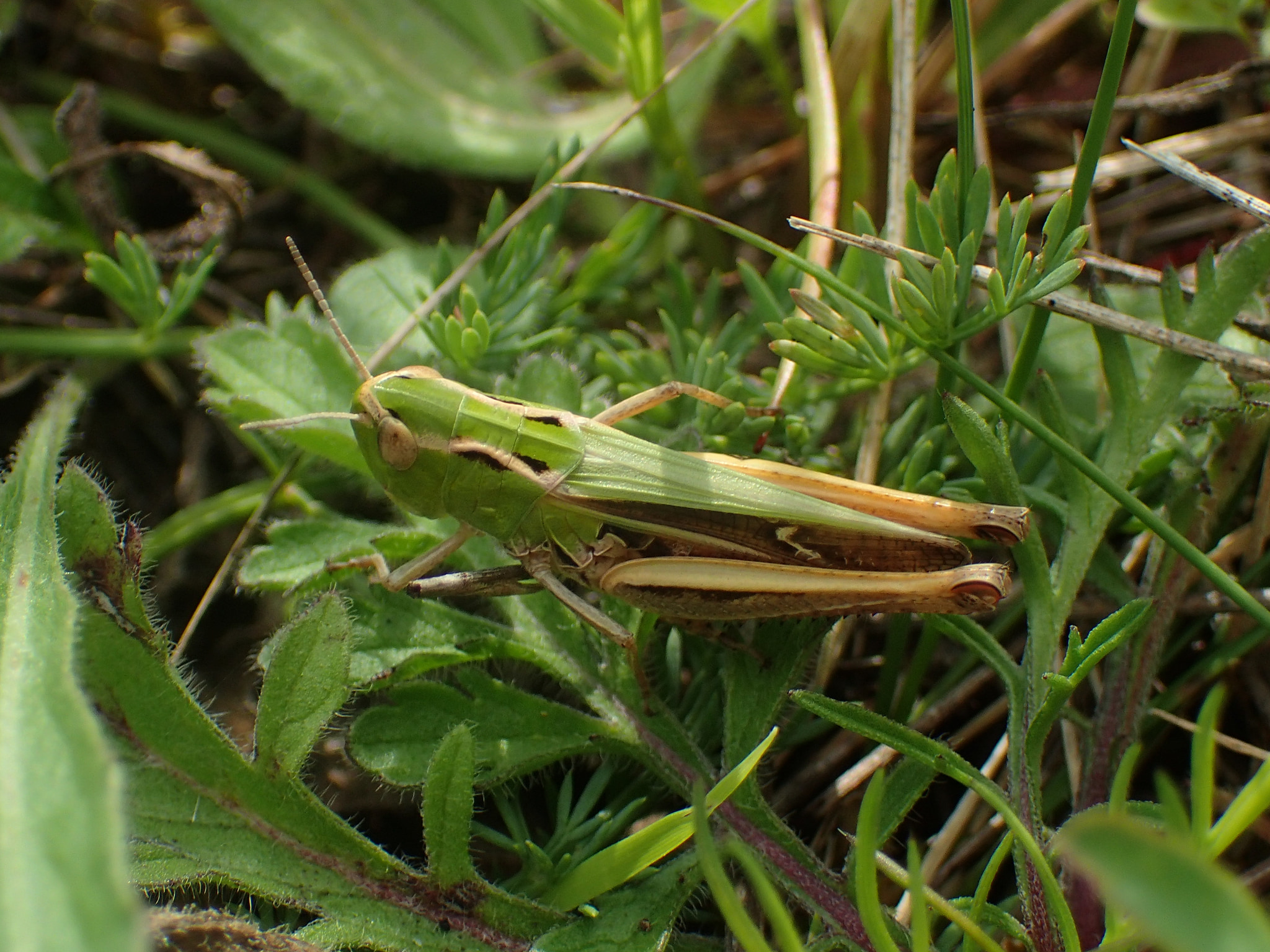
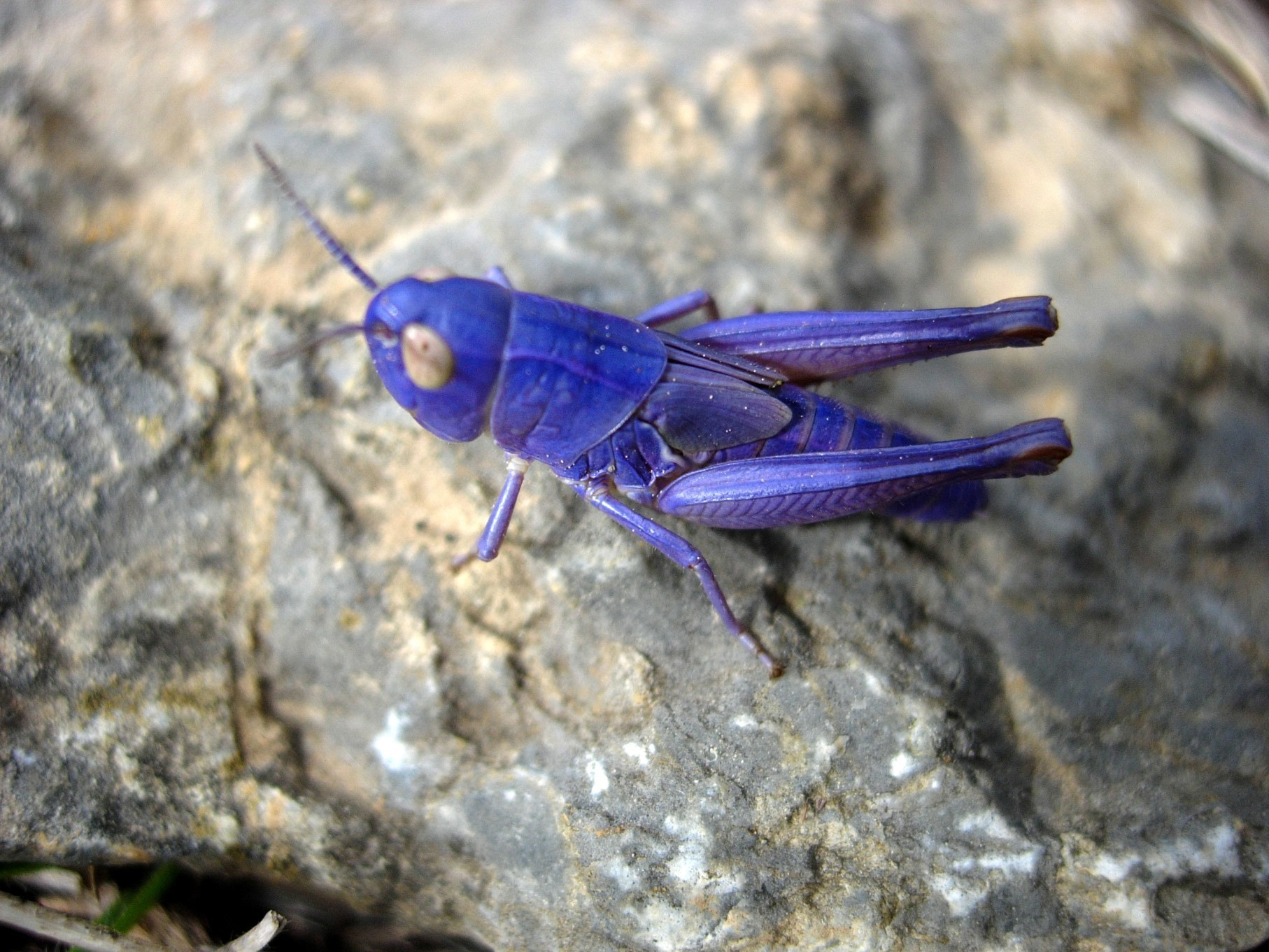
The colouring is contrasting and variable. Most are green and brown with a red tinge on the abdomen. Some males turn orange on the abdomen and hind tibiae, and females are sometimes pinkish or purplish. Wholly lilac-blue individuals also occur. The white mark on the forewing is a more reliable feature than colour.
Swatches are illustrative. Do not identify a species by colour alone.
Often confused with
The stripe-winged grasshopper is an insect of short, permanently low grass. It lives on nutrient-poor grasslands, sandy grasslands, pastures, limestone heathland, Alpine pastures, quarries and the drier parts of bogs. It prefers steep, south-facing slopes that sheep do not graze too much. It regulates its body temperature in the shade of grass tussocks and stones. It is generally missing from mown farmland.
The stripe-winged grasshopper is listed for Georgia's fauna. The records date from 2025 and 2026: two come from Mtskheta-Mtianeti, in Mtskheta and Kazbegi municipalities, and one from Samtskhe-Javakheti, near Akhalkalaki. Adults were recorded in August and September.
Data: Reptiles.ge + iNaturalist · Methodology
- Field observation
- Several records in one spot
- Region with records
The stripe-winged grasshopper feeds on various grasses and herbs. It finds its food on the short-grass, sunny grasslands where it lives. When it becomes very numerous, it damages cereal grasses, hayfields and alfalfa.
Adults are seen from mid-June to the end of October. The female lays her eggs in the lower leaf sheaths of grasses, and the eggs survive the winter. The male's song is the slowest of any European grasshopper: one phrase lasts 10–25 seconds and is made of 15–35 syllables, at about 1.2–1.5 syllables a second. It starts quietly, soon gets louder and sounds like a wheezy breath. Near a female the male sings longer phrases, sometimes for over a minute. Between them he makes a quite different, fast ticking sound, which usually lasts about half a minute and sometimes more than an hour. The two sounds alternate several times before the male tries to mate.
It has not been assessed on the global IUCN Red List (NE). On the European Red List it is not threatened (LC, 2016). It is not on Georgia's 2014 Red List. In parts of Central Europe it has declined as nutrient-poor, lightly grazed grasslands disappear. Heavy grazing and intensive mowing harm its populations.
Related guides
Continue with related pages
Yes, it is listed in the catalogue of Georgia's grasshoppers. It has been found in Mtskheta-Mtianeti, in Mtskheta and Kazbegi municipalities, and in Samtskhe-Javakheti, near Akhalkalaki. Everywhere it chooses short-grass, dry, nutrient-poor grasslands. In such places, from summer to autumn, listen for its slow, wheezy song.
The song is very slow and wheezy. The male sings one phrase for 10–25 seconds, at only 1.2–1.5 syllables a second. That is slower than any other European grasshopper. The phrase of the similar Stenobothrus fischeri lasts 3–5 seconds and is much faster. One minute is enough to record the song and compare.
By the white mark on the forewing and the male's cerci. The stripe-winged grasshopper has an oblique white mark just behind the middle of the forewing. The male's cerci are simply conical, while in the similar S. fischeri and S. nigromaculatus they are flattened from the sides towards the tip. These features only show in a close photo, so record the song too.
No, the stripe-winged grasshopper is harmless to people. It does not bite and has no venom. It feeds on grasses and harms fields only when it becomes very numerous. If you find one, take a photo and leave it where it is.
References
What this profile is based on
Species profiles are compiled from peer-reviewed literature and established biodiversity databases, and are reviewed as new taxonomic and conservation data become available.
Prepared by the Reptiles.ge editorial team from the sources listed here.


