


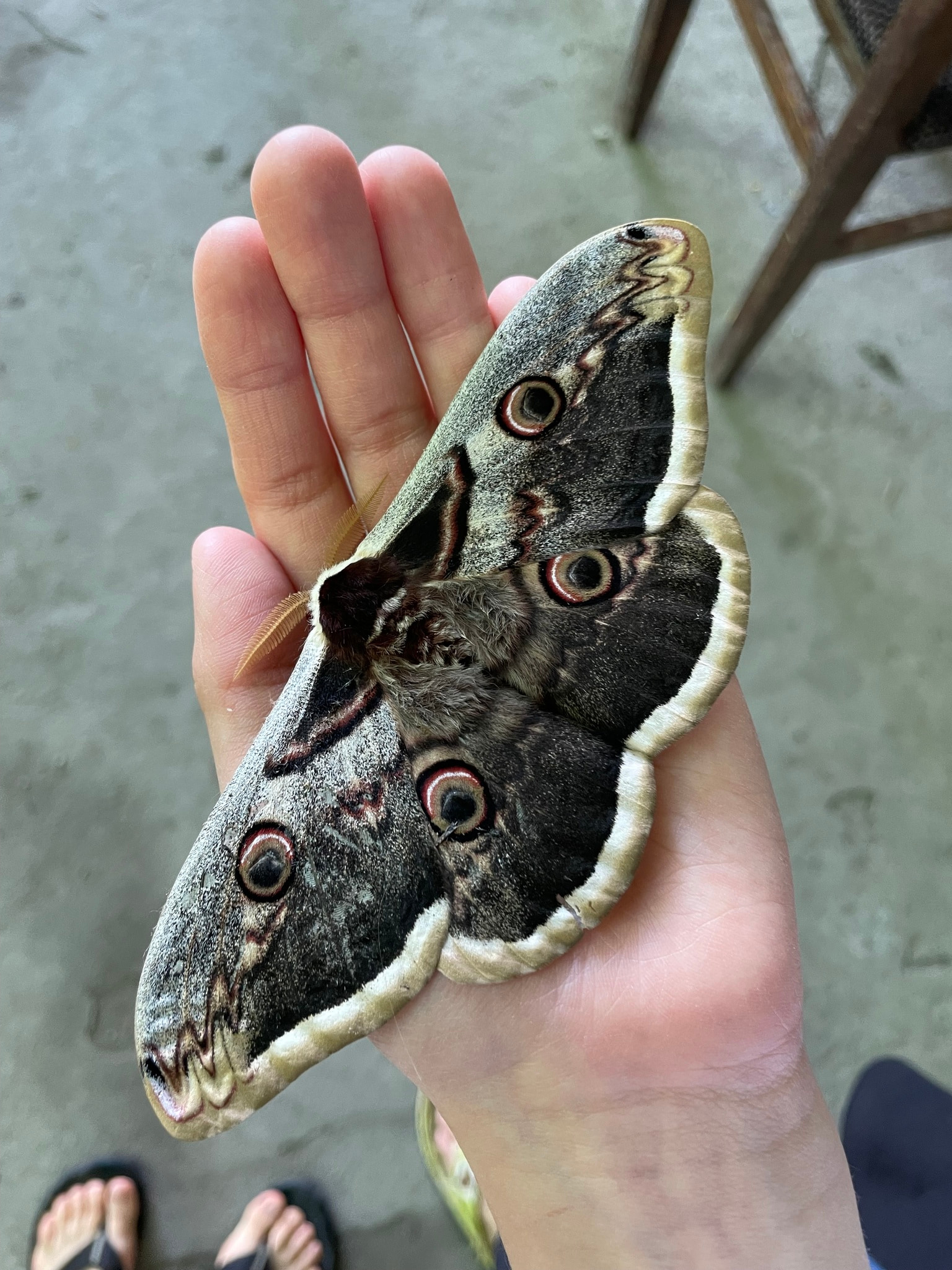

Giant peacock moth
Saturnia pyri
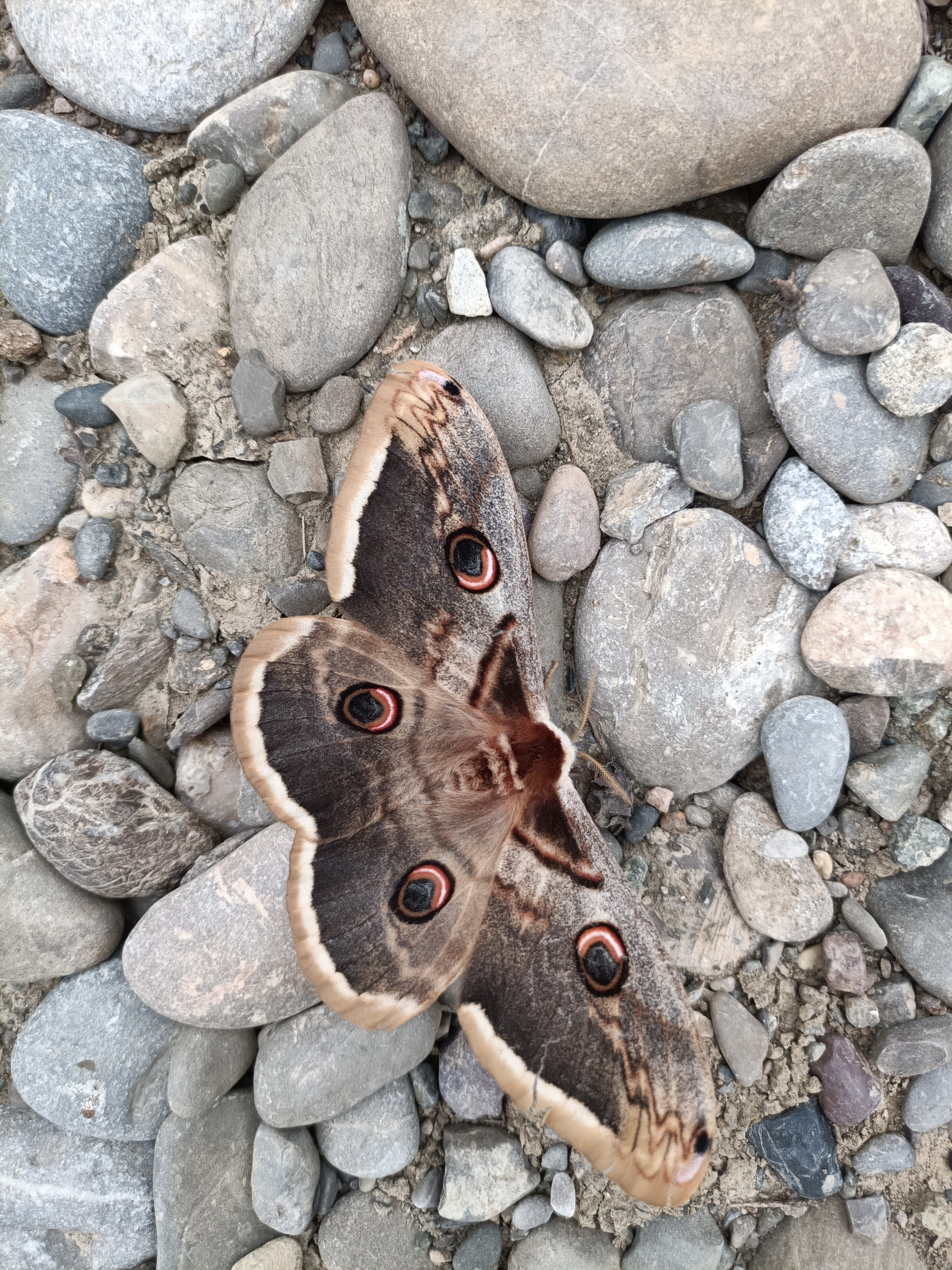
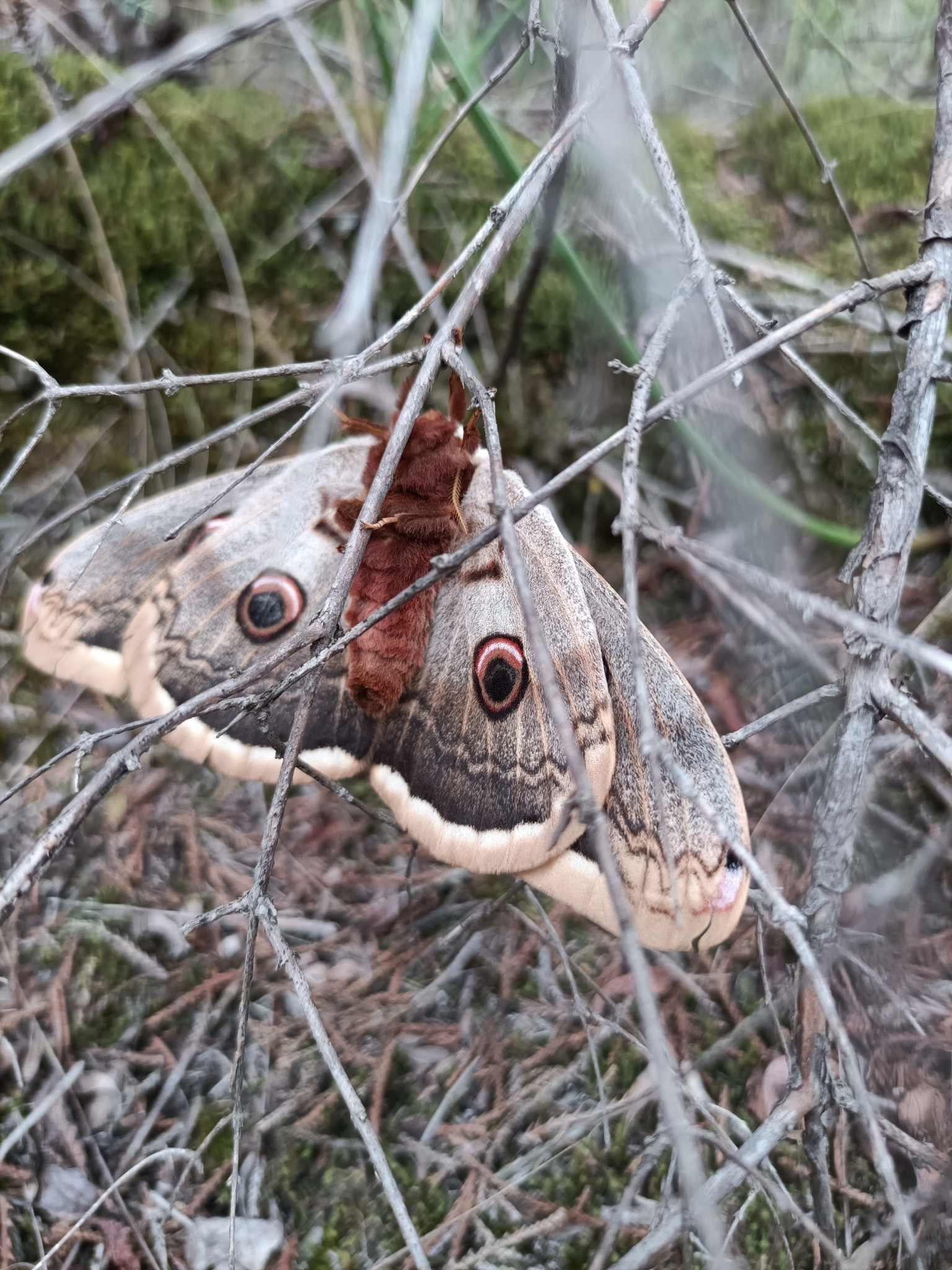
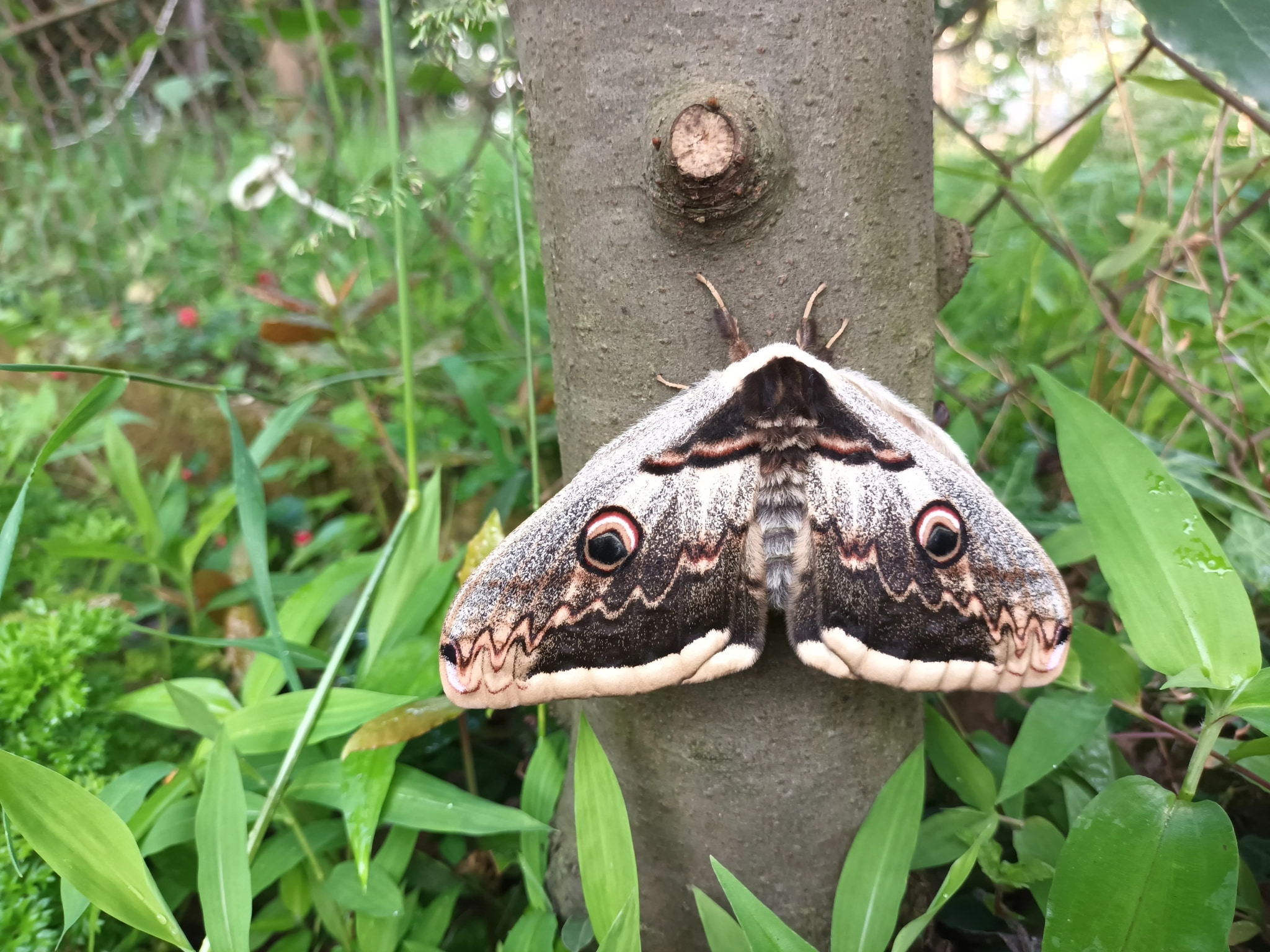
nalya · Tbilisi Georgia field photo
Key facts in one look
- Size
- Wingspan: ♂ up to 120 mm, ♀ up to 150–155 mm
- Group
- Insect
- Family
- Saturniidae
- Status in Georgia
- Native species
- Activity
- May–June, evening and night
- Conservation
- NE
The giant peacock moth (Saturnia pyri) is Europe's largest moth by wingspan. It has a massive, densely hairy body and dark brown wings, each with a large black "eye". It flies in the evening and at night, and when it circles a light its size makes it look like a bat. Its bright green caterpillar grows up to 110 mm long. It is native to Georgia and has been known from the country since 1885.
Identification
Giant peacock moth: how to identify it
A very large moth: the forewing is 50–70 mm long, and the wingspan is up to 120 mm in males and up to 150–155 mm in females. Each wing has a large black eyespot. The male's antennae are long and feathery, the female's comb-like.
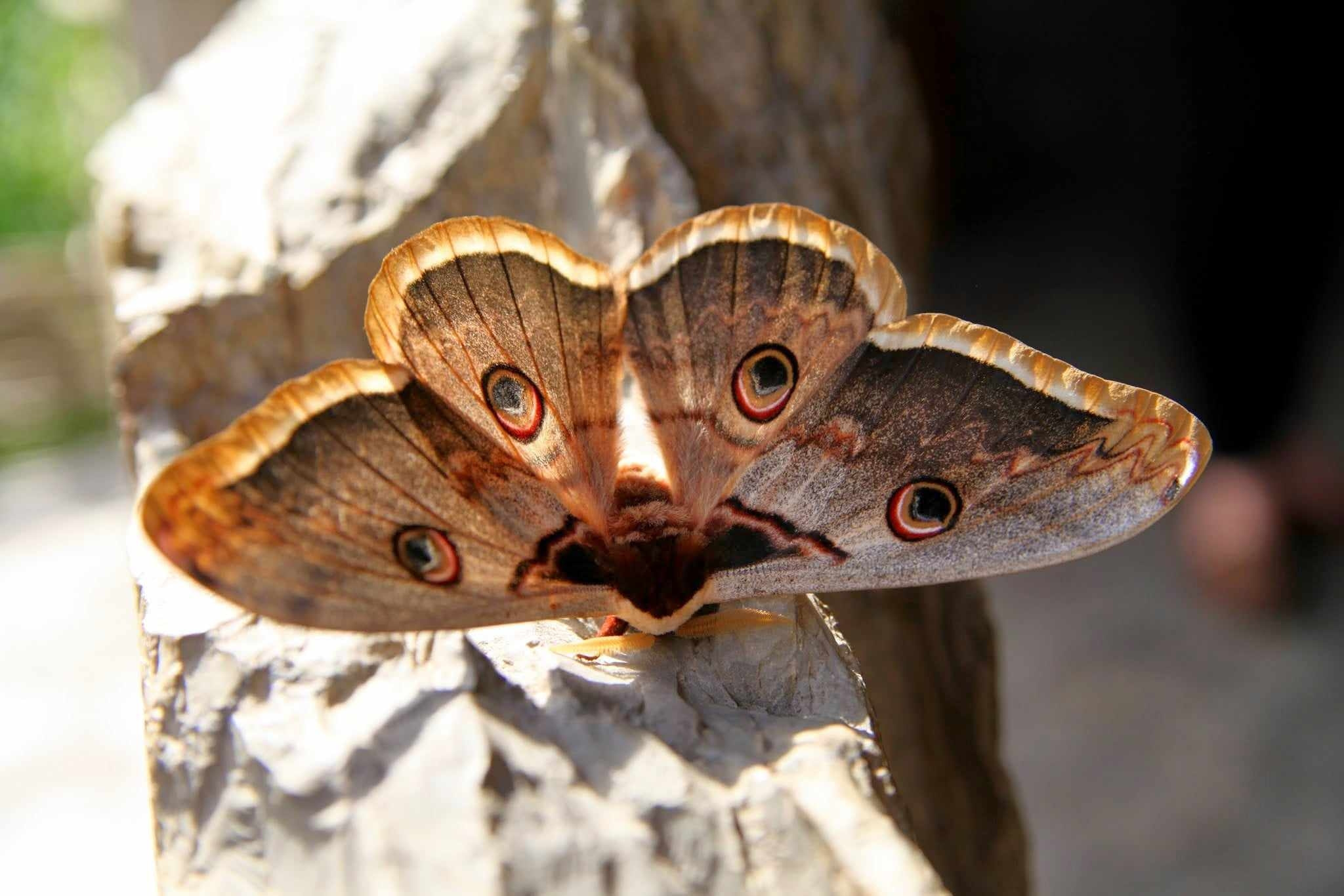
The eyespot is large and black, with blue scales inside. It is surrounded by a white and bluish border and by reddish-yellow and black rings. There is one on each of the four wings, so it shows well on a moth with spread wings.
The male has long, feathery antennae, the female comb-like ones. The female is noticeably larger than the male. With these features you can tell the sexes apart even in a photo.
The caterpillar is bright green, up to 110 mm long and 15 mm thick. It has long, club-tipped hairs on blue, sometimes pink warts, and red spiracles. Before pupating it turns brown.
Colour
The upperside is dark brown, the front edge of the forewing lighter and greyish, and the forewings are dusted with grey. The wings have two bands: a straight, dark inner one and a lighter, irregularly toothed outer one. A pale stripe runs along the wing edge, followed by a black band broken only at the forewing tip. The body is massive and densely hairy.
Swatches are illustrative. Do not identify a species by colour alone.
The giant peacock moth is a moth of broadleaf woodland, above all valley and floodplain forests, where wild fruit trees often grow: apricot, cherry, sweet cherry, pear and walnut. It also lives in open woodland, scrubby wasteland, at forest edges, in parks, gardens and orchards. It prefers warm slopes with open scrub. It is native to Georgia.
The giant peacock moth is native to Georgia and has been known from the country since 1885. Most records come from Kakheti, around Lagodekhi, Sagarejo and Dedoplistskaro, from Adjara, around Batumi and Kobuleti, from Samtskhe-Javakheti, around Aspindza, Akhaltsikhe and Borjomi, and from Abkhazia: Gagra, Gudauta and Sokhumi. It has also been found in Imereti, Mtskheta-Mtianeti, Shida Kartli, Kvemo Kartli, Racha-Lechkhumi and Kvemo Svaneti, Tbilisi and Samegrelo-Zemo Svaneti. Records span April to September, most of them in May and June. Some of those from July to September are caterpillars.
Data: Reptiles.ge + iNaturalist · Methodology
- Field observation
- Several records in one spot
- Photo record
- Region with records
The caterpillar feeds mainly on fruit trees of the rose family: apple, pear, cherry, plum and blackthorn. Less often it develops on walnut, elm and ash. In many places wild pear (Pyrus) is its most important food.
The adults are active in the evening and at night, and males sometimes fly by day. The flight season is May–June. The female stays in one place and waits for a male, and males find her by her sex pheromone. In one observation, males even found a female 10–11 km away. After mating the female lays several hundred eggs. The caterpillars develop from June to August and pupate in late August–September. The dense, egg-shaped brown cocoon is often spun on the lower part of a tree trunk. It spends the winter as a pupa, sometimes two winters.
It has not been assessed on the global IUCN Red List (NE). It is not on Georgia's Red List. In the northern part of its European range it is threatened by scrub clearance and intensive orchard management, including insecticides. In the south, for example in Greece, it is still quite common. It is listed as a rare species in the Red Data Book of Ukraine.
nalya · koozmin · Nikita Tiunov · Vadim Nikurashvili · Tom Kirschey · Arvidas Merkelis · Gocha Nemsadze
Related guides
Continue with related pages
Yes. It is native to Georgia and has been known from the country since 1885. It chooses broadleaf woodland, forest edges, gardens and orchards, where its caterpillar's food trees grow. Look for the adult moth at night in May and June.
Yes, by wingspan it is Europe's largest moth. The female's wingspan reaches 150–155 mm, the male's up to 120 mm. The caterpillar is large too: up to 110 mm long and 15 mm thick. When it flies around a light, the moth is the size of a bat.
No, it is harmless to people. The adult moth comes to lights at night and sometimes turns up by houses. The caterpillar has long, club-tipped hairs on bluish warts. Still, do not catch it: a photo is enough.
Mainly fruit trees of the rose family: apple, pear, cherry, plum and blackthorn. Less often walnut, elm and ash. In orchards insecticides kill it, so wild pear and scrub matter to it.
References
What this profile is based on
Species profiles are compiled from peer-reviewed literature and established biodiversity databases, and are reviewed as new taxonomic and conservation data become available.
Prepared by the Reptiles.ge editorial team from the sources listed here.


